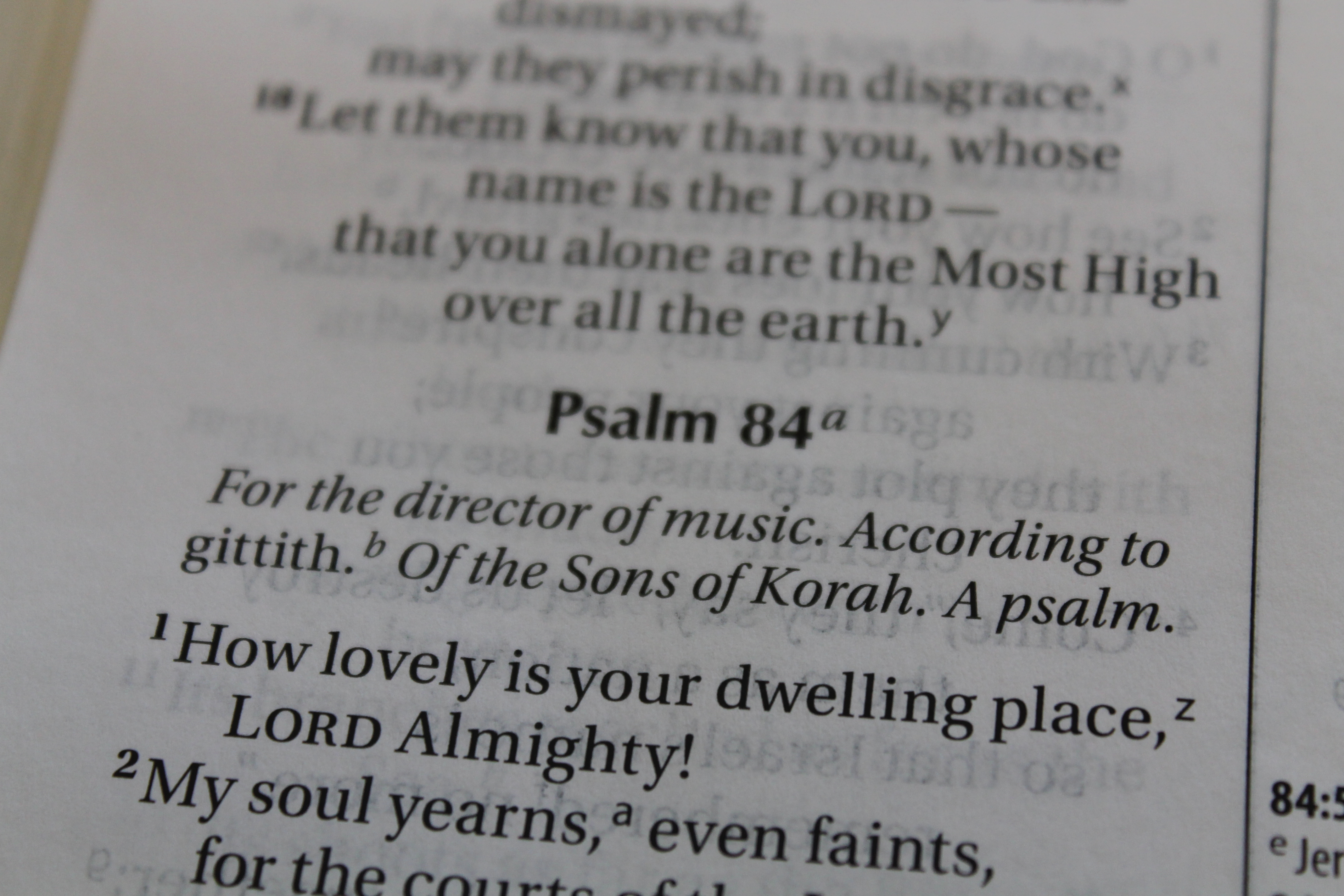
The most literal reading of the Bible is to understand the Bible in its original context: historical context, geographical context, cultural context and literary context.
I have an atypical daughter. Despite all the baby books stating that infants sleep 10-12 hours during the night, along with 2 hour-long naps during the day, for a total of 12-14 hours of sleep, my daughter has proved the exception. On good nights, she only wakes up once in the middle of the night, and on bad nights, she wakes up every hour. As for her daytime naps, she prefers to nap only half hour instead of an hour. Whether daytime naps or nighttime bedtime, it takes a while to get her sleeping. At the advice of many baby books and baby website, I find the most effective way to get her to fall asleep is by singing. Naturally, I turn to the songs I learned in church as a child. Upon singing these children's church songs now as a grown adult with a bachelors in Bible Education, a Masters in Divinity and as a Ph.D. candidate in Biblical Studies, however, some of these songs I find peculiar, while other songs rub me the wrong way. In the past, I have been particularly hard on contemporary praise & worship songs. It only seems fair to be equally hard on children's church music. Below I have picked out the children's church songs I sing to my daughter on a regular basis, all of which I learned as a child myself. I will grade each song with a pass/fail grade, and then I will give my reasoning why.
JESUS LOVES ME: This song is probably the most famous of the bunch, and it deserves it. It teaches children 1) Jesus loves them, 2) the Bible teaches them about Jesus's love, 3) that all children belong to Jesus, and 4) they can always find their power and strength in Jesus, even when they are weak and have no agency of their own. Jesus Loves Me clearly gets a PASS.
JESUS LOVES THE LITTLE CHILDREN: This song is probably the second most famous song of the group, and it deserves it. Not only does the song hammer down on the doctrine that Jesus loves the little children (see Matthew 19:13-15/Mark 10:13-16/Luke 18:15-17), it also hammers down on the fact that Jesus loves the children of all races (see Revelation 7:9), which should hopefully take the right steps on fighting the sin of racism that could develop within a child. Jesus Love the Little Children obviously gets a PASS.
THE B-I-B-L-E: This song does an important job of teaching children that the Bible is the Word of God, and that the Bible is the strong foundation on which the Christian's beliefs stand. My only hesitancy is the spelling part, for children unable to spell, or even read for that matter, may not know what they are spelling, and instead think they are just naming random letters. Some iterations of the song end by having the child yell, "BIBLE!" which would mitigate my hesitation. Still, I give the B-I-B-L-E song a PASS.
I AM A C: If the spelling part of the B-I-B-L-E song gave me a slight hesitancy, then I Am A C gives me a strong hesitancy. There is way too much spelling in this song. Don't get me wrong, the doctrine is good. It teaches that every Christian has Christ in their heart, and that a bonus of Christ in your heart means you get to live eternally, as stated in John 3:16. It's just that there's too much spelling. As stated above, for the children unable to spell, or read for that matter, in their minds, they are just spouting random letters. Even for the kid with a basic understanding of reading and spelling, throwing a lot of spelling at the kid, and on top of that a song with a fast tempo, it's easy for the kid to lose track of what he or she is spelling. Even as a grown adult, I have to slow down and make sure I spell everything correctly, especially "live eternally," which is spelled all as one. I have to give I Am A C a FAIL.
DEEP AND WIDE: I actually had to do research on this song. Apparently, the idea behind this song comes from Ezekiel 47, in which Ezekiel has a vision of a river flowing from the temple in Jerusalem, which gets deeper and wider. Without this context, though, there is nothing fruitful about knowing a deep and wide fountain exists. I have to give Deep and Wide a FAIL.
I'VE GOT PEACE LIKE A RIVER: Using water metaphors before Hillsong made it cool! Just like the previous mentioned song, while I'm glad the singer has peace like a river, joy like a fountain, and love like an ocean, without greater context, this really doesn't qualify as a Christian song. There is no hint in the song that the peace like a river, joy like a fountain or love like an ocean came from Yahweh, Jesus, the Holy Spirit, the Word, salvation, church, or anything like that. For all the singer knows, the peace like a river, joy like a fountain or love like an ocean came from another religion, or not even a religion at all. Anyone worshiping any god of any religion could see this song truly, and even the atheist could sing this song in truth. Some have attempted to connect this song to Isaiah 48:18, but most of my sources concluded that the song's origin is unknown, outside the fact it's an African-American spiritual song. Even if did it come from Isaiah 48:18, it would be an odd choice. The line in Isaiah 48:18 says, "If only you would have paid attention to my commands, your peace would have been like a river, your righteousness like the waves of a sea" (NIV 1984 ed.). The "if" clause implies that Israel has not paid attention to the Lord God's commands, so they never go tot experience the peace like a river. Therefore, by singing "I've got peace like a river" in the context of Isaiah 48:18, the singer is pretty much singing "I got to experience what Israel did not because I'm doing better off than Israel!" Pretty bold words. Besides, if the phrase "peace like a river" did come from Isaiah 48:18, it only explains the first verse, and it does not explain the origin of the second or third verse. If the first verse did come from Isaiah 48:18, then the third verse should say "I've got righteousness like the ocean," not love, or at least have a fourth verse that says, "I've got righteousness like sea," although I'm not sure such lyrics would align with the music. All in all, that's a lot to say I've Got Peace Like a River gets a FAIL.
I'VE GOT THE JOY JOY JOY JOY: No, just no. It promotes a Christian version of hedonism too much. It doesn't allow a church-going Christian, who has gone or is currently going through a time of trials and pains, to rest in the comfort that the Sovereign Lord remains in control, but rather, it forces that Christian to feel emotions that he or she cannot feel or doesn't want to feel. Yes, the second verse speaks on "the peace that passes all understanding," and the third verse talks about, "the wonderful love of our blessed Redeemer," but most of the time, when I hear this song, it never goes beyond the first verse. Even if/when it doesn't chorus repeats the idea of happiness in the words, "And I'm so happy, so very happy..." Again, too many of my Christian millennial peers already grade Christianity based off how happy it makes them, and I can't help but wonder that some of that thinking might find its roots in the song. Yes, I know the Bible talks about the joy of the Lord, but maybe we should hold that theology off until they are grown adults, who can weigh out the joy of the Lord with the cost of discipleship. In conclusion, I've Got the Joy Joy Joy Joy gets a FAIL.
THIS LITTLE LIGHT OF MINE: To me, this song is reminiscent of Matthew 5:14&15/Mark 4:21/Luke 8:16, in the sense that these verses talk about not hiding a lamp light, and the second verse of the song says, "Hide it under a bushel? No! I'm going to let it shine." From that, it's easy to extend the light shining to not letting Satan blow it out to shining it over until Jesus comes. This song gets a PASS.
MY GOD IS SO BIG: Again, this song is so simple, yet it works. It establishes doctrine, like 1) God is omnipotent (all-powerful), 2) God created the whole world, and 3) God is in control of the world. My God is So Big gets a PASS.
FATHER ABRAHAM: Technically, Abraham only fathered 8 children, and only 1 of those were the son of the promise, whom Sarah bore. Yes, Paul does teach twice in Galatians 3 that those in the faith are sons of Abraham (3:7) and those in Christ are Abraham's offspring (3:29), but this teaching needs careful interpretation. Paul says these things to compare the Christian faith to the faith of Abraham. Just as Abraham believed and it was credited to him as righteousness (Genesis 15:6) apart from having the Law, so the Christian comes to faith in Jesus Christ, not the Law. Such a concept might be too grand for a child to grasp it, and even if the child can understand it, this song does not do a good job of explaining it. Besides, children think more literally than figuratively, so they will think this song teaches that they are related to Abraham of the Bible like they are related to grandparents. Father Abraham gets a FAIL.
12 MEN WENT TO SPY ON CANAAN: Of all the Bible stories to teach children in song, it seems weird to pull out a random story in Numbers (a book that most Christians don't visit regularly anyways), in which Moses chooses 12 men, 1 from each tribe, to spy out the Promise Land, of which 10 come back with a bad report and 2 come back with a good report. Thankfully, the song skips over the part when the 10 bad spies die of plague and the rest of Israel doesn't get to enter the Promise Land. Despite the random choice of Bible stories, the song still ends on the strong note that some spies "saw that God was in it all," which in turn teaches the children see God in all their lives, whether going through the good parts or the bad parts of life. Therefore, 12 Men Went to Spy on Canaan gets a PASS.
HALLELUJAH/PRAISE YE THE LORD: Pretty cool that this song actually teaches children Hebrew. Indeed, the Hebrew word הַלְלוְּיהּ (hallelujah) is a compound word that literally translates into "Praise Yahweh" or "Praise (Ye) the Lord." Furthermore, the Hebrew word appears 46 times in 23 verses of the Psalms, making it very Biblical. Hallelujah/Praise Ye The Lord definitely gets a PASS.
THIS IS THE DAY: This song is literally Psalm 118:24 put to music. Can't criticize a song that literally uses Scripture without criticizing the Scripture itself. If one would grasp at straws to complain, the complaint would be along the lines that we don't if this musical piece is how the original Psalm was sung, but that's really grasping at straws. This is the Day definitely gets a PASS.
FISHERS OF MEN: This song is pretty much Matthew 4:19/Mark 1:17 put to music, except that the song takes the phrase "Follow me" and puts it at the end of the verse, adding the word "if" to make it conditional clause. The changes the song makes really don't change the meaning of the verse. Even adding the word "if" to the phrase "follow me" to turn the clause conditional does really affect anything. Clearly, Simon and Andrew had follow Jesus to become fishers of men. Simon and Andrew couldn't follow Jesus without becoming fishers of men, and Simon and Andrew couldn't become fishers of me without following Jesus. And thank goodness that the music does not allow anybody to change "fishers of men" to "fishers of people" like the NIV 2011 edition did! Fishers of Men gets a PASS.
THE WISE MAN BUILT HIS HOUSE UPON THE ROCK: This song pretty much paraphrases Matthew 7:24-27/Luke 6:47-49, and it pretty much does so faithfully. The first verse speaks of the wise man building his rock upon the rock, and the house stands firm. The second verse talks about a foolish man building his house upon the sand, and the house collapses. Together, these 2 verses accurately retell the parable of Jesus. Recently, however, it has come to my attention that this song has a third verse. The first half of the third verse say, "So build your house on the Lord Jesus Christ." I didn't think the song needed to explicitly declare the meaning of the parable (even so, Jesus teaches the meaning of the parable is to reflect the difference between those who put Jesus's words into practice and those who do not, not that Jesus is the firm foundation), yet here in the third verse the song does so. The second half of the song states, "The blessings go down as the prayers go up." At best, this is a misunderstanding of the parable. The blessings come as a result of obeying the instruction of Jesus, not by (merely) praying. At worst, this is the prosperity gospel, for it communicates to the children that they will receive blessing as long as they ask for it in prayer. Based on Bible Quizzing's two-thirds rule, The Wise Man Built His House Upon the Rock get a PASS, on the condition that nobody sings the third verse.
ZACCHAEUS WAS A WEE LITTLE MAN: The story of Zacchaeus takes up the first 10 verses of Luke 19. The song, however, stops short after the first 5 verses of Luke 19. The song seems fixated on his small height. Even the fact that Zacchaeus climbs the sycamore tree is to get up high to see Jesus, once again due to his short height. According to the song, the climax is that Jesus went to Zacchaeus's house. I would disagree, however, arguing that the climax is that Zacchaeus receives salvation, evident by his willingness to donate half his wealth to the poor and repay anyone he has wronged fourfold. Zacchaeus was a Wee Little Man only covers half the pericope, and half falls short of Bible Quizzing's two-thirds rule, so I have to give Zacchaeus was a Wee Little Man a FAIL.
REJOICE IN THE LORD ALWAYS: Again, this song is literally Philippians 4:4 put to music. To argue with this song is to argue with the Bible. Rejoice in the Lord Always gets a PASS.
BELOVED, LET US LOVE ONE ANOTHER: Once again, this song is literally 1 John 4:7&8 to music. To criticize this song is to criticize the Bible. Beloved, Let Us Love One Another gets a PASS. (For this song, the last song, and This is the Day, they should all be glad that I am grading them on theological accuracy, not creativity.)
HE'S GOT THE WHOLE WORLD IN HIS HANDS: I've heard many iterations of this song, and all iterations come back to the fact that God has the whole world, from the weather to the people, in his hands, i.e. in his control. He's Got the Whole World in his Hands gets a PASS.
I'M IN THE LORD'S ARMY: Ironically, I first learned this song in the Mennonite Church! The music leader, however, was very careful to stress that being a part of the Lord's army means that we will never march in an infantry, ride the cavalry, shoot the artillery or fly over the enemy, as the song's lyrics say (i.e. joining the country's military is a sin). Even more ironically, when this music leader taught us pupils motions to the song, the line "shoot the artillery" had the motions of pretending to shoot guns! To continue to add to the irony, I find it funny that Christians from church of other denominations will teach their children this song, yet still have a very pro-military stance, especially viewing those young men and women in their congregation who do join the military. The Mennonite in me wants the word "may" in the phrase "I may never..." to the word "will" to make the phrase "I will never..." Even pushing my Mennonite bias aside, this song teaches what the Lord's army isn't, but it does not teach what the Lord's army is. Thus, I'm in the Lord's Army gets a FAIL.
I AM THE CHURCH: If any song on this list deserves a "very pass," it would be this song. This song attempts to rectify mistaking the church as a building, especially one with a steeple, when in reality, the church is the people gathering together to worship Jesus. I haven't heard this song recently, and perhaps this song needs more air time, especially considering how many of these megachurches continue to add comforting amenities to their building. I am the Church gets a PASS.
Final Score: PASS - 14, FAIL - 7
In all honesty, even the songs that failed I will probably still sing to my daughter.
I wanted to start out with a visual, but I quickly realized
that I, in my limited artistic ability, could not create such a visual. So I
need you to create your own visual using your imagination. Close your eyes. I
want you to go to your happy place. Have you ever been told to go to your happy
place? It’s some kind stress reliever to help with anxiety, depression or other
kinds of stress. Now that you’re in your happy place, where are you? For some
of you, I imagine that you’re in a log cabin, or a ski lodge that looks like a log
cabin. You look at window and see the glistening snow softly drop on the
snow-capped mountains and hills. You can’t feel the cold, though, because
you’re sitting in front of the fireplace, wearing your favorite sweatshirt,
wrapped in your favorite blanket, drink coffee, tea, hot cocoa, or whatever
your choice hot beverage is. For others, it’s the complete opposite. You’re
sitting on the beach of a Caribbean island. You’re reclining in a beach chair,
toes buried in the sand. You’re overlooking the sea, so blue that you swear God
created with 3,000 Flushes. The warm sun beats down on you, but’s it’s not too
hot or too humid. Your beach umbrella gives you shade. A soft, gentle breeze
provides cool relief every now and then. And you’re sipping on your cold beverage
of choice, and that might just be an iced coffee or iced tea. Perhaps for some
of you, your happy place is in the middle of the forest. The only man-made
structure you see is the tent you just pitched. You’re sitting on a log,
roasting a hot dog or marshmallow over the campfire. Besides the crackling of
the campfire, the only sounds you can here are from nature. You look up at the
night time sky, and the stars are the brightest you’ve ever seen them. For
others, maybe your happy place is quite the opposite. You’re sitting on a park
bench in the middle of the city park. You watch the elderly feed the birds and
squirrels, you watch the children play on the playground, and you watch the
cars just drive on by. On a similar note, when I told you to go to your happy
place, you might have found yourself in the food plaza of the mall. You are
people watching. Not the judgmental kind, but you’re awestruck and amazed at
all the kinds of people God made. They come in all shapes, sizes, colors,
characteristics, personalities and traits. And still yet for others, you might
be on a boat out in the middle of one of Great Lakes. You recline in your boat,
waiting for a fish to tug at your reel.
But let’s get honest and be sincere. When I told you to go
your happy place, who find themselves in their church on Sunday morning,
worshipping the Lord God? I don’t mean to guilt you, and yet I do. If I would
have asked the poet who penned Psalm 84 to go to his happy place, that’s
exactly where he would go in his mind. He would be in his place of worship,
worshipping.
Explaining Psalm 84
84:0. Most Bibles
will some kind of heading before diving into the poetic words. It would seem
that the heading provided more information for the original audience, more
specifically for the choirmaster or director, but for the modern-day audience
it feels like it provides less information and more confusion. The heading
says, “According to the gitteth.” The scholar’s best bet is that the gitteth is
some kind of tune or instrument, but that’s all we know. Some commentators have
suggested the word come from root meaning “winepress,” hinting that the tune
might be one familiar around the fall harvest, but that’s more of a guess and
less of a hypothesis. The heading also states that this psalm is “of the sons
of Korah.” The “of” here more likely means “belonging to” or “performed by,”
and less likely means “wrote by.” Even if it did mean that, no one could
pinpoint a certain Korahite that wrote. Therefore, the author is unknown, and
this commentary will refer to the author as “the psalmist.” On a similar note,
no one knows the date the psalm was written. As you imagine, this heavily
affects the interpretation. If you believe this psalm was written in the time
of David or earlier, the dwelling place refers to the tabernacle. If you
believe this psalm was written in the time of Solomon or after, the dwelling
place is the temple. Each side has its own reasons, but we really can’t be
sure. Both the tabernacle and temple had courtyards. Yes, Psalm 84 does later
on use the word Zion, but we have to remember we are dealing with a psalm,
which loves using figures of speech. “Zion” could simply be a figure of speech
for meeting God. After all, Abraham met with God on Zion. In this commentary, I
will simply refer to it as “the dwelling place.”
84:1. In the
opening verse of Psalm 84, the psalmist blurts out how he admires the beauty of
Yahweh’s dwelling place. This will be the theme for the first stanza of Psalm
84. In the opening, the psalmist literally calls Yahweh “the Yahweh of hosts,”
as most literal English translations follow. The title for Yahweh hints at this
idea that Yahweh has invited the worshipper and is hosting the worshipper.
84:2. Awestruck
by the beauty of Yahweh’s dwelling place, the psalmist expresses that his whole
self, both the material and immaterial, desires to dwell with Yahweh in his
dwelling place. Both the verbs “long” and “faints” demonstrate an intense
desire, even to the point the soul exhausts itself to fainting. The phrase
“cries out” (one word in Hebrew) better translates into “sing for joy,” as most
literal translations do translate it. When coupled with the word “faint,”
however, the phrase adds a layer of sorrow. Together, they paint a picture of a
worshipper, so overjoyed about dwelling in the presence of the Lord, and when
the worshipper does not stand in the Lord’s presence, he or she suffers in
pain. Rob Lacey depicts in perfectly in his paraphrased version of the Bible, The Word on the Street, where he writes,
“Your place is best, God; I’m gasping for it, almost collapsing for it, God; My
skin, my soul, the whole of me screams for more of you, vibrant one.” The
synonymous parallelism in verse 2 demonstrates that at the heart of the
psalmist longing for the Lord’s dwelling space is the longing for the Lord
Himself. Whereas most Psalms, like Psalm 138, focus on the building itself,
Psalm 84 focuses on the worshipper meeting God in that place. What the psalmist
finds most amazing, awesome and beautiful about God’s dwelling place is that
God dwells in it.
84:3. The
psalmist then appeals to nature, in the form of a synonymous parallelism, as
proof to justify his feelings. Both the sparrow and swallows are birds found
aplenty in Israel. Here, “altar” is a metonym for Yahweh’s dwelling place. I
can imagine that, as the psalmist wrote Psalm 84, he noticed a bird, like a
sparrow or swallow make its nest nearby (or even on!) the temple. He must have
thought to himself, “Hmm, even that bird knows how important it is to be close
to the Lord. Should I not be the same way?” For whatever reason that bird put
its nest there, the human can learn a lot from it. Perhaps the bird built its
home because it felt safe there. If so, the human can learn he or she lives
safely in the presence of the Lord. Maybe the bird nested there because the
bird knew all it needed was nearby. In the same way, the human can learn that
he or she will have all that he or she needs in the presence of the Lord. The
author of Psalm 84 closes out verse 3 by calling Yahweh his king and his God.
The audience should not take this as a redundancy. By calling Yahweh King, the
author submits to Yahweh’s reign. By calling Yahweh God, the author
acknowledges only Yahweh is worthy of worship.
84:4. The
psalmist closes out his first stanza with a synthetic parallelism. He concludes
that those who stand in the dwelling place of God receive a special blessing by
just being there just because God is there. The psalmist goes on to explain
that that the natural reaction of such emotions would cause the person standing
in the presence of God to praise and worship him. The worshipper praises the
Lord because he or she realizes how much privilege he or she has for standing
in the presence of the Lord. The people the psalmist refers to in Psalm 84:4
most likely refer specifically to the priests and Levites, but it in general
encourages the reader to seek to live in the presence of God just as much as
the priests and Levites.
84:5. Now the
psalmist has expressed his love for Yahweh’s dwelling place, the psalmist moves
to describe a pilgrim’s journey getting there. In the second stanza, the
psalmist wants to make it clear to his audience that blessing does not solely
come from dwelling with Yahweh, but blessing can also come from the journey to
Yahweh’s dwelling. Therefore, in the second stanza of Psalm 84, the psalmist
describes a pilgrim on a pilgrimage to dwell in Yahweh’s dwelling place. The
psalmist opens the stanza with a synthetic parallelism, granting pilgrims a
blessing of strength. That blessing of strength cannot come from anyone or
anywhere buy the Lord. Only those who had their hearts set on worshipping the
Lord in his dwelling place would solely rely and trust on the Lord’s strength
and power to get them there.
84:6. The Valley
of Baka may have been a place all pilgrims would have taken to the tabernacle
or temple. The context clues in verse 6 alone already hint that the Valley of
Baca is a dry and arid desert. In Psalm 84:6, the psalmist paints a picture
that as the pilgrim marches through the Valley of Baca, springs of water come
forth, as well as pools, as a result of early rains, which, in the Hebrew
seasons, is early autumn. The psalmist depicts a place going from a dry and
arid desert to an oasis full of vegetation. Once again, the psalmist
illustrates to the readers that the pilgrim receives such blessings because the
Lord is with the pilgrim. Once again, the psalmist makes it abundantly clear
that the Lord and his blessings do not have to stay confined to his dwelling
place. God can dwell with his people anywhere and bless them, even in places
where it may seem blessing cannot happen.
84:7. The first
cola of Psalm 84:7 has caused some confusion, as the phrase “go from strength
to strength” only appears here in the entire Old Testament. Some commentators
have proposed it means they get stronger as time goes by, while other scholars
suggest it means they travel from refuge to refuge. The latter seems to make
more sense in context, especially in light of Psalm 84:6. Psalm 84:7 explicitly
explains what the psalmist is trying to illustrate in Psalm 84:6. The pilgrim
relies on bits and pieces of Yahweh’s strength from place to place, until the
pilgrim reaches his final destination. Not a single worshipper will fall out of
God’s sight or man. The Lord will make sure each and every worshipper appears
before God in Zion.
84:8. The
psalmist closes out his second stanza, using a synonymous parallelism. The
psalmist petitions Yahweh that what he described in Psalm 84:5-8 may be so,
that the pilgrim will be rewarded with blessings of provision and safety as he
makes his way to Yahweh’ dwelling. The psalmist may also feel led to pray that,
now that he or she has made such a journey to worship, God will indeed receive
the worship as an acceptable offering.
84:9. The closing
stanza wraps up Psalm 84. First, in verse 9, the psalmist reminds Yahweh of his
relationship with His people. That’s why the psalmist can use with confidence
the plural possessive pronoun. Yahweh’s shield is our shield because Yahweh and
his people are now in covenant.
84:10. Second, in
verse 10, the psalmist re-iterates his love for the Lord’s dwelling. The
psalmist states that a day in the courts of Yahweh is better than a thousand
elsewhere. Interesting enough, the Hebrew text does not have the word
“elsewhere.” Honestly, most English translations add the word “elsewhere,” with
the exception of the King James Version, which leaves it out. Most scholars
deem the addition necessary, for without the addition, it would sound like the
psalmist says that one day in the Lord’s courts is better than one thousand
days in God’s house. Some commentators, however, have suggested the psalmist
might have attempted to convey another truth. If given the choice of a one-day
life in the Lord’s courts or a thousand-day life outside God’s house, the
psalmist would choose the one-day life, knowing he spent it in the presence of
Yahweh. Either way, the second bicolon in verse 10 reaffirm the psalmist’s love
for the Lord’s dwelling. If given the choice, the worshipper would rather sit
at the threshold, or door, at Yahweh’s house than dwell among the tents of the
wicked. Being close to the presence of God is better than no presence at all.
Being the most humbled at the house of God is better than being the exalted
among the wicked. While the wicked may have possessions, God is the source of
all those possessions, as so much more. The singers, the Korahites, would have
understood this metaphor the best. Their ancestor, Korah dwelled in the house
of wicked men, as seen in Numbers 16:26. The Lord truly redeemed them. He
pulled them out of that situation and gave them the role of serving as the
doorkeeper to the temple (see 1 Chron. 9:19; 26:12–19)
84:11,12. Third,
the psalmist assures himself that God has heard and answered his prayer, that God
will bless those who make a pilgrimage to God’s dwelling place. The psalmist
remembers that the Lord, in his very nature, wants to protect and provide.
Therefore, the psalmist calls the Lord both a sun and a shield, adding to the
title given in verse 9. In fact, this is the only time in the Bible the Lord is
directly called a sun. Then the psalmist reminds himself that God delights in
giving good things to those who done good things. If in the goodness of a
person’s heart that person desires to worship God in his dwelling place, then
God will bless that person with what the person needs to get there.
Illustrating Psalm 84
After reading Psalm
84, only 1 question, consisting of 2 simple words, comes to mind: "What
happened?" How did we go from Psalm 84, about a person who loves the
dwelling place of God so much that when he is away from it, his body and soul
are hurting, to today? If you were to ask a lot of pastors today what the
biggest sign is that society is becoming more secular and less friendly to Christians
is, it's not something that's happening in the government, it's not something
that's happening in politics, it would be that more and more children sports
games are happening on Sunday mornings. And the worst part is that it's
sneaking into the church. Parents will take their children to their sports
games, not even blinking an eye, not even pausing to think if skipping church
for the sports game is wrong or what the right decision is. It's so bad that
pastors can't even feel like they can bring this concern up to their
congregation. They're afraid they'll be tagged as judgmental or selfishly
greedy about the tithe money or their popularity if they try to convict their
congregation that is wrong to skip church for sports games. How did we get to this
point?
I've studied church history and I've studied ecclesiology
(that is, theology of the church) and through the study of both, I've noticed
there's a lot of what I like to call "pendulum swings" in church
history and church movements. The importance and significance of church is one
of them. Earlier in modern church history, believe it or not, we did believe
that going to church was necessary for salvation. Our thinking went somewhere
along the lines of this: Real, true, good Christians go to church every Sunday.
Therefore, if you do not go to church every Sunday, you're not a real
Christian, you're not a true Christian, you're not a good Christian. One of the
strengths of this view is that, by golly, it got people to show up for church.
Your life depended on it. As you can imagine, though, it also quickly led to
some very negative drawbacks. People literally thought that because they were
sitting in the church pew for an hour a week, they were born again Christians,
saved from hell, on the road to heaven. Heck, you even had non-Christians
showing up once a week for an hour of church, just so they could tell their
Christian parents that they were going to church, and their Christian parents
could believe that they were good, real, true Christians, just because they
were attending church. Made it a little less tense at the next family get
together. Even if some people did not literally think in their minds that going
to church saved you, some people would still subconsciously act like it did. In
the season finale of season 3 of the hit sitcom Big Bang Theory, Sheldon Cooper meets his girlfriend Amy Farrah
Fowler for the first time. Their first conversation consists of this bit of
dialogue-
Amy Farrah Fowler: In any case, I'm here because my mother
and I have agreed that I will date at least once a year.
Sheldon Cooper: Interesting. My mother and I have the same
agreement about church.
Amy Farrah Fowler: I don't object to the concept of a deity,
but I'm baffled by the notion of one that takes attendance.
Sheldon Cooper: Well then, you might want to avoid East
Texas.
Well, Amy Farrah Fowler, I, too, am baffled by the notion of
a God that takes attendance. But when you believe that going to church is a
part of your salvation, you also believe God takes attendance. Then, you start
acting like it, some more literally than others. When I was studying my
undergrad at Lancaster Bible College, I was required to attend chapel three
times a week. To prove that I was actually there in chapel, I had to scan my school
ID badge before entering. I had another friend who went to a different Bible
college. They too had mandatory chapel three days a week, but unlike Lancaster
Bible College, they didn't have the technology to scan in, so they literally
had to sign in for chapel. Yeah, obviously church is not like this. I don't
have to scan in or sign into church, yet we still sometimes act like it. It's
like we expect one day for Jesus to return in bodily form at our church, and
the first thing he's going to do is start taking roll call. It's like we expect
that when we appear before God, whether that be before the great white throne
or the bema seat, we expect God to bring up our church attendance. We fear he
may say something along the lines of, "You only came to church about 67%
of the time? Geez, you know that 67% is a failing grade in some places. This is
really going to hurt your participation points." Once again, this is all a
side effect of believing that your salvation is affected by your attendance at
church. And it wouldn't surprise me if some Christians today still think or act
this way.
So a lot of pastors got the message out that going to church
did not make you a born-again Christian, and it did not save you from the fires
of hell. They emphasize that each and every person must make a personal
committed relationship with Jesus Christ. That's what saved you from your sin,
death and hell, and that's what put you on the path to heaven. After salvation,
they emphasized a personal devotion time with God, consisting of private Bible
reading and private prayer, to live out salvation. This all cause the church
pendulum to swing in the opposite direction. The evangelical church has a
theological term for this: reductionism. What is reductionism? If you haven't
caught on yet, you'll notice what I just described emphasizes individualism:
individual salvation, individual relationship with God, individual Bible
reading and individual prayer. Reductionism is when the Christian faith is
reduced down to these three concepts: individualize salvation through an
individual relationship with Jesus, individualized Bible reading and
individualized prayer.
Now, believe it or
not, reductionism does have its strengths. As crazy as this sounds, earlier in
church history, you would've been told that you cannot have a meaningful
spiritual experience with God outside of church. Reductionism reminded us that
you can indeed have a meaningful spiritual experience with God, even if you are
alone, even if you're by yourself, even if you're out in the middle of nowhere.
We go doubt that Moses had meaningful spiritual experiences with God on Mount
Sinai (or Elijah for that matter in 1 Kings 19), nor do we doubt Jesus had
meaningful spiritual experiences with God when he went alone to pray to his Father.
But as you can imagine, this has some negative drawbacks as well. Think about
it. If you individualize everything about the faith, good luck convincing
anyone to do anything corporate. Therefore, the evangelical church is having
the hardest time convincing people to come to church. If everything about the
faith of individualized, and salvation is not dependent on church, then why
bother to go? The best thing the evangelical church can do to get people into
church is to convince them that the church is a service, not for God, but for
you. The church is there to make sure you are spiritually healthy and
spiritually fit. Just like you go to the doctor when you're sick, or you go to
the mechanic to get your car fixed, the church is there to serve you, so when
you get spiritually unhealthy, the church can make you spiritually healthy again,
and when you're spiritually broken, the church can spiritually fix you. This
view can only do so much. Let's stick with our metaphor of the doctor and the
auto mechanic. You've probably been in this position before. You went to your
doctor to get in your annual physical. The doctor does some tests. At the end,
the doctor says, "Yeah, you're healthy. That'll be $25” (and that's
assuming you have good health insurance). Similarly, you didn't do your auto
mechanic to get the car inspected. Your mechanic runs a few tests. At the end,
the car mechanic reports to you, "Your car is running just fine. That will
be $88." In both instances, you're thinking to yourself, "Gee, I
could have told them that for cheaper than what they are charging!" Well,
that's how a lot of people feel about the church. If they feel like they're
spiritually healthy, they see no need to go to a place that will either verify
that they are spiritually healthy or disagree with them, telling them their
spiritually unhealthy, and all at a price of a 10% tithe!
To sum up reductionism, I would like to quote D.G. Hart, a
leader in the evangelical church, who is struggling alongside the evangelical
church to decide the importance and significance of the church. D.G. Hart is
quoting saying, "If, as the evangelicals believe, the most important
aspect of Christianity is a personal friendship with God through private Bible
reading and prayer, then who needs the ministry of the church?" And that's
exactly what reductionism has done to the church. It’s left everyone
questioning, “Why do I need the church?” and it has no answers.
Applying Psalm 84
At this point, I imagine you too have some questions you
want answered. You might be wondering, “How can we avoid this pendulum swing?
How can we get the pendulum to stop right in the middle, a balance between public,
corporate church and private, individualized church, a balance between needing
church for salvation and church being an optional, only desired when wanting a
spiritual tune-up? What can we do?” Would I sound blasphemous or heretical if I
suggested that there is nothing that we can do?
I italicized do
because I want to do draw emphasis to that word. When we say we want to do something, we mean we want to act,
but I think acting and doing in this case can actually be a roadblock. I assume
that many of you reading this have been born again Christians for years. You
know what to do. In fact, I wouldn't be surprised if you're already doing them.
Even if you don't know what to do or how to act, there are tons of books and websites
out there that will exhaustively list all the spiritual disciplines you can
practice and how to practice them. They would do a better job than I could here
and now, so anything I attempted would be redundant. Doing and acting also can
be a roadblock because not all applications have to involve activity. Application
can be passive, just simply be. Of course, the natural question to follow is, “How
do you passively just be?” and then my temptation would be to give you a list of
dos, which would be counterproductive. Trust me, I know there’s a very thin
line between doing and being.
One of my pet peeves is when people start categorizing Bible
verses into doctrine verses and application verses. I actually believe all the
Bible is application. It's just a matter of how to apply it. That falls into 3
categories. The first category you're most familiar with as application. It is
known by the theological term of orthopraxis. This theological term comes from
the Greek language. The Greek prefix ortho
most literally means “straight,” “upright,” “right,” or “correct,” but it also
carries a connotation of “sameness,” “like-minded,” “agreement” and
“consensus.” Don’t get me wrong. This does not mean “This is the right truth
because we all agree on it.” Rather, it means quite the opposite. It means, “We
all need to come a like-minded consensus on this truth because it is the right
truth.” Once again, we already see that true Biblical application is just as
much about community as it is about truth. The Greek verb praxis means “to do” or “to act” (this is where we get the English
word “practice”). Therefore, the goal of orthopraxis is to get everyone to act
correctly that is, acting in a godly, Christ-like manner. This is what we think
of most often when we think of application, but it’s not the only application.
Another application you might think of is orthodoxy. The doxy orthodoxy means
“thinking.” Therefore, the goal of orthodoxy is to get everyone to think
correctly, that is, thinking in a godly, Christ-like manner. I sometime call
this “checking off on your doctrinal statement.” Again, a common application,
but there’s still one more. The last application is orthopathy. The goal of
orthopathy is to get everyone to feel correctly, that is, feeling in a godly,
Christ-like manner. I believe that’s where Psalm 84 falls.
Psalm 84 isn't commanding you to do anything or act in a
certain way. As stated above, you're probably already doing enough, and if not,
there's plenty of other Bible verses that can teach you what to do. Psalm 84
isn't instructing you to think a certain. Psalm 84 states the truths
matter-of-factly, like it's common sense. The purpose of Psalm 84 is to get you
to honestly and sincerely ask yourself, “Do I have a heart to dwell in the
presence of God just as psalmist in Psalm 84?” If not, then Psalm 84 motivates you
to make your heart match the heart of the psalmist in Psalm 84. So does your
heart match the psalmist in Psalm 84? Do you have a heart to dwell in the
presence of God? Do you desire the presence of God in your life above
everything else, so much so that it hurts to be apart from God’s presence? Would
you go any distance just to be in God’s dwelling place? I hate to be this
blunt, but if you answered no to any of those rhetorical questions, there's
something wrong with you.
I know the 2 most common objections that will come up right now,
and to be honest, you could target right back at me. The first and foremost
object has you thinking along the lines of, “But Graham, some people just have
to work on Sunday mornings to stay alive and provide a living for their family.
Heck, weren’t you even working a Sunday morning job at one point?” Indeed, I
was at one point in my life working every other Sunday just so I could move out
of my parents’ home and move closer to my then-fiancée now-wife Carrie. (But to
be fair to me, in my defense, my boss told me at my interview that Sunday
mornings were voluntary. He failed to inform me that if no one volunteered, I have
to work every other Sunday. If I would have known that, I probably wouldn't
have taken the job.) So yes, I do understand that some people just have to work
on Sunday mornings to stay alive and support their family, I get it. Heck, I
would even go as far as to say that if a person worked 10 hours a day, 6 days a
week, and that person slept in on Sunday mornings because it is their only day
to sleep in, I understand that, too. After all, the Sabbath is to be a day of
rest. I could easily accuse those who work of Sunday morning of not having
enough faith to trust God to provide a job that doesn't interfere with Sunday
morning worship, but a feel that’s a cop-out. What if the Lord did provide that
job, in order that the person may in turn provide for his family? What if that
person’s act of worship is providing a godly, Christ-like work ethic to his
boss (I can relate to that)? Furthermore, I don't like that accusation because
I once again feel like that's focusing too much on the do. Psalm 84 brings up
questions of feeling. How do you feel about working on Sunday? For me, I hated
and dreaded it! I wanted to be at church, not at work. Once the boss dismissed
me, I would race to church (I will not mention how much over the speed limit I
was going) hoping to catch some church, even if it was the benediction. When I
no longer had to work on Sundays, I felt a joy swell up in my heart, not
because I had full weekend off now, but because I could now go to church every
Sunday morning to worship my Lord and King. If don’t go to church out of
necessity, but your heart hates or dislikes it, then your heart is in the right
place.
If you don’t go to church out of necessity, but your heart
doesn’t mind it, likes it or enjoys it, I might question your heart. I will
wonder and be worried that you might end up like one of Bible quizzing friends.
When I was a Bible quizzer, I quizzed with this one quizzing girl. This certain
girl I came to know as a sister in Christ who was really seeking God. She
wanted to know all the spiritual disciplines, and she wanted to practice each
and every one of them. She knew all different ways to read the Bible, and she
knew all types of prayers. She practiced everything from evangelism and discipline
to fasting and retreats of silence and solitude. So many Christians looked up
to her for spiritual discernment. Shortly after graduating high school, she started
seeking work, so she could move out of her parents’ home. The first job she
found was for the local grocery store. They wanted her to work Saturday and
Sunday mornings. At first, she was appalled. She had grown up going to church
every Sunday as a child. Soon, though, she quickly justified skipping church
work, using the extreme sides of the pendulum swing I just mentioned. She told
herself that going to church doesn’t bring about salvation, so she was still a
born again Christian, even though she did not attend church. She told herself
that she could individually practice her faith, through private Bible reading
and private prayer. Just before she took this job, we talked about it over
Facebook chat. I tried to remind her of the pros and cons, but she seemed set
on taking this job. I offered her my prayers, and that’s where the conversation
ended. We pretty much stopped communicating after that (which might be just
coincidence), but Facebook kept me updated on her, and I started noticing
changes. She started smoking. She started drinking. She started cursing. She
got a tattoo. Now, she’s a single mother. Now, although she no longer has that
Sunday morning job, she no longer attends any church because she doesn’t like
any church.
I know we could debate on whether those things I just listed
are sins or not, and I’d be more than glad to have a conversation about the
purpose of God giving people laws and commands (that’s for another time). What
I’m trying to illustrate is that I noticed a girl go from very godly, very
spiritual and very counter-cultural, to a girl who is very cultural and very
worldly. I don’t want to oversimplify it, but I can only see one common
denominator: she ceased going to church. Christians can no longer fool
themselves into thinking they can practice the faith alone. We turn into the
people around us, in one way or another. I’ll admit that one of the reasons I
avoid sin is because I know that if I sin, you might stop listening to me for
Biblical insight, and you might be the least judgmental person in the world! As
a church, we equip, edify and encourage one another to live out godly,
Christian lives. This alone is a good reason why Christians should develop hearts
that desire church.
The second objection goes something along the lines of this:
“But Graham, the Sabbath isn’t meant solely for worship. It’s also meant to be
a day of rest. You yourself even admitted earlier that you understand if a
person working 10 hours a day, 6 days a week would want to sleep in on a Sunday
morning. Heck, I’ve seen you on Sunday mornings during the fall. You dart out
of the church, so you can make the 1 o’clock kickoff of the football game!”
Indeed, I did say that I understand a person working 10 hours a day, 6 days a
week wanting to sleep in on Sunday mornings. But once again, I ask you, “Where
is your heart?” If you are sleeping in on a Sunday morning to get the rest you
to be a godly witness to your boss, supervisor and co-workers for the rest of
the week, I get it. But if you sleep on Sunday mornings for church, but you get
up early on Sunday mornings to leave for your week-long beach vacation or to
grab your coffee at Starbucks before you go on a morning, then there’s a heart
issue. That’s what Psalm 84 is asking us to do. Psalm 84 encourages us to
honestly and sincerely ask ourselves, “Where is my heart?” and to fix it if it
needs fixing.
So yes, I will confess that I do want to make the 1 o’clock
football kickoff, but I know where my heart is. One time, my wife Carrie
offered to buy me tickets to a 1 o’clock Philadelphia Eagles football game. I
looked at her sadly and said, “But then I’ll miss church.” One time, my wife
Carrie and I were planning to attend Philadelphia Eagles training camp. When I
found out the only days left were Sunday mornings, I immediately cancelled
those plans because I did not want to miss church. Once, Carrie and I went down
to Virginia Beach for the weekend. She asked me what the one thing I wanted to
do was. Of course, I told her I wanted to go to church! I can look deep inside
my heart and honestly answer that I put church before football. Can you look
into your heart and sincerely say that you put church before everything else?
In the commentary Opening
Up the Psalms, pastor Roger Ellsworth tells this story: “One of my
fellow-pastors had a church member who refused to attend church because he
claimed to be unable to sit on a pew for any length of time. But one day this
pastor passed by the pool hall and noticed this gentleman sitting there. Three
hours later the pastor went by the pool hall again and noticed the man sitting
in the same place. The pastor, thinking the pool hall must have had some very
comfortable seats, went inside. The only seats he found were old, unpadded
church pews!”
I’ve heard it once said, “There is no such thing as ‘busy.’
There are only priorities.” Think about it. When you say, “I’m busy,” you’re
really saying, “There is something else of higher priority I must do instead,
which will not allow me to do what you just asked.” We should never be busy for
God or his dwelling in our lives. God and his dwelling place should be our
highest priority.
Concluding Psalm 84
I get. Sometimes the struggle to desire God and his dwelling
place is because we don’t have a God that we can visually see or audibly hear.
That’s why we can spends hours with family or friends, yet a half hour, even a
quarter hour, with God can seem like a struggle. If you do struggle with that,
read the book of Revelation. To borrow the words of the Apostle Paul, right
now, when we dwell in the presence of God, it is looking into a poor reflection
of a dimly lit mirror. One day, though, we will dwell with God, face-to-face.
Remember practicing the presence of God is just that. It’s practice for the day
when we will walk with God and talk with God side-by-side, right to his face.
May that thought fuel the fire of desiring God’s presence in your place of
worship.
2012 was the year the world was suppose to end. Yeah, people have made crazy predictions since then, whether it be doing some pseudo-math with so-called "Biblical" numbers, or finding patterns in the date's numbers. I guess the reason most people "fell" for this date is that it's one of the oldest end of the world predictions. But alas, the world did not end, throwing this date into the wrong date pile. While the world didn't end, I saw some parts of my world end, or at least, parts of the world as I know it came to an end, and it made me sad to see them go.
The first one to go was quizzing. Now you're probably thinking to yourself, "What do you mean? I saw you at quizzing this year! You're were timekeeping!" Yes, I was quizzing at quizzing last year, and yes, I did timekeep. While I am glad to volunteer and be involved in quizzing any way possible, I do have my priorities on where I want to be quizzing, and I'm not there. First of all, I wish to be a quiz coach. I can root for any team, but I want a team I can root for that I can all my own. I want a team that I can pass on my knowledge not, not only my quizzing knowledge (the "game" of quizzing itself), but also my Biblcal knowledge, to help the youth spiritually grow. I got that wonderful opportunity in 2010 through an internship at Conestoga, for which I am eternally grateful. But since 2010, I have never gotten the opportunity again. In 2011, I sent my "quizzing resume" and a "quiz coach application" out to 40 church, most of which either currently quizzed or had previously quizzed. Yet few responded, and the few that did respond were a "no thank you." So this year, I tried a different approach. I took the church I regularly attended and asked them if I could have a quiz team there. Naturally, their response was, "If you can find the quizzers, you got yourself a quiz team." So I got the Sr. High and the Jr. High youth as hyped up as quizzing as possible. But alas, I could only find 2 who were somewhat interested. So for 2013, I will once again be back to staff. But even as staff, I'm not quizmaster, I'm not judge, I'm not even scorekeeping. I'm timekeeping. I'm reduced to pressing buttons. I feel like this is a waste of my talents. I'm careful to say that because I don't want to sound prideful, arrogant or conceited, but I did have a long-time quiz coach say that to me last year when I found out that I was timekeeping for a second consecutive year.
But during my second consecutive year of timekeeping, I had already decided that I would not let any of my spiritual gift of knowledge go to waste in quizzing. I figured that writing study materials would be useless because I did not have my own team. Instead, I decided to write a devotional commentary on John, the quizzing material, because I figured that it could be helpful not only to quizzers, but to anyone wanting to learn from John. And I have to say it was beneficial in two ways. First and foremost, I learned a lot about John's Gospel than I would from writing rout memory questions. Don't get me wrong; there's much importance to learning those simple knowledge questions. In fact, I believe that real spiritual growth cannot come unless this simple knowledge is comprehended. I just think I outgrew that rout knowledge and now I am moving on to something bigger and something more my level. Second, I found myself simply enjoying writing the devotional commentary than writing quizzing questions or quizzing study material. Further proof that my mind is ready for something better.
Overall, both the timekeeping position and writing the devotional commentary over the quizzing questions, I can't help but think that I've out-grown quizzing. Once again, don't get me wrong. I loved quizzing in my past and I will cherish those memories forever. And I still love quizzing now. I wish I could stay in it forever. But we all grow out of our childhood loves, and I'm afraid that quizzing might be one of them. I fear my days with quizzing might be running short. The thought of it makes me sad.
The second end I got the first hints while watching Dr. Phil while waiting for my car to get its lube oil and filter. All of Dr. Phil's guests were young adult men who had been in college for more than five years because they wanted to be in college longer! It wasn't for academic reasons, but for social reasons. They loved their social lives at college so much they kept finding reasons (or should I say "excuses") to stay at college and keep their college social life. Some were purposely failing classes in order to take them over again, while others would keep changing their majors. That was in no way me... or was it?
The real reality of it came thanks to a facebook friend who I came to know living with him for a year in my dorm section. He was at LBC for a two-year associates in Bible. (For the sake of explaining things, we'll say he had a junior year and a senior year.) Two years later, he did graduate, right on time. But that didn't stop him from coming to LBC on a regular basis. He would visit LBC at least twice a semester: graduation and a random day during the semester. His excuse would be "to visit friends" but besides that excuse, he had no reason to be there. But as long as he had friends there to visit, he always had an excuse to come back. Thinking about this, I did some math and my calculations concluded that by May 2013, everyone that he would have known while he attended LBC would have graduated. I wondered if he knew this. Well apparently, I think he does know that because he has seemed to devise a plan to solve this problem. He began making friends with the new freshmen! Really, it's brilliant, for now he'll keeping having friends whom he'll have to visit at least once a semester. That was in no way me... or was it?
I would definitely say that my 4 year undergrad college experience was a positive experience, especially in light of the 4 years of high school before that. Even the worst days of my college experience was greater than my best days at high school. And it wasn't just academically, but also socially. I wasn't expecting it to go that well socially. Before I went to college, I had planned to move out of the dorms and into an apartment as soon as I was allowed, but by the time I had reached my senior year, I was upset that I had to move out of the dorms and away from my favorite roommate Dylan to leave in an apartment. At sometimes my last semester didn't feel like my last semester. Student teaching made me more the teacher than the student, and I only saw a few friends once a week. Although I recognize it was necessary, it wasn't the way I would have liked to end my 4 year undergrad experience.
But it didn't have to end, did it? From the beginning, even before undergrad, I had decided to go for my Ph.D in Bible. The 4 years in undergrad showed me that not only did I want it, but I kind of needed it. Conveniently for me, LBC had a graduate school which I could continue my education. It seemed perfect. I could continue my education at LBC and everything would go back to normal, both academically and socially. I would be the student once again, learning in the classroom. I could see all my friends on a regular basis. It would have seem as if that student teacher semester was just a "hiccup" and everything would continue as normal. It felt like that for the first semester or two, but not for long. Class would only happen once or twice a week, so I felt less like a student and more like a part-time student, a student on the side. What I felt the most was the social changes. As time went by, friends, one by one, graduated. As for the rest of my friends still there, they entered their upperclassmen years, with more classes, with harder classes, and now adding internships and practicums.They became very busy, I became very busy, and our schedules conflicted so much that we could hardly see each other. Maybe for lunch or dinner, but that's about it. It didn't help that I moved away, but maybe I moved away because I felt like the bonds to the college were weaking.
And then in my fall semester of 2012, it hit me. I was in the same boat as my facebook friend I mentioned above. All my college friends that I knew as "seniors" or "juniors" the year I graduated had themselves graduated. All those who I called "sophomores" were now seniors, and would be graduating in the spring. All those who I called "freshmen" were now juniors. Yeah, it's true that they won't graduate until spring 2014, but there's a problem with saying "freshmen friends." Because of student teaching, I only spent one semester with those freshmen. I really didn't get the chance to know them, and therefore, I really don't consider any of them friends. So I really feel like I don't know any of the current junior class (at least enough to call any "friends"). As for the current sophomores and freshmen, I have no idea who these people are, for they became students after I graduated. The sophomores and freshmen see me as an older person. I know this because last semester I accidently ran into one leaving the bathroom, and he apologized, "Sorry, sir." Sir? Yes, I know that the proper term to address a male stranger, but I also associate that with someone older. Am I really that much older? All in all, I feel like I've soically outgrown LBC.
What perfect time to outgrow LBC socially because at the same time, I've outgrown LBC academically. After I complete my second class of Hebrew, I would be 1 class and 1 thesis away from graduating with a Masters in Arts of Bible. But this degree would hardly get me the qualifications for the career and ministry I want. After much thinking and praying, I have decided that for the equipping I need, I have to transfer out of LBC to a seminary for my M.Div. If you would told me this in 2011, I would be sad and emotionally unwilling to make such a move, but in 2012 and 2013, I don't feel this way. I feel like I've outgrown LBC, both academically and socially. I feel like there's nothing there for me anymore, both academically and socially. Therefore, I feel like it's time to move on. But I wish it wasn't so, that makes me sad.
Speaking of social ends, I wonder if I'm coming to an end with my home church. In June, my home church's pastor, who started his tenure almost exactly the same time my family began attending the church quit. He insisted that (similar to me) God told him that he had outgrown the church and it was time for him and his family to move on. As much as I like to accept this answer, I have had hard time accepting this answer. Ever since he became the pastor, people and families of the congregation would slowly, over the years, leave the church. In the beginning, good excuses passed by to make it not look bad, but as the years past, the good excuses became bad excuses, and the bad excuses eventually become no excuses. But my issue is not with why it happened or how it happened, but more that it just happened.
The best person who could explain my canundrum would be the Greek philosopher Theseus. Theseus is most famously known for his paradox of a ship. Suppose someone built a wooden ship. As each plank decays, the builder removes the old plank and installs a brand new plank in its place. This continues until all the planks decay, get removed, and get replaced with new planks. This ships begs the questions, "Once all the planks are replace, is it the same old ship or is it a brand new ship? At what point does it cease to be the old ship and become the new ship?" Some say it's still the old ship, others say it's a new ship. Some say as long as one plank is still is present, it's still the old ship; other say that once a new plank is inserted, it's a new ship. I'm not here to answer this riddle, but it does provide an answer to what I'm experiencing.
I can't help but think my home church is like this theoretical wooden ship. Ever since the pastor (now ex-pastor) came, the planks had replaced one by one. I was fine with the planks being replaced, but the more I think about it, I was fine with the planks being replaced as long as one piece remained the same, in this case, the pastor. Then the pastor quit, and it really made me wonder if this was the same church that I began attending all the way back in 1999. Sure, there are a few people and a few families who I know have attended since I first have gone there, but is it enough to convince me that it's still the same church? I miss that old church.
Of course, there are other reason. 4 years in undergrad college meant I only spent 3 summer months and 1 winter month at the church. That really didn't change in my graduate years either. Also, being out in Lancaster and York Counties longer that back home, I found myself more involved with churches out there than back home, so much I would continue attending these church even if I was at home. I don't want to say I've outgrown the church because I could probably use the church, and the church probably could use me. Maybe a better term is I've "grown apart" from the church. Less attachment comes with less time at the church and less involvement. Don't get me wrong, I love going back to reunite with my brothers and sisters in Christ there, but that's about it. I don't see myself stay there. Maybe it's God's way of telling me to move on. But I'm still sad to see an end to the Christian fellowship I had at my home church.
Speaking of social ends, I had a lot of those those this years. The first one, the big one, actually began in the fall of 2011. Actually, you can say the end itself came in 2011. I don't need to say who it is, for everyone reading this probably knows, or at least can figure out it. Let's just say that in a blog I wrote a few years ago called "3/4 the way through, and I think it's ruining me" I predicted he would eventually leave me, and sadly I was right. (Darn it, I hate it when I'm right!) I have a lot of theories on why it ended, but I can say any of my hypothesises are true. Let's just say this: A crisis arose, and when a crisis arises, it can destroy even the best relationships. A crisis arose, and even our strong friendship could not endure it. What made it feel like an end in 2012 is that in 2012 I decided to take action. First, I forgive my friend of any wrong he might have commited against me. Once I forgave him, I realized that left all blame on me. So I did everything in my power to fix and improve myself, to show him I was truly a changed man and I wasn't the problematic young adult he saw me to be. I was even willing to give up a huge chunk of myself to him to show him how much I wanted to reconcile our friendship. I told him that I recognized I was John Mark and he was Paul, but now I wanted him to see me as Omnesius and himself as Philemon. But it meant nothing to him. He said he saw himself as Joseph and I was Joseph's brothers, just looking for reconciliation to cover my butt. I didn't reply to him, but my reply to him is that I have become Jacob, and he has become Esau. He is willing to forgive, but not willing to reconcile. This is the first time I felt like I wash forced to wash my hands. Before, when I had washed my hands, it was because I felt like I did everything to help the person, and thus, I could do no more to help than, so I wanted no more responsibility with them. This time, I washed my hands because I did everything in my power to fix my faults, and that still wasn't good enough. Last time I washed my hands, I was mad, but this time I washed my hands, and I was sad.
If you don't believe God can speak to people in dreams, then skip this paragraph and move on to the next. But if you believe God speaks in dreams, continue reading this paragraph. I was very distraught that my friend would not reconcile with me, and I still felt guilty over the matter, but God gave me revelation in a dream. I had a dream I was sharing an apartment with this ex-friend of mine. This apartment was split top to bottom; I had the left side and he had the right side. A wall divided the sides, and the enterance and exit was a single doorway with two doors. The first door, the one closer to his side was a solid steel door with a deadbolt lock. The second door, closer to my side was a steel bar door with a screen over it, also with a lock. Both doors had a typical round doorknob; the only exception was the doorknob handle was only on the ex-friend's side of the door. Only he could open either door. In the dream, he never opened the steel bar door, but he did occasionally open the solid steel door, only for "buisness," and in a hostile voice. The metaphors were clear. The solid steel door represnted that my ex-friend had cut off our relationship. The doorknob on the one side meant that he was the only one who could change that, for I did everything in my part to fix it. The steel bar door represents that if/when he does talk to me (at least, in the beginning), there will be hospitality. Once again, I can only hope and pray that he will open the both doors and reconcile.
This one is truly an end. It was not an outgrown relationship and I just moved on. This was a friendship I was hoping and praying would last time. At the least, I would receive a birthday and Christmas card from him every year. But he doesn't want it so. The irony is he set out to prove to me that Christian fellowship is necessary, important and beneficial, but he only led me to the same disappointing conclusion I have come to realize since high school. Even more ironic, he abondaned our small group, doesn't attend church regularly and left his ministry. He can't keep up with his own Christian fellowship! To further the irony, he moved in with his best friend from his undergrad, and to further intensify the irony, the final good advice he gave me was: "Let go of the past." Isn't he himself trying to hold on to the past, the "good ol' days" of undergrad by reuniting and moving in with a past friend from undergrad? But I can't blame him. Aren't I trying the same thing?
I think I might be guilty of trying exactly that. I'm guilty of holding on to the past too tightly. I have been holding on to Bible quizzing, LBC, my home church and my former friends in my former small group too tightly. Now my ex-friend accused me of holding on to negatives, like slip-ups and mistakes, but I think I've been hanging on too tight because of the positives. I'm hanging on because I feel like if I keep them, I'll be able to keep life like the "good ol' days" of Bible quizzing, LBC, church and friends. But the truth is that those past good days are gone. I'm no longer an undergrad, no longer a quizzer or a quiz coach. My small group changed constantly over 4 years, and I'm now starting to realize that my home church changed over 10 years.
The solution: move on. It's as simple as moving on. I'm already in the process. After completing my second class of Hebrew, I will be transferring out of LBC. My top credentials of colleges/seminaries I want to transfer to are that they accept most of my class credits and that they have online classes. That differs from the credentials of my undergrad search, where the top credential was that it was nearby quizzing. So you guessed it right. I am well aware this could be my last year involved with ACC Bible Quizzing. If the distance is too far from quizzing, it won't bother me. I'll pursue continuing my education more than quizzing. On the same note, if this college/seminary is far away, I see my days at my home church running even shorter than they are now. Attending there will merely be for a pleasant visit when I am home. As for my ex-friend, I will keep up with my end of the minimum friendship. I send him birthday cards, Easter cards, thanksgiving cards and Christmas cards, reminding him that I thinking about him, praying for him, and keeping him updated with my life.
Does this mean I've abandoned all my past completely? By no means! I hope and pray that my friend will seek forgiveness and reconciliation one day, and that our futures will allow our paths to cross in a good way. Until then, like I said, he'll be getting cards from me to show him I still see him as a friend. As I said above, I will visti my home church when I'm in the area. And if they ever need a guest speaker or a supply pastor, I'm more than glad to fill in. As for ACC Bible Quizzing, as long as I'm in the area and they need help, I'll be there for them. This year, they need a timekeeper, so I will happily be a timekeeper. For LBC, I'll hopefully be back for homecoming, and hopefully I'll run into my old friends. Who knows? They might even hire me when I finally have all the education I need. The operative word is "need." I'm only going to be there if God needs me and wants me to be there. If that's not the case, I will move on.
I'd usually be scared of such change, and I'd usually be unwilling and resisting to move on, but I'm not. Why? My girlfriend Carrie. She is amazing. She tells me she wants to always be with me, and she says she'll go wherever I go. It's so comforting knowing that I'll have someone beside me every step of the way. I really think she was sent from God. She is the physicall reminder that God is always with me. She is truly my "suitable helper." And she's also the reason I can't dwell in the "good ol' days" of the past. For if I were to dwell in the "good ol' days" of the past, I wouldn't be able to discover new "good ol' days," such as being a husband, a father or a homeowner. I wouldn't know of a career or new hobbies, or even the friends that come with them. I'm not afraid of the future because I have God by my side following me wherever I go, and I have Carrie beside me, following me wherever I go.
So I guess my New Year's Resolution for 2013 is first and foremost is to not look in the past, but look into the present for my future. And here's a few more resolutions for me to start 2013 off right...
Look in the present, not the past, for my future.
Humble myself to serve in ACC Bible Quizzing wherever I'm needed
Transfer out of LBC and into a seminary for my M.Div
Contribute to the ministry of Stony Brook Mennonite Church
Keep in regular touch with the remnants of my small group from college
Take my girlfriend Carrie on a date night at least once a week
Write a devotional commentary on David (and maybe Samuel and Saul)
Re-boot the Spoiler Review, my video game reviews and discussion blog
Learn to play a real guitar. Really, this time.
Exercise more by dancing (even if it's Kinect games)
Here are some verses that help me. I hope they help you if you come into a similar situation.
"See, I am sending an angel ahead of you to guard you along the way and to bring you to the place I have prepared." -Exodus 23:20
"Have I not commanded you? Be strong and courageous. Do not be terrified; do not be discouraged, for the Lord your God will be with you wherever you go.” -Joshua 1:9
"Then Deborah said to Barak, 'Go! This is the day the Lord has given Sisera into your hands. Has not the Lord gone ahead of you?'” -Judges 4:14a
I’ll admit there was a reason I chose to do my devotional commentary on the Gospel of John, and if you know me well, you’ll probably be able to figure out easily. Yes, I chose it because the Gospel of John was the Bible quizzing material for the year. I wanted to study the quizzing material like the rest of the quizzers, but I wanted to study it more in-depth than just writing questions. It did come in hand elsewhere, though. At the same time, I took New Testament Theology class in graduate school. For the class, I had to write on the theology of a New Testament author. Naturally, I chose John. But to write on John, I couldn’t just read and write on the Gospel of John. I also had to read and write on John’s 3 epistles and Revelation. I did read it all, and I found I enjoyed reading 1 John just as much as the Gospel of John. In fact, in a way, I saw 1 John as a commentary on the theology in the Gospel of John because a lot of the theological themes in 1 John are similar to the theological themes in the Gospel of John. So I wouldn’t be doing justice if I were to leave out 1 John into our discussion. So without further ado, I present to you a devotional commentary on 1 John.
If you remember me correctly, you’ll know I’m a literalist…of sorts. I’m not a literalist in the sense I try to take a Bible verse and put in a timeless, spaceless bubble to make a timeless truth out of it. Actually, I sharply disagree with that method. I don’t know if there is a term for me. If there isn’t, I’ll make up a term: “contextual literalist.” I believe the most literally way to understand the Bible is to understand it in its context, especially the historical and cultural context. After all, the Bible was written in a timeless, spaceless bubble, but in history and in culture. The context will include, the author, the audience, the date, the location, the historical occasion and the purpose. So before we dive into any of the material, let’s look at the introductory information. We’ll start with the author, for that’s the most obvious (although it’s not as obvious as it seems). Next, we’ll go over the setting, with the location and the date. The setting will bring light to audience, and all 4 of these pieces will bring light to the historical occasion and the purpose, and the purpose will explain how the letter is structured.
THE AUTHOR WHO wrote the book was John, just like the title of the book tells us. But there are quite a few Johns in the Bible. No, this is not John, also known as Mark. The only book John Mark wrote is the Gospel of Mark. No, this is not John, the father of Peter. No, this is not the John in Acts 4:8 who is in the family of the high priests. And this is definitely not John the Baptist, the son of Zechariah, the second cousin of Jesus. This is John, the son of Zebedee, the first cousin of Jesus. And with that last statement, you got two facts about his family history. Let me throw in a third: his brother was James (and there’s 4 men named James in the Bible, but that’s a different discussion for a different day). John started out his life in the family trade of fishing with his father Zebedee and his brother James. Everyone knows John and James were disciples of Jesus, but not everyone remembers that John and James were first disciples of John the Baptist. Being disciples of John the Baptist, they were probably baptized by John the Baptist and they probably listened carefully to his preaching about repentance and the coming Messiah. Yet their following wasn’t too serious, as it seems like they followed him on the side and stayed focus on their job trade. This seems also true of being disciples to Jesus. When John points the two of them out to Jesus Christ in John 1, they follow him a bit and even acknowledged Jesus as a Rabbi, but then they went back to fishing. It wasn’t until Matthew 4 that Jesus needs to call them to follow to get through their thick skulls to stay with him longer. John, along with his brother James and Peter, were among the 3 disciples in the inner circle of disciples, who were the closest of Jesus, perhaps because they were the first ones called to be disciples. They got to see special events, like the raising of Jairus’s daughter, the transfiguration, and they got to be closer to Jesus in Gethsemane. This inner circle of 3 will stay tight until the end. When we see John in Acts, he’ll always be with Peter.
I will briefly mention here that while John is the traditional author of the book, and the author widely accepted by conservative scholars, not everyone agrees that John, or more specifically, “John the disciple/apostle” is the author of the book. Why? Most scholars believe that 1 John, 2 John and 3 John are all written by the same person, for all have the same writing styles. 1 John has not signature, but 2 John and 3 John are signed “The Elder” with no name. Now the conservative scholars will tell you that John the Disciple/Apostle became known as John the Elder later in the senior citizen days of his life. But liberal scholars will disagree, and they will point you to another source. This source is a letter, one that dates to the 2nd or 3rd century AD. The author of the letter claims to be a disciple, or a student, of John the Elder. The author then writes that his mentor, John the Elder, was a disciple, or a student, of John the Apostle. One of the lines in the letter says something along the lines of, “I asked my mentor, John the Elder, what it was like to be mentored by John the Apostle.” Liberal scholars conclude that John the Elder and John the Apostle were two different people. While John the Apostle may have written either the Gospel of John or Revelation (or both), the 3 epistles were written by John the Elder. What do I have to say about that? As you will find other conservative scholars saying, there were many Johns around that time, for John was a common name. On top of that, the title “elder” was a common title to any old, wise leader in the church. So it’s very possible and very likely that both men, John the Apostle, and John the Disciple of John the Apostle, both had the title “elder” and were both called “John the elder.” I can say I am certain John the Apostle wrote the 3 epistles because I believe the writing styles and theological themes of the 3 epistles match up with the Gospel of John and Revelation of John. So without a doubt, I am sure John the Apostle is the author of the 3 Epistles. If John the disciple of John the Apostle was involved, at the most, he might have dictated what John the Apostle said.
THE DATE WHEN the book was written is in relation to the Gospel of John. Clearly 1 John is written after the Gospel of John. The themes in 1 John are found in the Gospel of John. John assumes that the reader has already heard and understood what John has talked about in his Gospel. What John is out to do is to present new, different information on the same theological themes. In a way, 1 John can be seen as a commentary to the Gospel of John, but more about that in the structure. The point is the structure can reveal the date. 1 John has to come after the Gospel of John. The broad range for the Gospel of John’s date is 85-95 AD. The specific range for the Gospel would be 85-90 AD. If the Gospel of John is between 85-90 AD, then 1 John has to be between 90-95 AD. For simplicity’s sake, the date will be 90-91 AD.
THE LOCATION WHERE 1 John was written was Ephesus. Ephesus is a key location. Ephesus is located in on the coast of Asia Minor, which is modern-day Turkey. Being on the coast, Ephesus had ports for ships, making it a busy place for commerce. Not only were the seas an excellent way to reach Ephesus, but the rivers were also large enough for boats. A sailor could get to Ephesus either be sea or by river. Ephesus also had a main Roman road going through it, increasing the commerce. Between the ports and the roads, Ephesus was a really busy place. It always had people coming in and out of it. In fact, by the 1st century AD, Ephesus was most likely the 4th biggest city in the Roman Empire! What a wonderful place it would be to build a church and spread the Gospel message! Well, that’s exactly what happened. Paul began a church in Ephesus. He would minister many times, both by visits and by letters. He would also send those who studied under him, like Timothy and Tychicus. But that’s Paul, Timothy and Tychicus. How did John get there? Well, truth to be told, we don’t really know. It’s only tradition from the early church fathers that tells us so. But we have no reason to the church fathers’ tradition because it is very likely John is there. Revelation not only helps demonstrate why Paul was in Ephesus but it will also display proof why Ephesus is the right location setting for John’s 3 Epistles. Look at the 7 churches John writes 7 letters to. Now look on a map of 1st century Asia Minor and locate these churches (simply Google Image search “1st century Asia Minor Map” or “7 Churches in Revelation map” if you don’t have the map available in a book). You’ll notice that the follow a nice curved path on the major Roman road[s]. This is why I mentioned the trade routes going through Ephesus. One of those roads was the mail route, and the mail route begins in Ephesus. Because of such, Ephesus became a capital of the Asia Minor region of the Roman Empire. So it’s quite possible while the setting where the epistles are being written is in Ephesus, the letters could be going out all the other 6 cities mentioned in Revelation. With that in mind…
THE AUDIENCE WHOM John was originally writing to would be the Church in Ephesus or the Christians in Ephesus. You can use either one; they are one and the same. If I were to make a famous saying that would be quoted over and over again, it would be this: “Church is the plural for Christian.” So the Christians in Ephesus are the Church in Ephesus. But keep in mind what I wrote above. Just like Ephesus is the capital of Asia Minor, in a way the Church in Ephesus was a “capital church” in Asia Minor. And just like the news/mail would start in Ephesus and move along the mail route to other important cities in Asia Minor, it’s very possible, and very likely that this letter started in Ephesus, and then migrated to other cities and towns in Asia Minor, such as Symrna, Pergamum, Thyatira, Sardis, Phiadelphia, and Laodicea. Thus one could easily say that the original intended audience is the churches in Asia Minor or the Christians in Asia Minor. But for simplicity’s sake, we’ll stick to the Christians in Ephesus.
Alright, already there are 4 pieces of introductory matters we have at hand: John is the author, the date is 90-91 AD, the location is Ephesus in Asia Minor, and the audience is the church in Ephesus (possibly expanding to the churches in Asia Minor). Those 4 pieces are crucial in setting up the setting for the historical occasion and the purpose. So without further ado, let’s set up the historical occasion and the purpose.
THE HISTORICAL OCCASION is WHAT was happening with the people in the setting that caused the author (John) to write the book, or as in this case, the letter. It hasn’t changed much since the Gospel of John. Altogether, it’s false teachers. There are two main camps of false teachers: early forms of Gnosticism and early forms of Docetism (I say “early forms” because these cultic religions haven’t fully developed their beliefs, so they are slightly different in the earlier stages than in the later stages). Early Gnosticism was saying that Jesus was only human and Jesus was never God. The early Docetism was saying that Jesus was only God and never really human. He only appeared to be human while on earth (thus, the name “Docetism,” coming from the Greek word dokeo, meaning “it seems”). Both Gnosticism and Docetism were denying that Jesus was the Christ. It’s not certain if these groups were explicitly teaching that Jesus wasn’t the Christ, but as John will show us, the only way for Jesus to be the Christ is for Jesus to be both God and human, so anyone who only preaches one side is declaring Jesus was not the Christ. These incorrect teachings on doctrine were effecting the application on behavior. These false teachers were teaching that people who believed in Jesus did not need did not need Christian fellowship, did not need other people in their lives, even they didn’t need to love other people, both the Christians and the non-Christians. They were also teaching that since Jesus died on the cross to atone for sin, God does not care about sin anymore, since the price has been paid. Therefore, it didn’t matter how much or how little a person sinned because the sin was paid for. Obviously, Gnosticism denying Jesus was human and Docetism denying Jesus was God was already confusing the Ephesians because they contradicted themselves, but even the behavioral application was confusing because even if the false teachers agreed on that, it was contradictory to what the true Apostles were teaching. Confusion like this can easily lead to doubts, and doubts can lead someone to fall away from the faith. John doesn’t want the Ephesian Christians, nor any Christians in Asia Minor, to convert to either Gnosticism or Docetism. In fact, John wants them to avoid it all together. John also doesn’t want unsteady or shaky beliefs. So John needs to teach the right doctrine to the Church in Ephesus, as well as the churches in Asia Minor.
I want to make a quick aside to say that even though the historical occasion is for the audience 2,000 years ago, it could easily been the same historical occasion for the 2000s century. It’s not so much the doctrinal false teachings. Most Christians (and these are all the true Christians) will teach that Jesus is both God and man. Those that don’t are quickly denoted as Christian cults or different religions. Rather, the historical occasion stays true in the behavioral application sense. Of the 2, the biggest one would be that God doesn’t care about our sins. The best example I can give is from my Xanga page. For those who do not remember, Xanga was the popular social networking/blogging website before MySpace and Facebook. One day, I wrote in my banner (the best equivalent I can give you is the status on Facebook), “Can there be too much of a good thing? Can too much of a good thing be a bad thing?” Within a week, some random stranger from far away (how she found my Xanga site will always be a mystery to me) commented on my banner, saying it was true, citing the example that drinking too much water can be harmful to a person’s body. But I digress, for this is not the point. Curious to who this person was or even to figure out how she found me, I went to her Xanga site. On her banner, she had written, “Sex is a sin, but sin is forgiven, so let’s begin!” Now I could go on a long rant on how this is incorrect, on how sex isn’t a sin but rather the misuse of sex is a sin, but that’s not the point either. The point is that there is a belief floating around my generation and the next generation that Christ’s atoning death on the cross paid for sin, so therefore Jesus becomes like a hippie who allows you experiment with different sins, and allows you to keep the sins you like. They believe that since sin is forgiven, we can sin because it will ultimately be forgiven. It’s like you are about to sin, but then you have a quick, sudden jolt of guilt for sinning. You ponder to yourself, “Should I really be doing this?” but then you say to yourself, “It’s OK, Jesus will forgive me afterwards” and then go through with it! Let me tell you, you won’t get past the first chapter of 1 John if you hold on to this belief.
Although not as prevalent as the prior application belief, another one slowly and steadily beginning to float around modern Christianity is the denial of love or fellowship with other people, both Christian and non-Christian. This belief stems out of Christianity’s most recent correction to ecclesiology, or the doctrine of the church. The universal church has finally got it into their minds and their parishioners’ minds that going to church or being a member of a church (church here means more like a building or a systematic assembly) does not bring salvation to a person. This is good, for this is true. The problem is, however, that it has caused the pendulum to swing in the opposite extreme. Now all of a sudden Christian church parishioners are abandoning church (once again, referring to the building or service), Sunday School, small groups, Bible studies, and/or prayer meetings. Why? Well, since salvation does not come from church, and since most spiritual disciplines can be done by the person’s own self (at least, so they claim), there is no need to fellowship with Christians. It may sound crazy, but I do think that some Christians truly believe this, whether they explicitly state it or not. For example, a few years ago I worked with a ministry that focused primarily on evangelism, but also did a little bit of discipleship for those that they evangelized to and were newly saved. Their top 4 disciples for spiritual growth were (I believe I have them in proper order, too): reading and obeying your Bible, prayer, confession of sin, and witnessing/evangelizing to other non-Christians. Nowhere in the top 4 is any form of Christian fellowship. Going to church did rank as 5th on their list for spiritual discipline, but notice I said “Going to church” and not “Christian fellowship.” Their reason to go to church was so a person can learn more about God and worship him there, not to fellowship with other Christians. Although church is a means of learning about God and worshipping God, fellowship with other Christians is just as important for church as worship and learning. Without fellowship, church would missing a big part of it. This also can be dangerous. How it can be dangerous? I’ve noticed that a lot of people who believe that church is not necessary and have separated themselves from church become quite prideful, believing that what they are doing is better than the Christian attending church. This selfish pride can easily lead to a lack of love towards other Christians. John is going to show his readers how big of a piece would be missing in the Christian’s life without fellowship or love of other Christians.
THE PURPOSE is WHY the author wrote the book. When looking for the purpose, the first clue would be to look for a verse that would explicitly state a purpose or explicitly state why the author wrote. 8 times in 5 different verses John writes something along the lines of “I write to you” or “I write this/these things,” most of which are in chapter 2. But the one, the only one, that is not in chapter 2 is in chapter 5, and I feel confident that this verse is the purpose statement. Why? Just compare it to the Gospel! John waited until near the end of his Gospel to write the purpose statement, so it would make sense John would wait near the end of his epistle to state his purpose. The other reason I like the purpose statement found 1 John 5 is that it parallels the purpose statement of the Gospel of John very well. If you look both of them, you’ll see they parallel each other. Take a look…
John 20:31- But these are written that you may believe that Jesus is the Christ, the Son of God, and that by believing you may have life in his name.
1 John 5:13- I write these things to you who believe in the name of the Son of God so that you may know that you have eternal life.
I took the liberty of bolding the similar words. The most obvious and explicit seen differences is that 1 John 5:13 does not say Christ, nor does it even use the name Jesus. But by the time you get to 1 John 5:13, the reader has no doubts that John is talking about Jesus and John is proving that Jesus is the Christ. Also, you may notice a slight shift. In the Gospel of John, John writes that the reader may believe (or continue to believe) Jesus is the Son of god. In the Epistle of 1 John, John says he writes to those who already believe Jesus is the Son of God. Yet both times the end result is the salvific knowledge that brings about eternal life. Therefore, I see John doing the same thing in the Epistle of 1 John. John is trying to get his Christian believers to continue believing what they are believing, and not changing their beliefs to agree with the false teachers. John wants the Christians in Asia Minor to believe that Jesus is both God and man. John wants the Christians in Asia Minor to love one another and fellowship with God in a sinless lifestyle.
John wrote the book of 1 John to persuade Christians in Ephesus to continue believing that Jesus is the Christ and the Son of God, and to love God and other people by not sinning against them.
THE STRUCTURE is HOW John wrote his epistle to get his purpose across. How does John address that Jesus is God, Man and the Christ? How does John teach the importance of holiness, fellowship and love? At this time, I would talk about outlines and writing styles. 1 John is infamous for not being easy to outline. So we’ll wait to outline 1 John until we’ve read it all. Instead, let’s look at the writing styles John will choose.
First of all, what is will strike this epistle as weird is that it’s not epistle-like. Maybe I’ve been tossing around a word that is unknown to you, so let me define it. An epistle is a letter, simply put. In the Greco-Roman world of the 1st century, people wrote letters differently. A letter would usually start with the “from line,” or a line stating who the letter was written by. The next line would be the “to line,” or a line stating whom the letter was written to. The third line would be some kind of greeting. It could be as simple as “Greetings!” or be a little more complicated, like “Grace and peace be to you in the name of the Lord Jesus Christ.” Then the body of the letter would start. The first paragraph is a personal opening that would give a prayer of thankfulness and would also praise the recipients for their good condition and what they are doing correctly. Then the rest of body of the letter would commence. The letter would finish out by giving a personal farewell. Once again, the author will praise the audience for the good people they are and then will extend specific greetings with specific exhortations and specific commands. This is typically how Greco-Roman letters went, and this is typically how New Testament epistles went.
But take a look at 1 John. Anyone will notice that 1 John is not like the typical epistle or the epistle described above. 1 John does not a “from line” that states the author’s name. 1 John does not have a “to line” that states the recipients’ names. That third line, the greeting line, is missing. The author does not address the recipients with a greeting line of any sorts. Expanding on that idea, the body of the letter does not have any kind of opening of prayer or thanksgiving. The letter dives right into the material. On the other end, the epistle of 1 John does not have any personal, individual remarks at the end. The closest we get to personal remarks is the last line in 1 John 5, where John says in verse 21, “Dear children, keep yourselves from idols.” Even this seems thrown in a random. We’ll talk more about it when we get there, but the point is that it lacks the typical ending for an epistle. With all this against the epistle, some have suggested that 1 John should be seen less as an epistle and more as a sermon, like the book of Hebrews. Yet I’m not read to throw this book out of the window as an epistle. While it is true that there is no opening and closing personal remarks, that doesn’t mean this epistle is not personal. John does seem to be personal with this letter. John’s commands are serious because he is concerned about the spiritual well-being of the people. His pleas are emotional and heart-wrenching for the same reasons. He even calls his readrs by affectionate names, such as “friends,” “brothers” and “children.” John seems to have a personal connection with his readers, a personal connection that can only be found in an epistle.
While there may be little proof that 1 John is an epistle in its form, it can easily be shown in its function and its features. The function of most epistles was to give instruction for both doctrine (what to think) and application (what to do). 1 John gives both theology and practical ways to live out that theology. How does John present this theology? He uses argument. No, this is not argument like yelling, screaming and fighting. This is argument as in using evidence and claims to prove that his theology is correct. The evidence can come from logic, reason, history, culture, geography, philosophy, religion, etc. John will use these evidences, and they will come in handy.
On that note, remember the historical occasion. John does want to demonstrate that following the false teachings of the false teachers are wrong. But John is not going to be as direct as you think. John will neither give a defense nor give a counter-attack. John will not attack the false teachers’ teachings or attack the false teachers personally. John will not even simply defend himself or his teachings. John will simply present the real truth, the gospel. Then, by the end of the letter, John will simply ask rhetorically, “After hearing the truth, whose teachings are right, mine or the teachers who disagree with me [aka the false teachers]?” The evidence will be too strong, and any reader will be forced to acknowledge that John and the other apostles are the true teachers of the truth, while any others are false teachers.
Now that we have all the introductory information, we are ready to trek into 1 John, chapter by chapter. My goal is that this will be a devotional commentary that will serve both evangelism purposes and discipleship purposes. If after 21 chapters of the Gospel of John, you are still not convinced that Jesus is the Christ and the Son of God, I hope that by the end of the 5 chapters of 1 John, you will be convinced, and you will come to a saving faith that leads to eternal life. If you do already believe in Jesus as Christ and God, I hope that 1 John will teach you how to take your belief and practically live it out. I will do my best to point both of these out. I pray that by the end of my devotional commentary, I have either have new Christians or stronger Christians.