Showing posts with label Pharisees. Show all posts

Sunday, February 21, 2021

Selective seeing, hearing and remembering (Mark 8:14-21)

(This sermon was originally preached on Sunday, February 14, 2021 AKA Valentine's Day)

Sorry, no Valentine’s Day sermon on love today. Yes, Valentine’s Day actually falls on a Sunday, and I have no Valentine’s Day sermon on love. I have nothing against the holiday (well, I do have my reserves). As I have said in the past, all holidays, whether the holiday had a sacred or secular origin, have an important role in the Christian life for spiritual growth. The holiday allows the Christian to reflect on how he or she can improve in that aspect of his or her life. In regard to Valentine’s Day, Christians should not only reflect about the people that love them, but they should also reflect on how they love people and how they can improve on loving people.

This Valentine’s Day, I reflect on how I can love my wife Carrie more. After reflecting, I know how I can love Carrie more. I need to work on actively listening to here. Quite often, more often than I like to admit, Carrie has to call me out for not listening or selective hearing. To be fair to me, however, I think sometimes it is less of selecting hearing and more of selective memory. If she says something to me, and I cannot repeat what she just said, that’s selective hearing. If she tells me something on Monday about something she will do on the upcoming weekend, and she asks me on Wednesday or Friday, “Do you remember what I’m doing this weekend?” and I cannot remember, that might be selective memory (although I’m not sure that selective memory is a much better excuse than selective hearing).

In this account of Jesus’s life, it would seem that Jesus’s disciples have selective seeing, selective hearing, selective remembering or some combination of all of them.

Turn to Mark 8:14-21. Before studying in-depth the passage at hand, the passage needs the context set, especially how Mark 8:14-21 contributes to Mark 8 as a whole. The two accounts found in Mark 8:1-13 set the scene for Mark 8:14-21. Mark 8 begins with the feeding of four thousand. Yes, the feeding of the four thousand, not the feeding of the five thousand. In this narrative, Jesus takes seven loaves of bread and a few fish, breaks them apart, and he feeds four thousand people, with seven baskets full of leftover pieces. Now if Jesus fed the four thousand first and the five thousand second, that would make sense because Jesus would break his own record. Jesus feeding five thousand with less and then feeding four thousand with more does not make sense. It leaves the audience questioning why Mark talked about this miracle of feeding four thousand if the audience already knows Jesus can feed five thousand with little food. For starters, the pericope at hand mentions this miracle by name, so the audience needs to know about it, so they do not feel unaware. Also, without going into a mini sermon within a sermon, the feeding of the four thousand differs from the feeding of the five thousand in the initial action which sets the miracle in action. In the feeding of the five thousand, the disciples have to make Jesus aware of the problem: the people are in a desolate place for a long time, and the people need something to eat. In the feeding of the four thousand, Jesus makes the disciples aware of the problem: the people are far away for a long time with nothing to eat. It is as if Jesus says, “Oh no! Have I been talking all this time in a faraway place? These people must be hungry! What should we do?” Sadly, instead of the apostle answering, “Don’t worry, Jesus, you got this like you got it last time,” the disciples reply with how much of a herculean task feeding four thousand would be. While the numbers may differ, Jesus pretty much repeats the miracle, providing the crowd enough to eat, until they reached satisfaction. Based off of John’s experience of how the people responding to the feeding of the five thousand, I imagine Jesus caused quite the stir, so much so that it required Jesus and the disciples to retreat by getting in a boat and crossing to the other side of the Sea of Galilee.

Jesus feeds 4,000


The second story has Jesus and his disciples arrive in the district of Dalmanutha, where they do not encounter a crowd but Pharisees, who demand a sign from heaven. The reader might wonder why the Pharisees need a sign. The book of Mark has tons of miracles, which should work as a sign enough. The Gospel of Mark even explicitly points out Pharisees present for some of the miracle. Even if the Pharisees did not attend some of these miracles, they are quite possible heard about them from eyewitnesses. Still, they demand some kind of sign from heaven, perhaps sunrays shining directly down on Jesus, or maybe a choir of angels praising his name. Jesus must have felt the same way about the ridiculous request, for he outright denies them their request. He hops back into the boat to sail across to another side of the Sea of Galilee.

The Pharisees demand a sign


Both accounts, the story of the feeding of the four thousand and the pericope about the Pharisees demanding a sign, setup the narrative at hand.

8:14. The conflict of this story appears immediately in the beginning of story. Mark 8:14 ESV reads, “Now they had forgotten to bring bread, and they had only one loaf with them in the boat,” but the Greek text literally says, “And they forgot to take bread, [and] if not [for] one loaf they had, with them in the boat.” The strange wording emphasizes may factors. First, it emphasizes the apostles forgot to bring loaves of bread, for if they did remember, they would have brought more than one. Second, it highlights how much food the disciples lacked. One loaf was so little, the disciples might as well have no loaves. Third, the wording may stress Jesus is the bread of life, making him that one loaf. Speaking of loaf, prior to this narrative, “loaves,” the plural of “loaf,” has only appeared in the feeding of the five thousand and the feeding of the four thousand. This clues the reader into where this account will go. Speaking of the feeding of the five thousand and four thousand, the disciples find themselves with the problem that those crowds had. They find themselves with no bread and far away from the nearest food. With the literary context, it makes sense why the disciples forgot to pack break. Constantly having to leave one place to move on to the next, it became all too easy for the disciples to keep track of their belongings, even their rations.

8:15. Probably over their last contact with the Pharisees, and possibly overhearing the disciples talk about bread, Jesus takes advantage of the opportunity to present a new teaching with a new illustration. Jesus’s warning has a double command of “watch out” (ὁρᾶτε, orate) and “beware” (βλέπετε ἀπό, blepete apo). This double order merely draws emphasis to the warning Jesus will give. In other words, Jesus says to disciples, “Pay attention! This is a warning you really need to heed.”

The metaphor Jesus uses here involves “leaven” (ζύμη, zymē). Ironically, the Greek noun for “leaven” (ζύμη, zymē) in the New Testament is never literal and always figurative. Sometimes the Greek term has positive connotations. For example, in Matthew 13:33 and Luke 13:21, Jesus compares the kingdom of God to “leaven” (ζύμη, zymē) in flour, representing how the kingdom of God can grow like a rising dough. Other times the Greek word for “leaven” (ζύμη, zymē) has negative connotations. For example, in both 1 Corinthians 5:6-8 and Galatians 5:9, Paul uses “leaven” (ζύμη, zymē) to symbolize sin running rampart within the Christian community. Clearly, the common denominator here involves something growing uncontrollably. What makes the illustration good or bad  depends on what grows uncontrollably, whether the kingdom of God or sin. Therefore, what leaven means in Mark 8:15 will determine the positive or negative connotations.

The parallel passages in the other synoptic Gospels may yield clues to the figurative meaning of “leaven” (ζύμη, zymē), which will in turn yield either a positive or negative connotation of it. Matthew 16:11&12 says the leaven is teachings, which is a little more specific but still a lot broad. Luke 12:1 tells the reader that the leaven is hypocrisy, which gets more specific, but hypocrisy in regard to what? The problem with cross referencing the Mark passage at hand with its counterparts in Matthew and Luke comes down another difference, which is who the leaven belongs to. Matthew says the hypocrisy of the Pharisees and Sadducees. Luke just speaks of the Pharisees. Meanwhile, Mark speaks of the Pharisees and Herod or the Pharisees and the Herodians. These seem like three different groups, so Jesus may have used “leaven” (ζύμη, zymē) to describe these three different groups in three different ways.

Even the question to whether Jesus pairs Herod or Herodians with the Pharisees causes problems figuring out the metaphorical meaning of “leaven” (ζύμη, zymē). It seems like an odd pairing, to talk about a religious party and a vassal king in the same sentence. The literary context may help here. Immediately preceding this passage, the Pharisees demanded a sign, and Jesus denied it. Earlier in the Gospel of Mark, Mark introduces Herod in Mark 6. In fact, twice Mark repeats the phrase “Herod heard of it” in Mark 6:14-16. Heard of what? What is “it”? Well, the phrase in Mark 6:16 points back to the phrase Mark 6:14, and the verse prior to Mark 6:14, Mark 6:13, talks about Jesus sending out the Twelve apostles with the power to do what he can do: cast out demons and anoint with oil many who are sick to heal them. What seems unclean now become clear. Just like the Pharisees, Herod got more caught up in the signs and wonders Jesus could do, not the message Jesus proclaimed (cf. Mark 6:12&13 to Mark 8:11&12). Therefore, the leaven of the Pharisees and Herod in Mark 8:15 refers to belief based off signs and wonders. In fact, belief on the foundation of signs and wonder is not real, true belief; it is unbelief. The Pharisees did not believe because they saw the miracles, and they claimed it did not do enough. They declared they wanted more. For Herod, the miracles confused Herod, causing him to think more about John the Baptist and less about Jesus. Both the Pharisees and Herod saw and heard the miracles Jesus performed, yet none of them came to faith in Jesus. For belief to fully mature into faith, it must do so without the aid of signs.

8:16. The conversation shifts from the leaven of the Pharisees and Herod back to the bread, or rather, the lack thereof bread. This conversational shift may have come about in a few ways. First, the apostles could have merely ignored Jesus, focused too much on their provisions than listening to Jesus’s admonishment. Second, the disciples may have thought too deeply. They expect “leaven” to have a deep and complex figurative meaning, when in reality, they can take it more literally. Third, the term “leaven” (ζύμη, zymē) can simply be shorthand for “leavened bread,” which easily aids the transition from talking about leaven to talking about bread. Their “discussion” could have easily evolved into a debate about who to blame for lack of bread. Ironically, this puts the disciples in a worse position than the Pharisees or Herod, for quite a few reasons. First of all, the apostles had more of an insider view of all the miracles, whereas the Pharisees and Herod had to watch things from the outside, yet the disciples from the inside had the same faith as the Pharisees and Herod on the outside. Second, while the Pharisees and Herodians saw the signs and wonders. They wanted more. The Twelve, on the other hand, could not even recall the signs and wonders they had seen for themselves. For if they did, they would know that having one loaf of bread really did not cause that much of an issue.

8:17&18. For the third time in this account, the narrative brings up that the apostles did not have enough bread in the boat with them. Again, Mark here draws emphasis on their lack of supplies. As sharp as Christ’s reproach may seem, the disciples totally deserved it. Despite witnessing everything Jesus had done, they failed to understand what it really meant for the fourth time (see Mark 4:13, 6:52 and 7:18). Thus, this group of twelve disciples could easily belong with the Pharisees or Herod because they too saw and heard what Jesus did, but they could not perceive or understand what Jesus did. The inspiration for Christ’s rhetorical questions in Mark 8:17&18 comes from the major prophets, more specifically, Isaiah 6:9, Jeremiah 5:21 and Ezekiel 12:2. All three major prophets describe those outside God’s covenantal people as people who have eyes yet cannot see and who have ears yet cannot hear. This illustration has a clear meaning. The eyes have the job to see, so an eye that cannot see has no use. The ears have the job to hear. Ears that cannot here have no purpose. As a matter of fact, Isaiah does the best job with this wordplay in Isaiah 6:9. In Isaiah 6:9, Isaiah pretty much says, “They can see, but they can never say, ‘Oh, I see’ (as in “Oh I get it”); they can hear, but they are not listening.” In essence, the major prophets prophesy to their original audience, who are the people of Israel and Judah who are about to go into exile, that they have become a useless people in their covenant with God. Now Jesus uses the same words to describe the apostles. They have become useless disciples if they cannot perceive and understand what Jesus does. This must have pained Jesus, who had intentions for his disciples to both see and perceive and hear and understand, even if the outside crowd could not (see Mark 4:12&13). Jesus desired to make the disciples the inside group, yet they acted like the outside group.

8:19&20. Just in case the disciples truly forgot what they saw and heard, Jesus quizzes them on two miracles, more specifically, the feeding of the five thousand and the feeding of the four thousand. Jesus hopes that by knowing the facts, the apostles can comprehend what happened and apply it to their lives. Clearly, the disciples have not forgotten, as they ace their test! In reality, though, the Twelve did not ace their test; they actually failed it because they did not get what the miracles meant! Remember that this narrative centers around the lack of bread. Jesus precisely picks the miracles of feeding the five thousand and feeding the four thousand because they too deal with bread. If Jesus can feed five thousand men with five loaves and have twelve baskets of leftovers, and if Jesus can feed four thousand with seven loaves and have seven baskets of leftovers, then Jesus can feed thirteen adult men (the twelve disciples plus Jesus) with one loaf of bread. The clear moral of the story for both the feeding of the five thousand and the feeding of the four thousand is that Jesus is Yahweh Yireh (you probably know it as “Jehovah Jireh”), the Lord who provides, yet the disciples did not get that because they act like they will run out of provisions. Again, the disciples act just like those outside. They got caught up so much in what Jesus did that they did not get what Jesus meant. More specifically, they got too caught up in what Jesus did and missed who Jesus was.

8:21. This account on the life of Jesus concludes again with a rhetorical question, and it also addresses the apostles’ ability to understand. Thus, the rhetorical question becomes a call for the Twelve to deepen their discipleship with Jesus. They should not merely see and hear what Jesus does; they should perceive and understand who Jesus is. Note also how the rhetorical includes the two words “not yet” in the middle. This wording provides hope that the disciples will eventually and ultimately understand.

Exiting this account of the life of Jesus, the context brings even more light to the narrative. This pericope takes place between two miracles: one in which Jesus makes a deaf man hear (7:31-37) and the other in which Jesus makes a blind man see (8:22-26). This context gives the reader hope that Jesus can make the spiritually deaf disciples hear and the spiritually blind disciples see. Even more fitting, Mark 8 closes with Peter’s confession of Jesus as Christ, for it will demonstrate that the disciples did take that call to perceive and understand who Jesus is seriously.

After studying this story, the question remains, “How do modern-day disciples of Jesus make sure they do not fall into the same mistake as Jesus’s twelve disciples back then?” Three applications will help safeguard twenty-first century disciples of Jesus from becoming like the first century disciples of Jesus.

First, see and hear what God has done! Unfortunately, no Christian today can see and hear firsthand the works of Jesus like the twelve apostles did. Fortunately, today’s Christians do have a very reliable account of the works and words of Jesus, the four Gospel books of Matthew, Mark, Luke and John. Nobody can perceive unless that person first sees, and no one can first understand unless that person hears. Anybody who wants to perceive and understand what Jesus does in this world must start will seeing and hearing what Jesus did, as found in the Gospels. That not only applies to Jesus in the Gospels, but it also applies to God in the whole Bible. Take some time out of the day, whether in the beginning of the day before breakfast or at the end of the day before bed or any time in between, to read about what the Lord has done. The sixty-six books of the Bible are sixty-six love letters from the Lord. If you do not take the time to read those love letters your loving God gave you, then shame on you!

See and hear what God has done!


Second, marinate in the Word of God. Maybe I am just hungry for a nice steak, but I really think marinate is the best verb to describe what the Christian should do with the Bible. Sure you can quickly throw juices and spices on a piece of meat and throw it in the oven, but if you really want the most flavorful meat, you will let the meat sit in those juices and spices for hours, even days, before cooking it. The most professional chefs have marinating meat down a science to get the most flavorful meats. Believers need to have the same approach in their Bible study. Before I go on any further, let me quickly include a disclaimer. I know many brothers and sisters in Christ who do the read through the Bible in year, and they do it every year. Because they do it every year, their knowledge and wisdom on the Bible matches anybody who has graduated from a seminary. My only problem with reading through the Bible in a year comes down to the fact that it comes with a very strict schedule, and it can sometimes force a reader to move on to the next passage without making sure the reader has fully grasped what he or she had read in the prior passage. Bible quizzing, on the other hand, has the quizzer read over the same section over and over again for a whole week. This repetition leads to what I call “subconscious memorization.” Repeating the same chapter over and over again result in “accidently” remember it. Anyone inexperienced with Bible quizzing will watch one of the top quizzers quiz and think, “Wow, that quizzer must have memorized all those chapters!” Nope. The quizzer has merely repeated those chapters over and over again until it sunk into memory. That’s what happened to me. When I quizzed as a quizzer, I learned and memorized so much through mere repetition. Not only did I read the Scripture passage daily, but I also listened to it daily on an audio version of the Bible, which further cemented what I wanted to learn. I found this memorization by repetition so beneficial, even though I no longer quiz as a quizzer, I still practice it. Yes, from the beginning of the new year to the end of March, I read and listen to the same Bible passage over and over again. No matter how many times I see or hear the same Bible passage, I always pick up on a new detail. Try it yourself. The Holy Spirit may teach you things you never thought about in Bible stories quite familiar to you.

Marinate in the Word of God!


For a third application, read Mark 4:25. In Mark 4:25, Jesus says, “For to the one who has, more will be given, and from the one who has not, even what he has will be taken away.” Christians, like the Pharisees, sometimes wish that the Lord would just reveal God’s will for the Christian life from heaven, perhaps sun rays shining down from the sky, or maybe a choir of angels. Getting visions and dreams does sound cool, too, but the Lord will not hand out that kind of revelation unless the Christian has proven himself or herself faithful in the revelation God has provided for all people, the Bible. I will tell you that I have had dreams, in which the Lord wanted me to know something. For example, in 2019, I kept having a recurring dream that I missed the invitational Bible quizzing tournament in Ohio. Those dreams felt more like nightmares, often waking me up in night sweats or even tears. Back in 2019, I merely dismissed those dreams, but now that both the 2020 and 2021 invitational Bible quizzing tournament have been cancelled, I wonder if God wanted to warn me about the cancellation to prepare me for it. For certain, every time I had a dream in which the Lord wanted me to know something, it happened when I was on top of my Bible study and devotions. It all goes back to Mark 4:25. For the one who has Bible study and devotions, the Lord deems it fit to be given even more revelation. For the one who has no Bible study or devotion, not only does God take away unique revelation, that person will also miss out on what God wants to reveal to him or her in the Bible. Do not miss out on what God wants to speak to you. Cherish your devotional time, and you will find the Lord speaking to you.

Prior to Mark 4:25, in Mark 4:24, Jesus says, “Pay attention to what you hear: with the measure you use, it will be measured to you, and still more will be added to you.” The Bible has revealed so much about God the Father and his Son Jesus. May believers all around the world prove themselves worthy to have it, not by merely seeing or hearing it, but by perceiving and understanding it.

Bibliography:

Guelich, Robert A. Mark 1–8:26. Vol. 34A. Word Biblical Commentary. Dallas: Word, Incorporated, 1989.

Lane, William L. The Gospel of Mark. The New International Commentary on the New Testament. Grand Rapids, MI: Wm. B. Eerdmans Publishing Co., 1974.

Wednesday, March 28, 2018

Dirty Dishes (Luke 11:37-41)


A mother once lamented on Facebook, “I don’t know what’s harder: instilling good habits into my children or removing bad habits from them!” I bet all parents can think up one of those times raising their children. For my parents raising me, my parents struggled to get me to brush my teeth twice a day every day. I think even at one point we a chart to check off every time I brushed my teeth, and if I filled a whole month, I got some kind of reward, like my choice of video rental. Still, I preferred not brushing my teeth over choosing a movie rental. Every time my mother took me to the dentist, she would tell the dental hygienist to talk about my teeth brushing habits. My mother really didn’t have to tell her; she could tell just by looking at my teeth. She would always tell me, “Suppose for dinner your parents fed you a bowl of spaghetti, drenched in tomato sauce. Then for dessert you had ice cream, and for the following morning, you had your favorite cereal, but you had the same bowl. Would you eat out of that?!” Of course, I chimed in, “I don’t like tomato sauce!” but I could see the moral of the story. Eating with unbrushed teeth was like eating out of a dirty bowl. In the 21st century world, such a bad habit only concerns hygiene. At most, people might stand away from you because of your bad breath. In the 1st century, however, such a bad habit could bring into question your righteousness. Imagine someone calling you a morally bad person because of the way you clean or wash. Crazy, right? Don’t worry, Jesus found it crazy, too, and he addresses it in Luke 11:37-41.

While Jesus was speaking, a Pharisee asked him to dine with him, so he went in and reclined at table. – Luke 11:37


The scene opens with Jesus accepting an invitation to eat with a Pharisee at his house. While Luke does not give a name to the Pharisee, Luke wants his audience to identify this man as Pharisee. While Pharisees differed from the Sadducees in many ways, the big difference, in regards to this story, is the authority of the written law and the oral law. The written law refers to what Christians call the Pentateuch, which are the first 5 books of the Bible: Genesis, Exodus, Leviticus, Numbers and Deuteronomy. The oral law refers to the traditions and interpretations of the written law. According to the Sadducees, the written held the primary seat of authority, while the oral law held a secondary seat. According to the Pharisees, the written law had equal standing with the oral law. All God’s laws had equal standing with the Pharisees’ rules, according to the Pharisees. This will play an important role as the story continues (and if I may foreshadow more, the oral law concerns the external more than the internal or spiritual). Knowing the hostility between the Pharisees and Jesus, the reader might find it odd that a Pharisees has invited Jesus over for a meal. Some commentators, like Warren Wiersbe, suggest that the Pharisee might have wanted to watch Jesus more closely to hopefully catch him sinning in everyday life, but more probable Luke records this event at a time early on in the ministry, when the Pharisees are at least open to hear what Jesus has to say. In fact, in the 1st century Jewish culture, Jesus should have felt honored that a Pharisee would invited Jesus to the Pharisee’s home for a meal because that meant the Pharisee felt impressed by the teachings of Jesus and wanted to hear more.

In the 1st century Jewish culture, the Jews ate 2 main meals during the day. The Jews ate the first meal, called ἄριστον (áriston), around mid-morning, and the Jews partook of the second meal, named δεῖπνον (deípnon), sometime around late afternoon or early evening. If a Jew had a physically demanding job, he would also have a third, additional meal early in the morning to provide him enough calories to handle the tasks for the day. Since Luke 11:37 records the Pharisee asking Jesus to ἀριστάω (aristao), a verb form of the noun ἄριστον (áriston), the Pharisee probably invited Jesus to the mid-morning meal. A translation could accurately write that the Pharisee asked Jesus “to brunch” or “to lunch” with him. Also following the culture of the 1st century, tables stood low to the ground, so people would recline next to the table to eat.

The Pharisee was astonished to see that he did not first wash before dinner. -Luke 11:38


The host feels astonished that Jesus did not wash, specifically his hands, before the meal, or his lunch. Before moving on any further, the modern reader should not think the Pharisees made this rule because they had a deep concern for hygiene. This had nothing to do with scrubbing dirt off of hands. In fact, the Greek word used in the Greek text is βαπτίζω (baptizo), from which the English gets word “baptize.” Thinking about immersion baptism would give a hint at the Pharisee’s practice. The Pharisees would dunk their hands in a large bowl or basin, and then they would lift up their hands in an upward motion, until the water ran down to their elbows. Again, this baptism of hands really didn’t wash them clean. In reality, their hands could be as dirty as before, except now they went from a dry dirty to clean dirty. For the Pharisees, washing hands brought the religious ceremonies of the temple to daily life.  As Christians, we believe that Jesus, as the perfect God-man, lived a sinless life, meaning Jesus did not break any of God’s laws. Therefore, we can assuredly assume that this washing of hands cannot be found in the Torah. Indeed, no Old Testament Law command such a thing; this washing is merely part of the oral traditions of the Pharisees. If anything comes across as odd, the reader might wonder if Jesus could have at least been courteous enough to follow his host’s house rules. In the Pharisee’s mind, because Jesus did not wash his hands, Jesus still was unclean and unfit to share a meal with clean Pharisees. Jesus could have been polite enough to make his host feel comfortable, but perhaps Jesus purposely left out washing his hands to teach the Pharisees a lesson.

And the Lord said to him, “Now you Pharisees cleanse the outside of the cup and of the dish, but inside you are full of greed and wickedness.” – Luke 11:39


There are 2 schools of thought on how to interpret the words of Jesus in Luke 11:30. The first interpretation, and most popular, is to understand the words of Jesus metaphorically. To criticize the Pharisee’s concern with cleanliness, Jesus makes an object lesson using objects present at the meal. When I worked for Child Evangelism Fellowship, training to become a summer missionary, my friends and I would play a game called “object lesson.” One person would name a random object, and the other person would have to someone connect it to sharing the gospel message of Jesus Christ. Apparently, this game is very biblical and very Christ-like, as Jesus does the same thing. Naturally, the Pharisees would have bowls and cups out as dishes to serve the meal. Jesus uses the bowl and the cup to draw comparison to the Pharisees. Just like a dish clean on the outside and dirty on the inside, the Pharisees’ rules had made their actions look righteous, but their hearts were still dirty with greed and wickedness. The metaphor works perfectly. If you think about it, when you use a bowl or cup, you only use the inside. The outside can be dirty, and it will not impact your dining experience, but if the inside is dirty, the disgusting, leftover and rotting food will ruin the taste.

Consider the following example. At the Holcomb home, we run the dishwasher right before we go to bed. Praise the Lord that it hasn’t blown up or caught on fire. I’m the first one to get up in the morning. I might start my morning by eating a bowl of cereal for breakfast. First, I check the cupboard for a bowl. When I find no bowl, it will remind me that we ran the dishwasher the night before, and all the bowls still reside in there. I open the dishwasher. Before I go on any further, I have to pause and explain my dishwasher philosophy, for my dishwasher philosophy differs from a lot of people. I’ve noticed a lot of people, after scraping the leftovers off the dish, procced to rinse the dish before putting it in the dishwasher. Not me, that’s the dishwasher’s job, not mine! I throw it right in the dishwasher. If the dishwasher misses anything, I will get it afterward. Remember that. I open the dishwasher and pull out the first bowl. I notice the first bowl has this big splotch or stain on the inside of the bowl. I’m going to think myself, “Yuck, that will touch the cereal, that will touch the milk, that’s disgusting.” I put that bowl in the sink, and I’ll wash it when I get home from work. I then grab the second bowl. This second bow has a splotch or a stain on the outside, not the inside. I will probably think to myself, “Well, the spot is on the outside. It won’t touch the cereal or milk,” and I’ll proceed to eat out from that bowl. Again, the inside is more important because I use he inside not the outside. To connect to the Pharisees, the Pharisees had taken the time to cleanse the outside, but the inside remained unclean. The Pharisees had forgotten to clean the most important part!

Let me sum up the metaphorical meaning with my own metaphorical paraphrase of Luke 11:39. It is as if Jesus says to the Pharisee, “You see these dirty dishes? Wouldn’t it be foolish if you only washed in the outside of the job and not the inside? We’d miss the important part because that’s the part from which we eat. But that’s exactly you’re doing! You ceremonially wash yourselves on the outside, but on the inside, you are dirty with greed and wickedness. You missed the most important part!”

Some scholars, however, argue the words of Jesus could be interpreted literally. To be fair to the Pharisees, the Pharisees didn’t invent this rule out of pure imagination. While the Torah has nothing to say about washing hands, the Old Testament Law, specifically Leviticus, had a lot to say about clean dishes. In Leviticus 11, the chapter about clean and unclean animals to eat, Leviticus 11:33-35 adds, “If one of them falls into a clay pot, everything in it will be unclean, and you must break the pot. 34 Any food that could be eaten but has water on it from such a pot is unclean, and any liquid that could be drunk from it is unclean. 35 Anything that one of their carcasses falls on becomes unclean; an oven or cooking pot must be broken up. They are unclean, and you are to regard them as unclean.” In Leviticus 15, a chapter about handling human blood and other human bodily fluids, Leviticus 15:12 reads, “A clay pot that the man touches must be broken, and any wooden article is to be rinsed with water.” The Pharisees knew the Law had a lot to say about clean dishes. In fact, these two Leviticus passages were on of the hot topics of the day! Some Pharisees believed that these laws referred merely to the cleanliness of the inside of the dish, whereas other Pharisees believed the outside could make the dish clean, even if the inside remained unclean (once again, reiterating that cleanliness here has nothing to do with hygiene, just ritual). Perhaps the Pharisees wanted to go above and beyond what the Torah required. After all, the dish could be clean, but if someone with unclean hands touched it, it would become unclean. They wanted to make sure their vessels remained clean by washing their hands clean. While the Pharisees remembered these laws, and they went above and beyond to follow the law, at the same time, the Pharisees lived lives full of greed and wickedness. Luke, in his gospel, will constantly call them out as lovers of money, who will go to great lengths, and even evil lengths, to obtain money (see Luke 16:14 & 20:47). The had ignored the laws against greed and wickedness, which greatly outnumbers the cleanliness laws.

To review the literal interpretation, may I offer another paraphrase, with a little sarcasm. Imagine Jesus sarcastically saying, “Congratulations! You found some unknown, obscure law in the Torah, and you made sure you followed it to the letter, dotting every i and crossing every t, yet the Law has so much to say against greed and wickedness, and you managed to ignore all of them! But hey, as long as our dishes our clean, who cares if our greed makes the poor poorer!”

“You fools! Did not he who made the outside make the inside also?” -Luke 11:40


In Luke 11:40, Jesus calls the Pharisees ἄφρονες, (aphrones), or foolish. The Greek language has a couple ways to call someone foolish. The UBS Handbook on the Gospel of Luke defines ἄφρονες, (aphrones) as “indicating culpable ignorance and carrying a strong note of reproach.” If I may paraphrase, ἄφρονες, (aphrones) means “someone is so stupid he should be apologizing for it because he has willingly chosen ignorance.” Jesus doesn’t mind calling the Pharisees such a strong, negative word because the Pharisees stand fully guilty. They have chosen to ignore their sins of greed and wickedness, and they have instead chosen to pride themselves in ritualistic washing of hands.

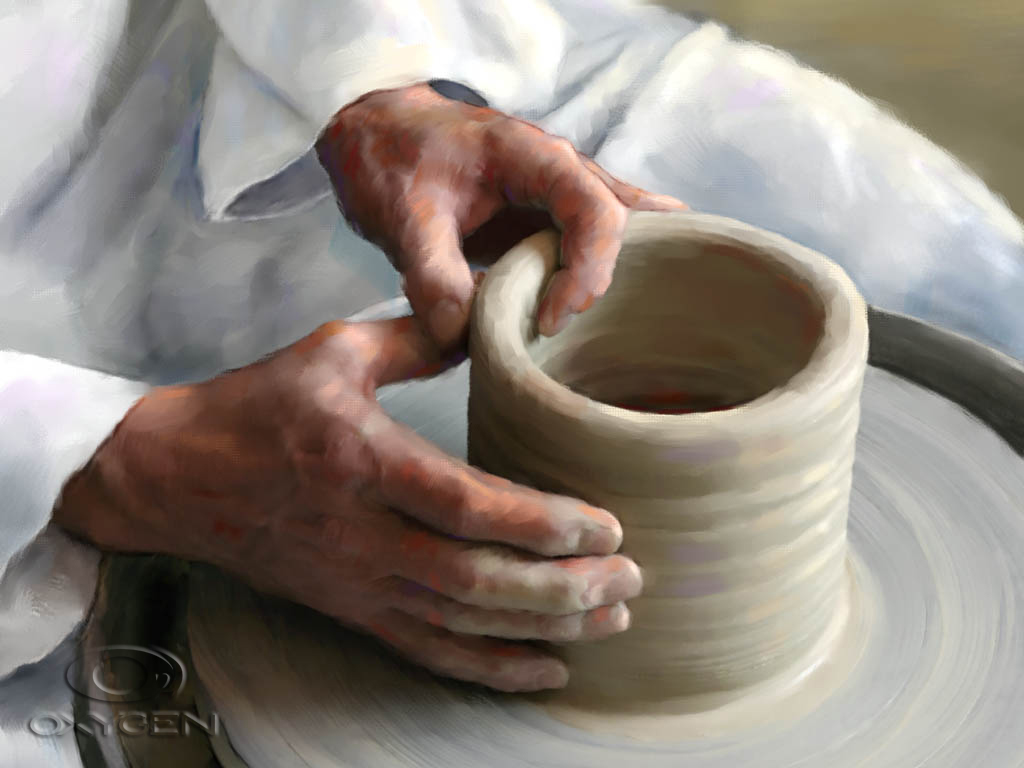
For the subject of his next sentence, Jesus uses the generic pronoun “he.” Does the “he” refer to the potter who made the dishes or the Lord who made humanity? This ambiguity leaves room for double meaning. Just like the potter of a clay vessel creates the both inside and outside of the vessel with one lump of clay, so the Lord, the potter of man, has created both the internal of the external of the person. Therefore, the Lord who created both the external and internal has the authority over both the external and internal alike. Here, Jesus insinuates a command to clean both the internal and the external.

“But give as alms those things that are within, and behold, everything is clean for you.” -Luke 11:41.

If the Pharisee did not catch the implicit command Jesus provides, Jesus gives the Pharisee an explicit command, which will solve the inward uncleanliness. Translation and interpretations of Luke 11:41 have caused problems for scholars. Most scholars believe that when Jesus spokes this sentence in Aramaic (the native tongue of the land during the 1st century), he probably included some wordplay, which does not translate well into Greek. Most Bible translations, like the English Standard Version (ESV), the Kings James Version (KJV), the New King James Version (NKJV), Revised Standard Version (RSV) and New Revised Standard Version (NRSV) translates the command as “give [as/for] alms” that which is within, and that will make the unclean clean. The solution makes the perfect sense. What made the Pharisees internally unclean was greed, the selfish desire for more than what is needed. The instructions Jesus provided encourages the Pharisees to a life of charity instead of a life of greed.  If the Pharisees change their heart from a greedy heart to a charitable heart, they will willingly and easily give alms, thus cleansing them. Instead of their greedy heart storing money to live a wealthy life, the Pharisees’ charitable heart will give their money to the poor and other people in need. Now the Pharisees will truly grasp God’s Law. They Pharisees thought they upheld the Law better with their traditions and interpretations, but they were having an adventure in missing the point. God gave the Israelites the Law so the Israelites could live together as the people of God. Giving alms benefited the community of God’s people, but ceremonially washing hands didn’t do anyone any good. Jesus challenged the Pharisees to think of the true heart of the Law, not some interpretation to make them feel comfortable about themselves. Then their outward appearance would accurately reflect they had the right relationship with God and His Law internally.

In light of the metaphor of cups and dishes, the command Jesus gives has even stronger meaning. Jesus might have referred to the food and drink in the dishes and cups. No doubt the Pharisees probably brought costly foods and drinks to the lunch. Jesus saw right through the expensive presentation. Jesus knew the money paying for the luxurious meal came about through the Pharisee’s greed. For their first step of changing the Pharisees’ hearts from greedy to charitable, the Pharisees should use their money to give food to the poor of needy, instead of using their money to buy expensive foods to show off to guests.

Note that verse 42 ends with Jesus saying, “everything is clean for you.” Let’s clarify what Jesus does not mean by these words. Jesus does not axe any Law in the Torah. Jesus does not claim that the good work of giving would provide penance for their sin. What Jesus wants the Pharisees to do here is to work on cleansing the inside so thoroughly that the overflow of the internal cleansing will also clean the outside. Instead of washing their hands, Jesus wants the Pharisees to wash their hands. If anything, Jesus might suggest that if the Pharisees can internally clean their heart, the internal cleansing will flow out to cleanse them externally, meaning all those extra laws and rules and external cleansing will no longer apply because it will come naturally. The Pharisees could truly eat with clean hands, not because they washed their hands, but because their hands did not partake in any greedy money grabs. After all, external cleansing without internal cleansing is a superficial cleansing. The Pharisees were guilty of exactly that superficial cleansing. The Pharisees did practice the giving alms, but once again, the Pharisees concerned themselves more with external than the internal. Jesus wants the Pharisees to give their hearts with alms, displaying a genuine concern for the poor, instead of simply giving because the Lord commands it in his law.

When Christians reads a pericope about Jesus in Gospels, temptation easily comes to put themselves in the place of Jesus. In reality, Christians might better put themselves in the place of the Pharisees. When Christians read Luke 11:37-41, they have to take a seriously look at themselves and wonder, “Am I making the same mistakes as the Pharisees?”

Do I concern myself more with my outside than my inside? Luke 11:37-41 exposes several dangers of focusing on the external over the internal. Concerning ourselves with the external over the internal will leave the Christian with an unhealthy view of God, of others and of the self.

As born-again Christians, with the blood of Jesus justifying us and the Holy Spirit sanctifying us, Christians strive to think and feel with God. The Bible clearly states how God does think and feel about this. In 1 Samuel 16:7b, the Lord has to remind his prophet Samuel, “For the Lord sees not as man sees: man looks on the outward appearance, but the Lord looks on the heart.” When Christian look at the inward, they see things as God see things. When Christians look more at the outward, they do not reflect Christ.

When Christians focus on the outside over the inside, Christians don’t see humanity, the creation God made in his own image, as God sees it. That’s a shame because it can cause Christians to miss out on God moving out on people. Let’s think back to the illustration of the bowls and cups. We know metaphors of bowls and cups which are clean on the outside but dirty on the inside represent people like the Pharisees, who hypocritically make themselves look good on the outside while they remain wicked on the inside. What about, though, a bowl or cup that is clean on the inside but dirty on the outside? Who would that represent? Does such a person exist? I suppose that this person is a newly born-again Christian. He or she has received the gospel message, and he or she has received it with great joy. The sacrifice of Jesus Christ on the cross has justified that person from all sin, and the Holy Spirit has begun sanctifying the person, giving them a pure, clean heart. Addictions and habits from the old, sinful nature, however still can be found ingrained in the flesh. That’s the person who is like a bowl or cup clean on the inside but dirty on the outside. Imagine if the Christian saw that person based on the outward appearance. The Christian might disregard the person as sinner, stuck in his sinful nature. The Christian might not approach him or her, or worse, not allow him or her into the church. If the Christian, however, can look at the person like God does, the Christian will see a person seeking to reflect Jesus. Not only should that cause the Christian to praise God for saving another soul, it should also cause the Christian come alongside the struggle newly born-again Christian to help him or her fight addictions and other sinful habits.

When a Christian concentrates on the outside more than the inside, it does not allow the Christian to properly self-evaluate spiritual growth. This is how tradition, which is a spiritual experience has passed the test of time, gets turned into a dogma, a tradition followed merely for the sake of tradition. The Christian finds himself or herself practicing the spiritual discipline just because that’s just what Christians are supposed to do. The Christian now focuses on what he or she is supposed to do for the spiritual discipline, instead of who he or she is supposed to become through the spiritual discipline. If not done properly, this can leave the Christian in a worse condition. The Christian now tries to cover up internal sin with more external good deeds, instead of changing the heart. Consider, for example, a child with a dirty mouth spewing foul words. A parent might choose to punish the child by washing his mouth out with soap. Now I get that the punishment comes from the nasty taste of the soap bar will discourage the child from cursing, but it doesn’t matter what brand of soap the parent uses, no soap brand can make the child stop cursing. The child has to make a change within the heart, and that internal change will lead to, not just action, but habit. In the same way, if think the problem lies in their outward actions, the problem will never be solved because they are not fixing the root of the problem. Instead, Christians need to spend time cleaning their heart and the mind, the thoughts and the feelings. Then, the outward actions will follow. Listen, I get why C.S. Lewis said in Mere Christianity, “Do not waste time bothering whether you ‘love’ your neighbor; act as if you did. As soon as we do this we find one of the great secrets. When you are behaving as if you loved someone, you will presently come to love him.” He feared that if Christians wait to act loving until they felt loving, they would never get around to actually loving. My fear, however, is that Christians will fall into the same trap as the Pharisees. They will look loving on the outside, but on the inside, they will be filled with wickedness. I would expect those Christians to get the same reaction from Jesus as the Pharisees did.

Thursday, February 09, 2012

John 9: I Was Blind, But Now I See

Did you get the reference of the title? No, did you get the real reference of the title? If I were to survey people on what the title was referencing, most of the people surveyed would say it’s the last line of the first verse of the famous hymn “Amazing Grace.” This is true, but it’s not the original reference, as hymn writer borrowed this line for another source. From where did he get it? He got it right here in John 9. What’s so amazing (yes, pun intended) about his use of the line from John 9 is that he used it in the right context, comparing going from blind to seeing as the same is going from lost to found. John 9 explains how they are the same, too. Let’s check it out.

Before we dive right into the story, let’s talk about the structure a little bit. The chapter will start off with a miracle. The miracle is the 6th and second-to-last miracle. Do you remember how John 5 used the healing of the invalid as an introduction to Christ’s teaching? Do you also remember how John 6 used the feeding of the 5,000 to introduce Christ’s preaching on the bread of life? John 9 will follow in the same pattern. In the beginning of chapter 9, Jesus will perform a miracle. This miracle will be the “attention-getter” for the teaching that will take up the rest of the chapter. Another piece I would like to note is that this teaching also has a thesis line. As I said in the conclusion of the chapter before, the thesis is one of the “I AM” statements in John 8. More specifically, it’s John 8:12. I’ll put up John 8:12 again in case you forget, but Jesus does use another form of the statement in John 9:5.

John 8:12-
When Jesus spoke again to the people, he said, “I am the light of the world. Whoever follows me will never walk in darkness, but will have the light of life.”

John 9:5-
“While I am in the world, I am the light of the world.”

Now let’s dive into the chapter. Along their journeys, Jesus and His disciples pass a man blind from birth. So this man has never seen in all His life. When the disciples see the blind man, they do not have pity or mercy on him, but rather, they turn it into a theological debate. Indeed, this topic was hot topic, just as much as it is today: why do people suffer? The Jews in the 1st century had got it down two possibilities: either the person sinned or the person’s parents sinned. Both views are supported by Old Testament Scripture (Ezekiel 18:4 and Exodus 20:5, 34:7 respectively). The Jews of the 1st century, however, were trying to take it a step further. They were trying to create a methodology to determine whether a person’s suffering resulted in the person’s sin or the person’s parents’ sin. Some rabbis were even declaring that a disability from birth was caused by the person sinning in the mother’s womb. This was a heavily weighted debate, and so the Twelve Disciples asked their rabbi for His view.

What really strikes me here is what I said early on the paragraph above. When the disciples see the blind man, there’s no compassion, no mercy, no pity not even a “Poor guy.” They break out in a theological debate, and right in front him. The man is blind, not deaf. How hurtful that must have been to hear people standing in front of you, arguing whether you are a sinner or your mom and dad are sinners. The blind man might be crying out for help, but they don’t hear because they are too involved in their debate. Sometimes I fear Christians have fallen into the same rut. Christians can get so caught up in being right in their theological debates that they miss the people who are hurting. I remember one time I was in Washington, D.C., walking by the steps on the Supreme Court. On one end of the steps was a Christian man, holding a big, wooden cross that had a poster board nailed to it, which read, “Bring back prayer to school.” He was also handing out persuasive pamphlets. A worthy cause, I will admit. On the other side was a beggar, holding a big, tin coffee can, begging for money. Once again, I will say that bringing back prayer to schools is a worthy cause, but this Christian man was caught up in trying to make a political change that he totally ignored the beggar in need not too far from him. I wanted to yell at him, “Help him!” This Christian man probably would not have a made difference in this nation’s decision on prayer in school, but he probably would have had made a difference to man the begging if he had simply helped the man. Christians, let make sure we don’t get caught up in trying to be right or trying to make a political change that we ignore the people who are truly hurting and in need. When we help them, then we show we are right and making a change.

Jesus understood that. He did not see a theological debate in front on him, but rather a person, a human being, that needed help. Jesus, being the good rabbi he was, did answer the disciples’ question, but he was quick and to the point so He could move on to healing this man. Jesus revealed to His disciples that suffering doesn’t always have to be a result of sin (although it could be). Suffering doesn’t always have to be a negative consequence. Suffering can lead to a positive consequence, like glorying God or healing. Jesus does not deny this blind is a sinner, and the same is true for the blind man’s parents, but He’s simply clearing up that it’s not sin that led to suffering, but the suffering will lead to the works of God being seen. (On the note of “Why do people suffer, on top of our sin, our parents sin, and to give glory to God, I want to note that Romans 3 will tell us people suffer because we’re naturally in a corrupt, depraved, fallen, sinful world. So there’s 4 reasons why people suffer, but that’s another blog for another time.)

How does Jesus perform the miracle? Jesus spits on the dirt, makes mud with it and puts it in the blind man’s eyes. Now I’ve heard some people say Jesus used spit because spit does have healing properties. After all, that’s why people suck on their skin when they get a cut, bruise or burn. But I don’t think that just anyone today could spit in someone’s eyes and heal them, so there definitely still is a great miracle happening here. Then Jesus commands the man to go wash in the Pool of Siloam. The Pool of Siloam is located at the mouth of Hezekiah’s tunnel, which was the waterway that led fresh water from the Gihon Springs outside the city of Jerusalem insider the city of Jerusalem. When I was in Israel, I went to Pool of Siloam, and to this day, it still has water in it. Israeli children take the word “pool” very literally, as they play in it on a hot summer day. The blind man follows the instructions of Jesus, and by the time the blind man gets home, he has 20/20 vision!


Now all the Jews living in the city knew this man as the blind beggar. And now all of a sudden, they see their blind beggar seeing. They cannot comprehend this. Some ever going as far as to say it’s just the man’s doppelganger (“look alike”) or maybe a twin, but it cannot be the man, since he’s been blind from birth. But the man who was blind just keeps insisting “I am the man!” When they ask him how he can see, he tells the story word for word, even giving Jesus the credit. The only thing he cannot tell them is the whereabouts of Jesus.

The befuddled Jews of Jerusalem bring the man who was blind to the Pharisees. There’s a lot of reasons to do this. The Pharisees were greatly valued when it came to spiritual affairs. If the Jewish people needed answers, the Pharisees were the ones to go to. In John 9, the people bring the formerly blind man to the Pharisees to get them to verify he was once blind, he is indeed seeing, and this was a legitimate miracle. This practice is somewhat backed up by Scripture, as the Law of Moses did say a cured person had to go to a priest to be declared fully healed. Now in verse 14, John brings to light a very important key aspect, probably because it is on the Pharisees’ minds as well as all the other people’s minds. According the Pharisees, Jesus broke the law twice. First, Jesus made mud on the Sabbath, and the Pharisees thought that making mud or clay on the Sabbath was doing work, thus breaking the 4th commandment. Second, Jesus healed a person on the Sabbath, and the Pharisees believed that healing on the Sabbath was work, and therefore a sin (unless the person healed was dying). So when the formerly blind man tells his story for a second time, the Pharisees simply dismiss Jesus as a sinner because he broke the Sabbath laws twice. But this further baffles the people who brought in the blind man. They know healing can only come from God, and they also know God only works with the righteous, not the sinners. A sinner cannot work with God, so the miracle must mean Jesus is righteous. In verse 16, John once again describes the Jewish people as “divided.” So for the tie-breaker, the Pharisees act the man who was blind directly. The man simply answers, “I think he’s a prophet.”

Well, this still isn’t good enough for the Jews. So they drag his parents in, just to make sure this is their son, the son blind from birth. But then the Pharisees turn on them the question of how he was healed. The parents do verify that the man is indeed their son, but on how he got healed, they simply reply, “We don’t know. Ask him. He is of age.” John explains the parents’ motif. It almost seems as if the parents do believe this is miraculous healing from Jesus. Yet they are afraid to admit it because the Jewish leaders have declared that anyone who called Jesus the Messiah would be “put out of the synagogue.” We think of “synagogue” as building, and indeed it was a building for public meetings. But the Greek word that “synagogue” comes from could literally be translated as “gathered together.” The term synagogue, to the Jewish people, is not only a building, but can also mean the general assembly of Jews as whole. So to be “put out of the synagogue” would mean being excommunicated or shunned from the general assembly of Jews. The Jews saw this as no longer being a Jew, no longer being God’s chosen people, so they did not want to say or do anything that would shun themselves, including saying that Jesus is the Messiah.

Still not satisfied, the Pharisees drag the man who was blind back and make him swear an oath proclaiming God healed him, and not Jesus, for Jesus is a sinner. The man does not accept and agree with the Pharisees’ decision, nor does he disagree by defending Jesus. He does not know who caused the healing (God or Jesus), nor does he know if Jesus is a sinner. So he simply states the facts he knows are true: “I was blind but now I see.” It’s like the man is crying out, “Who freakin’ cares who made see or how I can see, all that matters is I was freakin’ blind and now I can freakin’ see!” Still, the Pharisees are not satisfied, so they start questioning the formerly blind man as to what had happened, hoping to find some kind of contradiction in his story. They still don’t believe he is telling the truth, even after he’s sworn a solemn oath.

Now the man who was blind is going to start to become bold in front of the religious leaders. When the Pharisees ask the formerly blind man to re-tell the story, the formerly blind man says, “Why bother? I already told you everything over and over, and you did not listen. I could tell you again, but still won’t listen,” and then at the end he adds, and I do quote, “Do you want to become His disciples, too?” I can really sense sarcasm in the formerly blind man’s last sentence. It’s like he’s saying, “Apparently you love hearing me talk about Jesus so much. I bet you secretly want to become his disciples.” I’m almost sure this is sarcasm, and my proof is the Pharisees’ reaction to it. But I think the man born blind is on to something. He knows that the Pharisees are out to get Jesus. He even proves it, in the boldest fashion, in John 9:30-33. In a way, the man who was blind shows he has greater spiritual wisdom than the religious leaders. The man who was blind from birth simply states what everyone in the crowd is thinking. God only works with the godly who do His will, not sinners. Thus, a sinner cannot make a blind man see, but only a godly man. Therefore, Jesus has to be a godly man, not a sinner, because he can make the blind man see. Well, the Pharisees won’t take this. Since the man was blind from birth, they take their belief he was in sin since he was in the womb. Seeing themselves as righteous and the man as a sinner, they throw him out and shun him.

Before we move on, let’s take a moment to really feel bad for this poor man. He was born blind, which means he wasn’t able to see all his childhood, and a lot of his adulthood. As the disciples demonstrated, he was probably the topic of many theological talks. Then Jesus comes along and heals him. To be healed after being blind for so long would be a reason for praise, rejoicing and celebration…wouldn’t it? I think it is, but that’s not what the blind received. First, his neighbors do not believe it was him, even claiming it was a doppelganger that just looked like him because the blind man could never see. Next, he is dragged before the Pharisees, where he has to explain again and again what happened. Does it cause the Pharisees to rejoice or praise God? No. The Pharisees just keep asking him questions, which turn into accusations. Then the conversation goes from the blind man to Jesus, and they almost forget that a seeing blind man is standing before them. Soon, even the blind man’s parents are brought forward. Do they rejoice and celebrate their son can see? No, because they are afraid, since the Jewish leaders have struck them with fear. By the time, they get to the end, the blind man is insulted and excommunicated. To sum it all up, the Pharisees did to seeing man what the disciples did to the blind. Instead of recognizing and rejoicing, they instead turned it into a theological debate. Once again, I cry out to Christians: Never get so caught up in the theological “why” and “how” that we forget to just praise and worship God for what He has done.

The story concludes quickly after the man is shunned, but it really hits back to the “I AM” statement used in John 8:12 and John 9:5. When Jesus receives news that the man who was blind has been kicked out, He reaches out to the potential believer. Jesus simply asks him in John 9:35, “Do you believe the Son of Man?” Jesus carefully chooses His words. The term “Son of Man” was a title the prophet Daniel gave the Messiah. The man who was born blind shows willingness and unawareness at the same time. Yes, he does want to believe in the Messiah, but he does not know who the Messiah is. Once again, I see Jesus carefully picking his words, and I love how He does it. I love how Jesus says, “You have now seen him.” Jesus is not merely saying, “It’s the man standing before you,” but He’s also saying, “It’s the one who opened your eyes and made you see.” And it brings the formerly blind man to belief and worship. Jesus explains to the man (and possibly everyone around him), “For judgment I have come into this world, so that the blind will see and those who see will become blind” (John 9:39). The Pharisees who overhear Jesus become indignant at Jesus. Whether they know Jesus is being figurative, or even if they take it literally, they know Jesus is calling them blind. In John 9:41, Jesus makes that connection of blindness to sin, or, in the words of the hymn “Amazing Grace,” Jesus makes the connection of “I was blind, but now I see” to “I once was lost, but now am found.”

I was a summer missionary for Child Evangelism Fellowship (CEF) for 4 years, and one of those years, the curriculum we used taught children 5 of the “I AM” statements of Jesus. Even the memory verses were those 5 “I AM” statements. On Day 4 (typically Thursdays), the “I AM” statement and memory verse was John 8:12. The Bible story was not about this blind man in John 9, however, but the story of blind Bartimeaus, as found in all 3 synoptic Gospels. They did it because, for the sake of the children, blind Bartimaeus is an easier story to tell because there’s more action and less talking. Let me be clear that the blind man in John 9 is not Bartimeaus. There are many differences in the story, but the biggest difference is the blind man in John 9 lives in Jerusalem, while the blind Bartimeaus in the synoptic Gospels lives in Jericho. But as CEF revealed, theologically speaking, there are commonalities, and those

In other ancient writings, blindness was seen as a blessing. In ancient writings, most blind people were sages who had a deeper understanding of the world, and some could even use it to “see” in the future (yes, the pun was intended, but so was the irony in ancient writings). Not true with the Bible. Blindness was seen as a curse. As the Jews well understood by the 1st century AD, they knew that blindness, a disability, might have been the result of a sin, and there’s some truth to that. But I think the bigger picture God was trying to get across was that blindness was a literal, physical ailment that was to be a symbolic metaphor for being lost in sin. A blind person could be described as “walking in darkness” because darkness is all they could “see.” In the same way, someone who is in sin could also be described as “walking in darkness.” A blind man needs to be led, for if he wasn’t led, he would get lost. In the same way, someone in sin in lost in sin. Blind people represented the fallen human race, lost in their sin, whether could literally see or not. Then Jesus came along, and he made the blind see. In the same way Jesus helped the blind to see, or helped those who “walked in darkness” to “walk into the light,” Jesus brought salvation to sinners so they would no longer have to walk in the darkness of their sins, but walk into the light of salvation. If Jesus can heal the blind of their blindness, Jesus can heal sinners of their sin. This is how Jesus demonstrated He was the Light of the World. Those who believe in Jesus, as the blind man did, are no longer walking in the darkness of their sin, but are now walking in the light of life. On that day, the blind man just didn’t go from blind to seeing, but also from being lost in his sin to being found.

On that same day, the Pharisees took a step back. They went from seeing to being blind (in a spiritual sense). They went from being found to being lost (once again, in a spiritual sense). Their pride would not allow them to trust in Jesus for salvation. So they lied to themselves, believing themselves to be righteous. Jesus said to them that by doing so, they have not becoming innocent, but have made themselves guilty. Jesus also says, as found in verse 39, just as much as he’ll make the blind see, he’ll make the seeing blind. Christians, may we never make the same mistake as the Pharisees and be blind to see the sin in us and around us. May we always walk in the light of Jesus Christ.

So after 9 chapters of John, we have 1 miracle left and 4 “I AM” statements left. 3 times we saw Jesus use a miracle as the “attention-getting” introduction to the teaching, 2 of which were “I AM statements.” To follow the pattern, the last miracle will be used in accordance with an “I AM statement.” But first, we have another “I AM” statement, and it will be found in the next chapter of John.

Tuesday, February 07, 2012

John 8: I AM and I AM

Remember how I told you to begin looking out for “I AM” statements? Well, 2 of these “I AM” statements will appear in John 8 alone. So let’s check them out.

But before we get to the “I AM” statements we have to discuss John 7:53 to 8:11 (although it has nothing to do with the I AM statements) because most of you probably won’t let this topic go. The last verse of John 7 and the first 11 verses of John 8 do not appear in any of the earliest manuscripts of John. The earliest manuscripts found with this story are not the most reliable manuscripts either. These manuscripts will put this story in the middle of John, at the end of John, in the middle of Luke, or at the end of Luke. None of the earliest church fathers (100s-300s AD) mention it, but that is an argument from the silence. The earliest mention of the story is in 450 AD. It was most likely part of the oral tradition (the story was passed down by word of mouth) and later on thrown in there by copyists. Isn’t it quite obvious, though? There is no smooth transition in and out of this story. As a matter of fact, some people say the transition is smoother without this story in it. The writing style, both the vocabulary and grammar, does not fit the rest of the book. For example, this is the only time the term “teachers of the Law” (“scribes” in more literal translations) is used in the whole book (yes, quizzers, “teachers of the Law” is key for the year). Another example is that this is the only time Jesus is called “Teacher” (Greek word didaskale), whereas the rest of the book calls him “Rabbi.”

So the passage is not written by John, but is it still Scripture? Is it still inspired, infalliable, inerrant, authoritative revelation breathed by God, which makes it Scripture? I would say yes. Why? As John will later tell us in John 21:25, Jesus did many other things that are not in the 4 Gospels, so much that there is not enough books in the world to write it all down. To put in my words, it would be easier putting the internet in a book than it would be to put every word and deed of Jesus in a book. But the biggest and greatest proof is that whether or not the passage belongs in the Bible is if it agrees or disagrees with the overall theology of the Bible. We know what books are psedupigraphal (fake Bible books) because their theology does not agree with biblical theology at all. John 7:53-8:11 certainly does not promote any theology that is against the Bible. The words and actions of Jesus are line with the character of Jesus. Same could be said for the Pharisees. In fact, going back to Jesus, the reader can find in John 8 alone preaching from Jesus that would defend his words and actions in John 8:1-11. For example, in John 8:15, Jesus says He passes judgment on no one. I conclude that this story is a true account of Jesus and does belong in the Bible. Even if John didn’t write it, we can say for certain God authored it. So let’s take a look at it.

The action of the story begins when the Pharisees and teachers of the law bring Jesus a woman caught in adultery. Adultery, in the most general sense, is a sexual sin. I define it in the most general sense because John uses the word “adultery” in most general sense in John 8. It could be premarital sex (having sex with someone before marriage), extramarital sex (having sex while married with someone who is not your spouse), homosexuality (having sex with someone of the same sex), incest (having sex with a family member or relative), bestiality (having sex with an animal), prostitution (having sex as a business, and being paid for it), or even rape (having sex with someone against their will). All these are strictly forbidden by the Law (see Leviticus 18 & 20) as adultery. While John isn’t specific on the adultery, one thing he is specific on is the Pharisees’ and teachers of the law’s wording. The Pharisees and teachers of the Law say that the woman was “caught in the act.” Isn’t that disturbing? Imagine the Pharisees and teachers of the law going around, going house to house, and checking to see if all couples having sex have a marriage license. Once they caught someone, they dragged that person out to a trial.

Using this adulterous woman as a visual aid, the Pharisees and teachers of the Law ask Jesus what her fate should be. Should the woman be stoned, as the Law says, or not? As John 8:6 reveals, this question is merely meant to trap Jesus. It seems like a simple “yes” or “no question, but there is no right answer. If Jesus says “no,” He is breaking the Jewish Law, for indeed, the Law of Moses did say adulterers need to be stoned to death (see Lev. 20:10 and Deut. 22:22-24). If Jesus said “yes,” He is breaking the Roman Law, for the Romans would allow occupied people groups to carry out their own trials, but would forbid occupied people to carry out executions; they had to go to the Romans for permission. The Pharisees and teachers of the law set Jesus up to make him look like a bad teacher or even make him look like a sinner. Yet the Pharisees and teachers of the Law aren’t as pure as they think they are. They had made mistakes themselves. First, the Law of Moses (once again, both the Lev. 20:10 and Deut. 22:22-24 passages) declare both the man and the woman are to be stoned, not just the woman. The Pharisees and teachers of the law needed to bring forth the man as well. Second, according to the Law, for a proper trial to happen, the trial must be performed by a proper judge. By the 1st century, judges were commonly from the Sanhedrin. Although the Christian reader knows Jesus is the real, true judge because He is God, in the human mind and in human terms, Jesus could not be the judge because He was not in the Sanhedrin. So the fact is the Pharisees and teachers of the law were breaking the Law by setting up this question, thus sinning.

Of course Jesus knows this is a trap so instead of stating an answer, Jesus bends to the ground and draws on the ground. John doesn’t say what he wrote, so many people have guessed what He was writing. The most common one I hear was Jesus was writing down the names of the people there, followed by all the sins they have committed. Some even go a step further and say Jesus was writing down all the names of those who committed adultery themselves, as well as their adulterous acts. Along with the previous thought, some scholars have suggested Jesus was literally acting out Jeremiah 17:13, where the names of those who have fallen away are written in the dust. Perhaps Jesus was writing down the names of the people who did not believe in Him, showing them to be as guilty as the woman was. Some have suggested Jesus was writing down one of the Laws that spoke out against false witnesses or false testimony, such as the 9th commandment or Exodus 23:1,7. Others think that Jesus was following a Roman custom, in which it was a requirement for the conviction to be written out during the trial. There’s even a few crazy guesses. For example, Jesus was merely doodling or Jesus was drawing 2 sets of tablets on the ground to remind the Jews that the Israelites sinned, causing Moses to break the tablets. Whatever it was, it was enough to rattle the people watching, especially the Pharisees and the teachers of the law. It causes the people in the crowd to walk away, in the order of oldest to youngest. Why? Once again, the Bible does not say, and a whole array of reasons could be given. Again, the point is that it the drawing/writing shook the people up so bad, they walked away.

In the middle of the drawing, Jesus interrupts himself to say, “If one of you is without sin, let him be the first to throw a stone at her.” Simply put, I see Jesus throwing the question back at the accusers. This is why the most popular interpretation of the drawing on the ground is the most common. Jesus had exposed that all the people there were sinners. Jesus exposed all the people there deserved to be stoned to death because they were sinners. Paul will state this clearly to Christians in his book which we call Romans. Take a look in Romans 3:23 and 6:23a and put the 2 verses together to make a fine doctrine. “For all have sinned” + “for the wages of sin is death” = We all deserve to die because of our sins. Jesus showed the Pharisees, the teachers of the law, and everyone else watching that they deserved to be on death row as much as they were. On the same note, Jesus is demonstrating that they have as much a right to accuse and condemn the adulterous woman of sin as the adulterous woman has the right to accuse and condemn them. A lot of people would say Jesus is making a bold and powerful statement against the death penalty, and I would agree. No one should be executed for a crime because all deserve to be executed for their sins. But I think there’s a strong message here, a message about judging people and condemning people. No person should judge a person (the person himself/herself, not their acts), nor should a person condemn a person (judge them as guilty beyond hope of redemption). Why? We all have sinned, so we all deserve to be judged and condemned. Yet a sinless Jesus, who had the right to judge and condemn us, forgave us, so we should forgive as well. I hope you can see and understand that, and if you can’t wait until the end of the story in verse 11, and you’ll definitely be able to see it.

The crowd thins out until only Jesus and the adulterous woman is left. Jesus shows her all her accusers have gone away, even asking if there is anyone left to condemn her or stone her. I imagine the woman looking around and giving her simple answer: “No, sir.” Jesus replies that he does not condemn her either, but he sends her away, commanding her, “Go now and leave your life of sin.” Now I hope you understand what I was saying. The last person standing with the adulterous woman was the man who was without sin and could throw the first stone with a clear conscience. Yet He did not. He chose to forgave her. If the sinless man, who could condemn, chose to forgive, shouldn’t the sinners who are trying to walk in His footsteps also do the same?

The best example that really hits home is another example of adulterous women. It is the pregnant teenager and the single mom. The Church still struggles with this question every day. They set themselves up with the same question that the Pharisees and teachers of the law tried to set Jesus up with: Do we condemn the sin, and thus possibly condemn the sinner with the sin? Or do we instead ignore the sin, but instead support and help? Christians, whether it be in the church, Christian schools/colleges, Christian ministries, or any other Christian organizations, get stuck in a rut trying to answer this question. If Christians cast out the mother, they might appear as mean, rude and heartless to someone in need, and legalistic as well. But if Christians help the mother, they might look like they are ok with the unwed pregnancy, which in turn would make them look like hypocrites. What should Christians do? I don’t think there’s an easy answer, but John 8:1-11 does shed some light on it that would help. Condemnation of the sinner is a definite no-no. The pregnant teenager or single mother is not to be treated like a hopeless sinner, and neither is her child. Neither the mother nor the child are to be treated like lesser humans. Instead of condemnation, forgiveness needs to be given. Even if the mother does not ask for forgiveness, it still needs to be given. It can be given in support and care. What does need to be done is confession and repentance of sins. Jesus did not dismiss the woman’s sin as if it was nothing. He told her to leave her life of sin. This does not need to be some kind of public spectacle for everyone to watch. It just needs to be taken care of with the woman who committed the adultery. There needs to be an evident change in the woman’s lifestyle. This can be a little more conditional. If she still continues a life of adultery and gets pregnant again, then maybe that support and care should be withdrawn. But not to the point where there is no hope of redemption and reconciliation. Christians must struggle daily to find a way to love the sinner and still hate the sin. God does not tolerate sin, and neither should Christians. But God does love and forgive the sinners, and Christians should do likewise.

Alright, that’s the end of the questionable story and the end of the questionable “hot button” topic. Let’s get to the rest of the chapter and look at what we know is true Scripture, and look at what the topic of this chapter is. Indeed, there are 2 “I AM” statements in John 8. Lo and behold, one of those statements are in John 8:12, once the reader gets past the first 11 verses of the last story. It’s interesting to think that if that story really wasn’t in John, John 8:1 would be have the been the “I AM” statement. An “I AM” statement would be definitely the right way to start off this chapter. So let’s look at it

John 8:12-
When Jesus spoke again to the people, he said, “I am the light of the world. Whoever follows me will never walk in darkness, but will have the light of life.”

Some people will say that talking about Jesus as the light of the world is a smooth transition from the adulterous woman story because the adulterous woman story is showing how Jesus is the light of the world. I’m not sure if I see this, so I’m going to skip that. Actually, for John chapter 8, I am not going to spend a lot of time talking about Jesus as the light of the world because I actually believe John 9 will be better for it. But I will cover what the verse says about itself.

This isn’t the first time Jesus is called light in John. As early as John 1:4-9, John called Jesus The True Light. In John 1:4-9, John proclaimed The True Light gives light and life, the True Light shines in the darkness, and the darkness does not understand The True Light. In the greater scheme of the Bible, light is constantly used as a metaphor for God, most specifically in reference to His holiness. On the opposite end, the sinful and evil world is described as being in darkness. After all, darkness is the opposite of light, and the opposite of holy God is a sinful and evil mankind. A specific Old Testament example would be Isaiah 9:2, where Isaiah describes the sinners heading for death as “people in darkness” and those with God are ones with light. Jesus brings this idea into the New Testament. The “people in darkness” are those without Jesus, who are also sinners heading for death. Those who believe in Jesus are the ones with light. They will have life, as Isaiah 9:2 and John 1:4-9 tell us. If any Jew knew Isaiah by memory, it’s quite possible Isaiah 9:2 came to mind when Jesus said John 8:12. Also many Jews called God “the giver of light,” going back to Genesis 1:3. For Jesus to proclaim Himself as the source of life, He was calling himself God. Other specific examples of Old Testament metaphors of light would be Psalm 27:1 and Isaiah 58:8. In both verses, light symbolizes God bringing salvation. When Jesus called Himself “the light of the world,” he was calling Himself the source of God’s salvation. (I also want to note many people have tried to connect Jesus as the “light of the world” using typology of things in Old Testament, such as the candelabra in tabernacle/temple, the pillar of fire and the Feast of Lights, but these tend to be allegorical views that ignore the practicality and the original context.)

Now I will admit, this verse does seem to be a little out of context. From verse 13 to verse 30, there’s not going to much talk about light or how Jesus is the light of the world. It’s more going to talk about the testimony Jesus has. Now it’s not Christ’s fault that this happens. The Pharisees take Him off track my challenging His testimony. Jesus does not ignore these challenges, but confronts them. I’m not going to talk about this too much because we’ve already covered it in John 1 and John 5, but I will skim over it and hit new parts.

The Pharisees challenge the testimony of Jesus because their interpretation of Deuteronomy 17:6 said that a self-testimony or a testimony of one person was not good enough. Some scholars believe the Pharisees are trying to throw back Christ’s words at Him (see John 5:31) Once again, Jesus is forced to defend himself. First, Jesus calls the Pharisees out for their judgment of Him. Jesus legitimately uses the fallacy so many 21st century teenagers commit in the right context: “You don’t know me, so don’t judge me.” Second, Jesus claims that He does have someone to second His motion: the Father. Once again, we see a clear image of trinity, and once again, it’s in the light of judgment. It’s as simple as this: the judgments of Jesus are the same judgments God the Father would make. Thus, the Father testifies for the Son, and the Son testifies for the Father. Jesus demonstrates that this fulfills the Law’s requirement of needing at least 2 witnesses, as found in Deuteronomy. When the Pharisees question Jesus on who His Father is, in verse 19, Jesus merely says that they don’t know Him because if they knew Jesus, they would know His Father. To know Jesus is to know God, and to know God is to know Jesus. In John 8:14-19, John demonstrates to reader the trinity, more specifically the relation between the Father and Son, which indirectly shows us Jesus is God the Son.

In John 8:21-22, Jesus once again proclaims to everyone with hearing range that He is going to a place they cannot go to. The Jews are still stumped on this. Last time we left the Jews in John 7, their guess was Jesus was going to the Gentiles areas of the Roman Empire, such as Greece. Their current guess is that Jesus is going to commit suicide. (This is really ironic because after Christ’s death, which skeptics have joked as a “suicide mission,” God did spread the Word to the Gentiles.) Jesus does try to correct the view, using more heavenly metaphor, such as “above the earth.” Even the Jewish culture and customs understood heaven to be above. Jesus turns their misconception about Jesus committing suicide. It’s almost as if Jesus is saying that those who do not believe in Jesus are “committing suicide” because they are killing themselves with their sin.

Let’s jump down to John 8:31 because from John 8:31, Jesus will start talking about a subject that will set him up for His next “I AM” statement, which is near the end of the chapter (which is ironic since John 8:31 is close to the halfway point of the chapter). After the end of the first half of John 8, many Jews came to believe in Jesus through His preaching. So Jesus goes on to preach the next step for these new believers to become disciples. They are to keep believing in Christ’s words, which are the truth, so they can be free. When the Jews hear this, they raise objections. They claim that since they are children of Abraham, they have always been free and never been enslaved. It’s funny to think they these men were scholarly because they have easily forgotten that the children of Abraham time after time were enslaved and were not free. The most obvious example would be the Israelites were slaves to Egyptians for 400 years. During the times of the Judges, many times a people group would invade the land and take control of it for a few years. Even if the Jews didn’t count the Judges, they had to count being exiled to Babylon for 70 years, and even after that, they did not have political sovereignty, as they would always be occupied by the Persians, the Greeks and the Romans. So how could the Jews claim they were free? Well, for once, the Jews agreed with Jesus that freedom is a spiritual thing. The Jews did believe they were spiritual free, meaning they were children of God, not slaves of God. Why? Abraham was their father, and the Jews considered Abraham a child of God. If Abraham is a child of God, then Abraham’s descendants are children of God. Jesus does not agree with this.

Jesus attempts to open the Jews’ eyes. Clearly, the Jews cannot see that they are slaves to sin. In fact, everyone who sins is a slave to sin. The Jews did not see themselves as sinners, so they don’t see themselves as slaves to sin. Jesus has to show them they are sinners, so He can open their eyes to their present slavery. In verse 35, Jesus uses common knowledge of the slavery system back in the 1st century AD. In the 1st century AD, slaves were not considered part of the family unit, so they did not benefit from the same benefits family did, including the final will of the father of the children and master of the slaves. Jesus calls himself the Son because if the son of the family set a slave free, the slave was indeed free. Since Jesus is the Son, he can indeed set people free of their sin.

The Jews keep insisting, as seen in verse 39, that they are sons of Abraham (and now the song “Father Abraham” is stuck in your head: “Father Abraham, had many sons, many sons had Father Abraham…”). It reveals a sad reality among the Jews. For salvation, the Jews were banking on themselves as being children of Abraham. Their thinking was along the lines of “If God wants to keep His promise to Abraham, He has to save us. If he didn’t, He would be breaking His promise to Abraham.” What really makes this sad is that this was the same thinking of the Jews before they got swept off into exile: “God won’t punish us and send us into exile because we’re the descendants of Abraham, and He promised Abraham his descendants would get the land.” Like I said, the Jews were really banking on God saving them because they were Abraham’s descendants. No wonder the Jews felt threatened when Jesus brought this thinking into question when he declared that a true believer would follow Christ’s words.

Doesn’t this sound familiar in the 21st century? Today, we’re not banking on being Abraham’s descendants, but like the Jews, we’re banking on the actions of someone in the past. The Jews were banking on Abraham’s past actions. Some Christians today bank on Christ’s past actions, mainly His death and resurrection. The Christians bank on Christ’s actions so much that, like the Jews of the 1st century, they don’t think obedience is necessary. They think that all they have to do is “believe.” To them, “believe” just means to accept a doctrinal statement as their own. So for them, to be saved means to just take on the Christian doctrinal statement as a personal beliefs statement, and they are saved. Jesus would correct these Christians just as much as He corrected the Jews. What did Jesus say was the qualifications of being a disciple of Jesus. In John 8:31 (NIV), Jesus says it’s “hold to my teaching.” More literal translations say, “abide in my teaching” or “continue in My Word.” More dynamic equivalencies and paraphrases say “continue to obey.” The point they are trying to get across is that this “believe,” used over 90 times in John, is not simply accepting a doctrinal statement. It’s living out what Jesus taught. After reading this, I no longer evangelize saying “believe in Jesus” but rather “follow Jesus” because that encompasses practices as well as doctrine. I pray that you Christians out there are not merely “believing” in Jesus, but following Jesus.

Jesus points out a big flaw the Jews have in John 8:40. Jesus comments that a true child of Abraham would follow in Abraham’s footsteps, such as believing in God and obeying God. The Jews were doing neither, and so they did not have the same justifying faith. The Jews might have been the biological descendants of Abraham, but in no means were they spiritual descendants of Abraham. Jesus also points out that Abraham would have never killed a messenger from God, yet the Jews were trying to kill Jesus, the Son of God. Thus, the Jews cannot be children of Abraham, but children of sin and children of the devil. (Another quick note. The majority view is that the “father” in John 8:41 is the Devil. A minority view is that the “father” in John 8:41 is the forefathers of the Jews that killed the prophets. While the majority view makes more sense in the immediate context, I do think the minority view holds some water.) Yet the Jews end verse 41 by saying that they are not illegitimate children, but children of God. I find it funny that the Jews are now waffling. They first insist they are children of Abraham, and now they insist they are children of God. But then again, maybe they see “children of Abraham” and “children of God” as interchangeable.

If I could sum up Christ’s reply in John 8:42-47 in one sentence, it would be “No, you’re not.” Jesus explains this by setting up a sharp contrast between God and the Devil. More specifically, he talks about the truth and lies. This well sums up a common theological theme in John 8. God speaks only the truth, but the devil’s native langue is lies. The Son of God (Jesus) also speaks the truth, but the children of the Devil (the Jews in their sin) speak lies. Thus, when they talk to one another, it’s like 2 people of 2 different languages speaking to each other. They can’t comprehend what the other one is saying. Therefore, the Jews do not understand Jesus, and they do not believe. Instead, like the Devil, they want Jesus dead.

Since Jesus called the sinful Jews children of the Devil, now the accusations from the Jews are going to fly. First, they call him a Samaritan. Is Jesus a Samaritan? No. But remember the Jews see the Samaritans as “half breeds” and “half human.” Calling Jesus a Samaritan is calling him a lesser human. That one is out there, so I’m going to leave that one be. I want to spend more time on the Jews’ accusation of Jesus as “demon-possessed. Not only do they do it twice in this chapter alone, but 4 times in John alone (7:20, 8:48, 8:52, 10:20)! This one sticks out to me because it is turning the tables on Jesus. They are now trying to call Jesus the Son of the Devil, or the Spawn of Satan. John 8:53b sums up it when they ask, “Who do you think you are?”

Yet Jesus keeps going back to God the Father for His testimony. Jesus says He knows the Father, while the Jews do not. Jesus reminds the Jews He is out to honor and glorify the Father, not Himself. He does so by keeping the Father’s Word, which is also His Word. Now Jesus is getting bold. He calls out the Jews for dishonoring Him, because dishonoring Him means dishonoring the Father. He accuses the Jews of lying because they claim to follow God, but they are not. Jesus then reveals that Abraham looked forward to seeing “[Christ’s] day,” saw “[Christ’s] day” and was glad and rejoiced. To understand what Jesus is saying, we got to understand the Abrahamic Covenant. God promised Abraham salvation through the Messiah, who would come in His family line. When the Messiah fully brought salvation to His descendants, that day would the “Day of the Lord.” Now we can say for certain that Abraham, in his old age, did get to see a son born to him and did get to see that son enter adulthood. Most scholars believe this is what Jesus meant when He said Abraham saw “[Christ’s] day.” There is a Jewish tradition, however, that states near the end of Abraham’s life, God gave Abraham a vision which allowed Abraham to see everything played out, to see His seed, to see the Messiah, and to see the Day of the Lord. If that is true, then indeed Abraham saw Jesus and Jesus saw Abraham. Whether or not that is true, we all know Jesus did indeed see Abraham because Jesus is God and God saw Abraham, knew Abraham and worked with Abraham. But once again, the Jews faced the problem of taking things too literally. They saw a man in His 30s proclaim He saw a man who lived about 2,000 years before their time. How can this be? The Jews set Jesus up perfectly for His next “I AM.” Let’s read it together.

John 8:58-
“I tell you the truth,” Jesus answered, “before Abraham was born, I am!”

Some translations, make this shorter, like “Before Abraham was, I am!” or “Before Abraham, I am!” but either way, this statement is meant to be short and impacting. It indeed was, for look at the reaction! Jesus might as well said, “Before Abraham, YHWH!” for that’s what He was claiming. This can be taken quite literally. The Jews knew the name of their God was “I AM,” as recorded in Exodus 3:14 (In fact, the Septuagint, which is the Greek translation of the New Testament, translates the “I am” in Exodus 3:14 as the same “I am” in John 8:58). Jesus was using the same name God gave Himself to name Himself. We can also go deeper into this. Jesus was claiming He existed before Abraham, during the time of Abraham, and after Abraham, all the way up to the current time (and further!). By doing so, He was claiming He was greater than their forefather Abraham, one of highest (if not the highest) human figure in the Jewish religion. To make this claim, Jesus had to claim to be God. Jesus was claiming for Himself the same eternal attributes as God Himself, so Jesus must be God.

Like I said, you know that’s what Jesus was claiming by their reaction. The believed Jesus was committing blasphemy. Blasphemy is claiming that you (or it could be another human) are God or you (or another human) is the messiah. Blasphemy was a serious crime, as the punishment was death. When they heard Jesus claim to be God, they were ready to pick up stones and stone him. Remember I said above that the Jews could not perform an execution without Rome’s permission. Yet these people were so offended by the claims of Jesus, they would have stoned him and accepted whatever consequence the Romans gave them. Yet they could not. Jesus can hide in the thick crowd and slip away. Many times through his Gospel account, John will accredit this to God’s Will keeping Him safe, for God has planned for the right time for Jesus to give His life, and only then would an execution happen.

So there it is. In 1 chapter we saw 2 “I AM” statements, bringing us up to 3 “I AM” statements. Yet we were only able to fully flush out 1 of the statements, the other one was just there. Well have no fear, for the next chapter in John will give us a better picture on that “I AM” statement. I hope in this chapter you saw how an “I AM” statement reveals Jesus to be God, and I hope the next chapter will do the same.

1 Samuel 1: Not Striking Deals But Surrendering Desires

Introduction In those grade school English classes, whether English composition classes or public speaking classes, both taught me that a st...