Showing posts with label God. Show all posts

Wednesday, May 31, 2017

Is Your Happy Place God's Dwelling Place? (Psalm 84)


Introducing Psalm 84

I wanted to start out with a visual, but I quickly realized that I, in my limited artistic ability, could not create such a visual. So I need you to create your own visual using your imagination. Close your eyes. I want you to go to your happy place. Have you ever been told to go to your happy place? It’s some kind stress reliever to help with anxiety, depression or other kinds of stress. Now that you’re in your happy place, where are you? For some of you, I imagine that you’re in a log cabin, or a ski lodge that looks like a log cabin. You look at window and see the glistening snow softly drop on the snow-capped mountains and hills. You can’t feel the cold, though, because you’re sitting in front of the fireplace, wearing your favorite sweatshirt, wrapped in your favorite blanket, drink coffee, tea, hot cocoa, or whatever your choice hot beverage is. For others, it’s the complete opposite. You’re sitting on the beach of a Caribbean island. You’re reclining in a beach chair, toes buried in the sand. You’re overlooking the sea, so blue that you swear God created with 3,000 Flushes. The warm sun beats down on you, but’s it’s not too hot or too humid. Your beach umbrella gives you shade. A soft, gentle breeze provides cool relief every now and then. And you’re sipping on your cold beverage of choice, and that might just be an iced coffee or iced tea. Perhaps for some of you, your happy place is in the middle of the forest. The only man-made structure you see is the tent you just pitched. You’re sitting on a log, roasting a hot dog or marshmallow over the campfire. Besides the crackling of the campfire, the only sounds you can here are from nature. You look up at the night time sky, and the stars are the brightest you’ve ever seen them. For others, maybe your happy place is quite the opposite. You’re sitting on a park bench in the middle of the city park. You watch the elderly feed the birds and squirrels, you watch the children play on the playground, and you watch the cars just drive on by. On a similar note, when I told you to go to your happy place, you might have found yourself in the food plaza of the mall. You are people watching. Not the judgmental kind, but you’re awestruck and amazed at all the kinds of people God made. They come in all shapes, sizes, colors, characteristics, personalities and traits. And still yet for others, you might be on a boat out in the middle of one of Great Lakes. You recline in your boat, waiting for a fish to tug at your reel.

But let’s get honest and be sincere. When I told you to go your happy place, who find themselves in their church on Sunday morning, worshipping the Lord God? I don’t mean to guilt you, and yet I do. If I would have asked the poet who penned Psalm 84 to go to his happy place, that’s exactly where he would go in his mind. He would be in his place of worship, worshipping.

Explaining Psalm 84
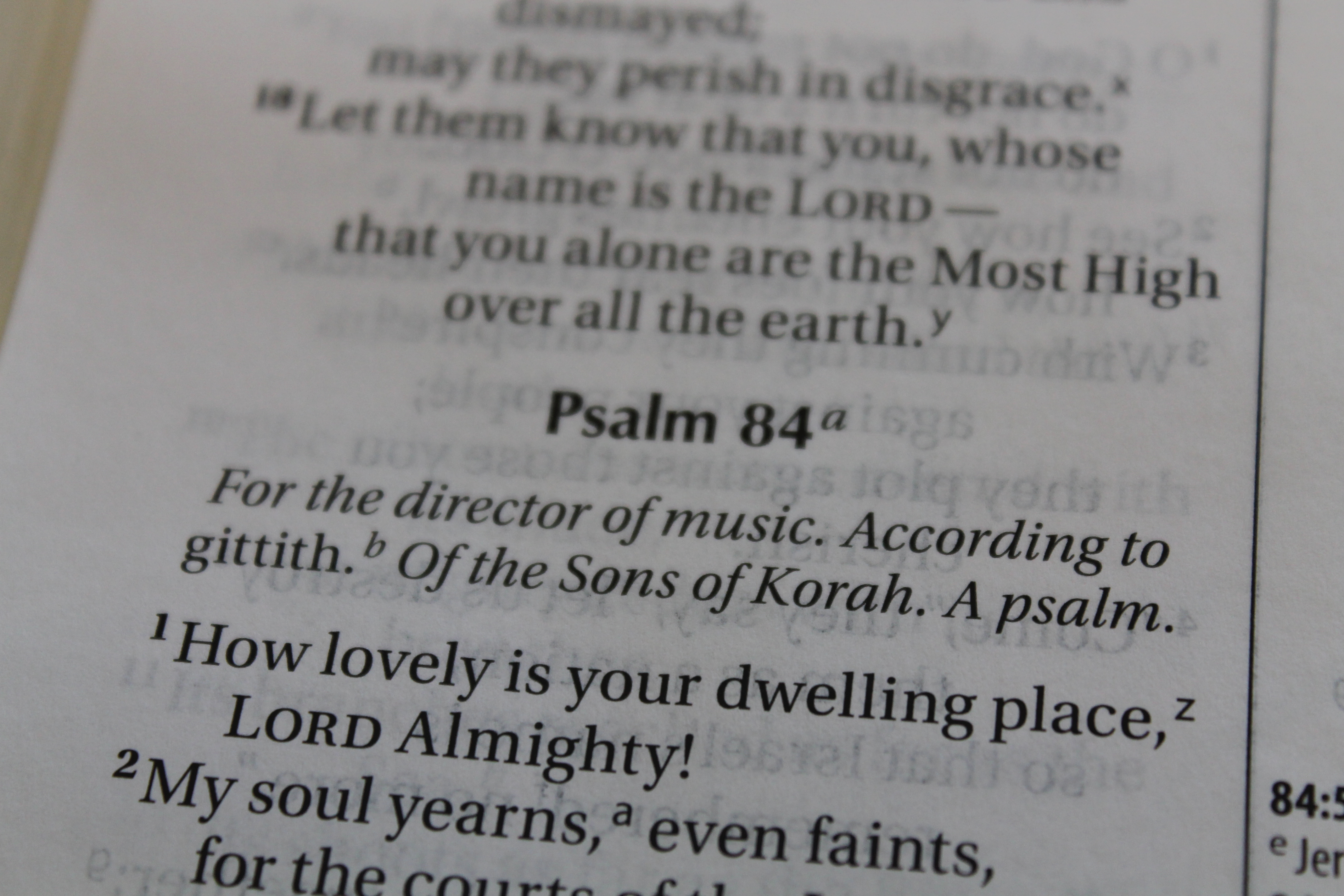


84:0. Most Bibles will some kind of heading before diving into the poetic words. It would seem that the heading provided more information for the original audience, more specifically for the choirmaster or director, but for the modern-day audience it feels like it provides less information and more confusion. The heading says, “According to the gitteth.” The scholar’s best bet is that the gitteth is some kind of tune or instrument, but that’s all we know. Some commentators have suggested the word come from root meaning “winepress,” hinting that the tune might be one familiar around the fall harvest, but that’s more of a guess and less of a hypothesis. The heading also states that this psalm is “of the sons of Korah.” The “of” here more likely means “belonging to” or “performed by,” and less likely means “wrote by.” Even if it did mean that, no one could pinpoint a certain Korahite that wrote. Therefore, the author is unknown, and this commentary will refer to the author as “the psalmist.” On a similar note, no one knows the date the psalm was written. As you imagine, this heavily affects the interpretation. If you believe this psalm was written in the time of David or earlier, the dwelling place refers to the tabernacle. If you believe this psalm was written in the time of Solomon or after, the dwelling place is the temple. Each side has its own reasons, but we really can’t be sure. Both the tabernacle and temple had courtyards. Yes, Psalm 84 does later on use the word Zion, but we have to remember we are dealing with a psalm, which loves using figures of speech. “Zion” could simply be a figure of speech for meeting God. After all, Abraham met with God on Zion. In this commentary, I will simply refer to it as “the dwelling place.”

 
84:1. In the opening verse of Psalm 84, the psalmist blurts out how he admires the beauty of Yahweh’s dwelling place. This will be the theme for the first stanza of Psalm 84. In the opening, the psalmist literally calls Yahweh “the Yahweh of hosts,” as most literal English translations follow. The title for Yahweh hints at this idea that Yahweh has invited the worshipper and is hosting the worshipper.

84:2. Awestruck by the beauty of Yahweh’s dwelling place, the psalmist expresses that his whole self, both the material and immaterial, desires to dwell with Yahweh in his dwelling place. Both the verbs “long” and “faints” demonstrate an intense desire, even to the point the soul exhausts itself to fainting. The phrase “cries out” (one word in Hebrew) better translates into “sing for joy,” as most literal translations do translate it. When coupled with the word “faint,” however, the phrase adds a layer of sorrow. Together, they paint a picture of a worshipper, so overjoyed about dwelling in the presence of the Lord, and when the worshipper does not stand in the Lord’s presence, he or she suffers in pain. Rob Lacey depicts in perfectly in his paraphrased version of the Bible, The Word on the Street, where he writes, “Your place is best, God; I’m gasping for it, almost collapsing for it, God; My skin, my soul, the whole of me screams for more of you, vibrant one.” The synonymous parallelism in verse 2 demonstrates that at the heart of the psalmist longing for the Lord’s dwelling space is the longing for the Lord Himself. Whereas most Psalms, like Psalm 138, focus on the building itself, Psalm 84 focuses on the worshipper meeting God in that place. What the psalmist finds most amazing, awesome and beautiful about God’s dwelling place is that God dwells in it.


84:3. The psalmist then appeals to nature, in the form of a synonymous parallelism, as proof to justify his feelings. Both the sparrow and swallows are birds found aplenty in Israel. Here, “altar” is a metonym for Yahweh’s dwelling place. I can imagine that, as the psalmist wrote Psalm 84, he noticed a bird, like a sparrow or swallow make its nest nearby (or even on!) the temple. He must have thought to himself, “Hmm, even that bird knows how important it is to be close to the Lord. Should I not be the same way?” For whatever reason that bird put its nest there, the human can learn a lot from it. Perhaps the bird built its home because it felt safe there. If so, the human can learn he or she lives safely in the presence of the Lord. Maybe the bird nested there because the bird knew all it needed was nearby. In the same way, the human can learn that he or she will have all that he or she needs in the presence of the Lord. The author of Psalm 84 closes out verse 3 by calling Yahweh his king and his God. The audience should not take this as a redundancy. By calling Yahweh King, the author submits to Yahweh’s reign. By calling Yahweh God, the author acknowledges only Yahweh is worthy of worship.

84:4. The psalmist closes out his first stanza with a synthetic parallelism. He concludes that those who stand in the dwelling place of God receive a special blessing by just being there just because God is there. The psalmist goes on to explain that that the natural reaction of such emotions would cause the person standing in the presence of God to praise and worship him. The worshipper praises the Lord because he or she realizes how much privilege he or she has for standing in the presence of the Lord. The people the psalmist refers to in Psalm 84:4 most likely refer specifically to the priests and Levites, but it in general encourages the reader to seek to live in the presence of God just as much as the priests and Levites.


84:5. Now the psalmist has expressed his love for Yahweh’s dwelling place, the psalmist moves to describe a pilgrim’s journey getting there. In the second stanza, the psalmist wants to make it clear to his audience that blessing does not solely come from dwelling with Yahweh, but blessing can also come from the journey to Yahweh’s dwelling. Therefore, in the second stanza of Psalm 84, the psalmist describes a pilgrim on a pilgrimage to dwell in Yahweh’s dwelling place. The psalmist opens the stanza with a synthetic parallelism, granting pilgrims a blessing of strength. That blessing of strength cannot come from anyone or anywhere buy the Lord. Only those who had their hearts set on worshipping the Lord in his dwelling place would solely rely and trust on the Lord’s strength and power to get them there.

84:6. The Valley of Baka may have been a place all pilgrims would have taken to the tabernacle or temple. The context clues in verse 6 alone already hint that the Valley of Baca is a dry and arid desert. In Psalm 84:6, the psalmist paints a picture that as the pilgrim marches through the Valley of Baca, springs of water come forth, as well as pools, as a result of early rains, which, in the Hebrew seasons, is early autumn. The psalmist depicts a place going from a dry and arid desert to an oasis full of vegetation. Once again, the psalmist illustrates to the readers that the pilgrim receives such blessings because the Lord is with the pilgrim. Once again, the psalmist makes it abundantly clear that the Lord and his blessings do not have to stay confined to his dwelling place. God can dwell with his people anywhere and bless them, even in places where it may seem blessing cannot happen.

84:7. The first cola of Psalm 84:7 has caused some confusion, as the phrase “go from strength to strength” only appears here in the entire Old Testament. Some commentators have proposed it means they get stronger as time goes by, while other scholars suggest it means they travel from refuge to refuge. The latter seems to make more sense in context, especially in light of Psalm 84:6. Psalm 84:7 explicitly explains what the psalmist is trying to illustrate in Psalm 84:6. The pilgrim relies on bits and pieces of Yahweh’s strength from place to place, until the pilgrim reaches his final destination. Not a single worshipper will fall out of God’s sight or man. The Lord will make sure each and every worshipper appears before God in Zion.

84:8. The psalmist closes out his second stanza, using a synonymous parallelism. The psalmist petitions Yahweh that what he described in Psalm 84:5-8 may be so, that the pilgrim will be rewarded with blessings of provision and safety as he makes his way to Yahweh’ dwelling. The psalmist may also feel led to pray that, now that he or she has made such a journey to worship, God will indeed receive the worship as an acceptable offering.

 84:9. The closing stanza wraps up Psalm 84. First, in verse 9, the psalmist reminds Yahweh of his relationship with His people. That’s why the psalmist can use with confidence the plural possessive pronoun. Yahweh’s shield is our shield because Yahweh and his people are now in covenant.


84:10. Second, in verse 10, the psalmist re-iterates his love for the Lord’s dwelling. The psalmist states that a day in the courts of Yahweh is better than a thousand elsewhere. Interesting enough, the Hebrew text does not have the word “elsewhere.” Honestly, most English translations add the word “elsewhere,” with the exception of the King James Version, which leaves it out. Most scholars deem the addition necessary, for without the addition, it would sound like the psalmist says that one day in the Lord’s courts is better than one thousand days in God’s house. Some commentators, however, have suggested the psalmist might have attempted to convey another truth. If given the choice of a one-day life in the Lord’s courts or a thousand-day life outside God’s house, the psalmist would choose the one-day life, knowing he spent it in the presence of Yahweh. Either way, the second bicolon in verse 10 reaffirm the psalmist’s love for the Lord’s dwelling. If given the choice, the worshipper would rather sit at the threshold, or door, at Yahweh’s house than dwell among the tents of the wicked. Being close to the presence of God is better than no presence at all. Being the most humbled at the house of God is better than being the exalted among the wicked. While the wicked may have possessions, God is the source of all those possessions, as so much more. The singers, the Korahites, would have understood this metaphor the best. Their ancestor, Korah dwelled in the house of wicked men, as seen in Numbers 16:26. The Lord truly redeemed them. He pulled them out of that situation and gave them the role of serving as the doorkeeper to the temple (see 1 Chron. 9:19; 26:12–19)


84:11,12. Third, the psalmist assures himself that God has heard and answered his prayer, that God will bless those who make a pilgrimage to God’s dwelling place. The psalmist remembers that the Lord, in his very nature, wants to protect and provide. Therefore, the psalmist calls the Lord both a sun and a shield, adding to the title given in verse 9. In fact, this is the only time in the Bible the Lord is directly called a sun. Then the psalmist reminds himself that God delights in giving good things to those who done good things. If in the goodness of a person’s heart that person desires to worship God in his dwelling place, then God will bless that person with what the person needs to get there.

Illustrating Psalm 84

After reading Psalm 84, only 1 question, consisting of 2 simple words, comes to mind: "What happened?" How did we go from Psalm 84, about a person who loves the dwelling place of God so much that when he is away from it, his body and soul are hurting, to today? If you were to ask a lot of pastors today what the biggest sign is that society is becoming more secular and less friendly to Christians is, it's not something that's happening in the government, it's not something that's happening in politics, it would be that more and more children sports games are happening on Sunday mornings. And the worst part is that it's sneaking into the church. Parents will take their children to their sports games, not even blinking an eye, not even pausing to think if skipping church for the sports game is wrong or what the right decision is. It's so bad that pastors can't even feel like they can bring this concern up to their congregation. They're afraid they'll be tagged as judgmental or selfishly greedy about the tithe money or their popularity if they try to convict their congregation that is wrong to skip church for sports games. How did we get to this point?

I've studied church history and I've studied ecclesiology (that is, theology of the church) and through the study of both, I've noticed there's a lot of what I like to call "pendulum swings" in church history and church movements. The importance and significance of church is one of them. Earlier in modern church history, believe it or not, we did believe that going to church was necessary for salvation. Our thinking went somewhere along the lines of this: Real, true, good Christians go to church every Sunday. Therefore, if you do not go to church every Sunday, you're not a real Christian, you're not a true Christian, you're not a good Christian. One of the strengths of this view is that, by golly, it got people to show up for church. Your life depended on it. As you can imagine, though, it also quickly led to some very negative drawbacks. People literally thought that because they were sitting in the church pew for an hour a week, they were born again Christians, saved from hell, on the road to heaven. Heck, you even had non-Christians showing up once a week for an hour of church, just so they could tell their Christian parents that they were going to church, and their Christian parents could believe that they were good, real, true Christians, just because they were attending church. Made it a little less tense at the next family get together. Even if some people did not literally think in their minds that going to church saved you, some people would still subconsciously act like it did. In the season finale of season 3 of the hit sitcom Big Bang Theory, Sheldon Cooper meets his girlfriend Amy Farrah Fowler for the first time. Their first conversation consists of this bit of dialogue-


Amy Farrah Fowler: In any case, I'm here because my mother and I have agreed that I will date at least once a year.
Sheldon Cooper: Interesting. My mother and I have the same agreement about church.
Amy Farrah Fowler: I don't object to the concept of a deity, but I'm baffled by the notion of one that takes attendance.
Sheldon Cooper: Well then, you might want to avoid East Texas.

Well, Amy Farrah Fowler, I, too, am baffled by the notion of a God that takes attendance. But when you believe that going to church is a part of your salvation, you also believe God takes attendance. Then, you start acting like it, some more literally than others. When I was studying my undergrad at Lancaster Bible College, I was required to attend chapel three times a week. To prove that I was actually there in chapel, I had to scan my school ID badge before entering. I had another friend who went to a different Bible college. They too had mandatory chapel three days a week, but unlike Lancaster Bible College, they didn't have the technology to scan in, so they literally had to sign in for chapel. Yeah, obviously church is not like this. I don't have to scan in or sign into church, yet we still sometimes act like it. It's like we expect one day for Jesus to return in bodily form at our church, and the first thing he's going to do is start taking roll call. It's like we expect that when we appear before God, whether that be before the great white throne or the bema seat, we expect God to bring up our church attendance. We fear he may say something along the lines of, "You only came to church about 67% of the time? Geez, you know that 67% is a failing grade in some places. This is really going to hurt your participation points." Once again, this is all a side effect of believing that your salvation is affected by your attendance at church. And it wouldn't surprise me if some Christians today still think or act this way.

So a lot of pastors got the message out that going to church did not make you a born-again Christian, and it did not save you from the fires of hell. They emphasize that each and every person must make a personal committed relationship with Jesus Christ. That's what saved you from your sin, death and hell, and that's what put you on the path to heaven. After salvation, they emphasized a personal devotion time with God, consisting of private Bible reading and private prayer, to live out salvation. This all cause the church pendulum to swing in the opposite direction. The evangelical church has a theological term for this: reductionism. What is reductionism? If you haven't caught on yet, you'll notice what I just described emphasizes individualism: individual salvation, individual relationship with God, individual Bible reading and individual prayer. Reductionism is when the Christian faith is reduced down to these three concepts: individualize salvation through an individual relationship with Jesus, individualized Bible reading and individualized prayer. 

 Now, believe it or not, reductionism does have its strengths. As crazy as this sounds, earlier in church history, you would've been told that you cannot have a meaningful spiritual experience with God outside of church. Reductionism reminded us that you can indeed have a meaningful spiritual experience with God, even if you are alone, even if you're by yourself, even if you're out in the middle of nowhere. We go doubt that Moses had meaningful spiritual experiences with God on Mount Sinai (or Elijah for that matter in 1 Kings 19), nor do we doubt Jesus had meaningful spiritual experiences with God when he went alone to pray to his Father. But as you can imagine, this has some negative drawbacks as well. Think about it. If you individualize everything about the faith, good luck convincing anyone to do anything corporate. Therefore, the evangelical church is having the hardest time convincing people to come to church. If everything about the faith of individualized, and salvation is not dependent on church, then why bother to go? The best thing the evangelical church can do to get people into church is to convince them that the church is a service, not for God, but for you. The church is there to make sure you are spiritually healthy and spiritually fit. Just like you go to the doctor when you're sick, or you go to the mechanic to get your car fixed, the church is there to serve you, so when you get spiritually unhealthy, the church can make you spiritually healthy again, and when you're spiritually broken, the church can spiritually fix you. This view can only do so much. Let's stick with our metaphor of the doctor and the auto mechanic. You've probably been in this position before. You went to your doctor to get in your annual physical. The doctor does some tests. At the end, the doctor says, "Yeah, you're healthy. That'll be $25” (and that's assuming you have good health insurance). Similarly, you didn't do your auto mechanic to get the car inspected. Your mechanic runs a few tests. At the end, the car mechanic reports to you, "Your car is running just fine. That will be $88." In both instances, you're thinking to yourself, "Gee, I could have told them that for cheaper than what they are charging!" Well, that's how a lot of people feel about the church. If they feel like they're spiritually healthy, they see no need to go to a place that will either verify that they are spiritually healthy or disagree with them, telling them their spiritually unhealthy, and all at a price of a 10% tithe!

To sum up reductionism, I would like to quote D.G. Hart, a leader in the evangelical church, who is struggling alongside the evangelical church to decide the importance and significance of the church. D.G. Hart is quoting saying, "If, as the evangelicals believe, the most important aspect of Christianity is a personal friendship with God through private Bible reading and prayer, then who needs the ministry of the church?" And that's exactly what reductionism has done to the church. It’s left everyone questioning, “Why do I need the church?” and it has no answers.

Applying Psalm 84

At this point, I imagine you too have some questions you want answered. You might be wondering, “How can we avoid this pendulum swing? How can we get the pendulum to stop right in the middle, a balance between public, corporate church and private, individualized church, a balance between needing church for salvation and church being an optional, only desired when wanting a spiritual tune-up? What can we do?” Would I sound blasphemous or heretical if I suggested that there is nothing that we can do?

I italicized do because I want to do draw emphasis to that word. When we say we want to do something, we mean we want to act, but I think acting and doing in this case can actually be a roadblock. I assume that many of you reading this have been born again Christians for years. You know what to do. In fact, I wouldn't be surprised if you're already doing them. Even if you don't know what to do or how to act, there are tons of books and websites out there that will exhaustively list all the spiritual disciplines you can practice and how to practice them. They would do a better job than I could here and now, so anything I attempted would be redundant. Doing and acting also can be a roadblock because not all applications have to involve activity. Application can be passive, just simply be. Of course, the natural question to follow is, “How do you passively just be?” and then my temptation would be to give you a list of dos, which would be counterproductive. Trust me, I know there’s a very thin line between doing and being.

One of my pet peeves is when people start categorizing Bible verses into doctrine verses and application verses. I actually believe all the Bible is application. It's just a matter of how to apply it. That falls into 3 categories. The first category you're most familiar with as application. It is known by the theological term of orthopraxis. This theological term comes from the Greek language. The Greek prefix ortho most literally means “straight,” “upright,” “right,” or “correct,” but it also carries a connotation of “sameness,” “like-minded,” “agreement” and “consensus.” Don’t get me wrong. This does not mean “This is the right truth because we all agree on it.” Rather, it means quite the opposite. It means, “We all need to come a like-minded consensus on this truth because it is the right truth.” Once again, we already see that true Biblical application is just as much about community as it is about truth. The Greek verb praxis means “to do” or “to act” (this is where we get the English word “practice”). Therefore, the goal of orthopraxis is to get everyone to act correctly that is, acting in a godly, Christ-like manner. This is what we think of most often when we think of application, but it’s not the only application. Another application you might think of is orthodoxy. The doxy orthodoxy means “thinking.” Therefore, the goal of orthodoxy is to get everyone to think correctly, that is, thinking in a godly, Christ-like manner. I sometime call this “checking off on your doctrinal statement.” Again, a common application, but there’s still one more. The last application is orthopathy. The goal of orthopathy is to get everyone to feel correctly, that is, feeling in a godly, Christ-like manner. I believe that’s where Psalm 84 falls.

Psalm 84 isn't commanding you to do anything or act in a certain way. As stated above, you're probably already doing enough, and if not, there's plenty of other Bible verses that can teach you what to do. Psalm 84 isn't instructing you to think a certain. Psalm 84 states the truths matter-of-factly, like it's common sense. The purpose of Psalm 84 is to get you to honestly and sincerely ask yourself, “Do I have a heart to dwell in the presence of God just as psalmist in Psalm 84?” If not, then Psalm 84 motivates you to make your heart match the heart of the psalmist in Psalm 84. So does your heart match the psalmist in Psalm 84? Do you have a heart to dwell in the presence of God? Do you desire the presence of God in your life above everything else, so much so that it hurts to be apart from God’s presence? Would you go any distance just to be in God’s dwelling place? I hate to be this blunt, but if you answered no to any of those rhetorical questions, there's something wrong with you.

I know the 2 most common objections that will come up right now, and to be honest, you could target right back at me. The first and foremost object has you thinking along the lines of, “But Graham, some people just have to work on Sunday mornings to stay alive and provide a living for their family. Heck, weren’t you even working a Sunday morning job at one point?” Indeed, I was at one point in my life working every other Sunday just so I could move out of my parents’ home and move closer to my then-fiancĂ©e now-wife Carrie. (But to be fair to me, in my defense, my boss told me at my interview that Sunday mornings were voluntary. He failed to inform me that if no one volunteered, I have to work every other Sunday. If I would have known that, I probably wouldn't have taken the job.) So yes, I do understand that some people just have to work on Sunday mornings to stay alive and support their family, I get it. Heck, I would even go as far as to say that if a person worked 10 hours a day, 6 days a week, and that person slept in on Sunday mornings because it is their only day to sleep in, I understand that, too. After all, the Sabbath is to be a day of rest. I could easily accuse those who work of Sunday morning of not having enough faith to trust God to provide a job that doesn't interfere with Sunday morning worship, but a feel that’s a cop-out. What if the Lord did provide that job, in order that the person may in turn provide for his family? What if that person’s act of worship is providing a godly, Christ-like work ethic to his boss (I can relate to that)? Furthermore, I don't like that accusation because I once again feel like that's focusing too much on the do. Psalm 84 brings up questions of feeling. How do you feel about working on Sunday? For me, I hated and dreaded it! I wanted to be at church, not at work. Once the boss dismissed me, I would race to church (I will not mention how much over the speed limit I was going) hoping to catch some church, even if it was the benediction. When I no longer had to work on Sundays, I felt a joy swell up in my heart, not because I had full weekend off now, but because I could now go to church every Sunday morning to worship my Lord and King. If don’t go to church out of necessity, but your heart hates or dislikes it, then your heart is in the right place.

If you don’t go to church out of necessity, but your heart doesn’t mind it, likes it or enjoys it, I might question your heart. I will wonder and be worried that you might end up like one of Bible quizzing friends. When I was a Bible quizzer, I quizzed with this one quizzing girl. This certain girl I came to know as a sister in Christ who was really seeking God. She wanted to know all the spiritual disciplines, and she wanted to practice each and every one of them. She knew all different ways to read the Bible, and she knew all types of prayers. She practiced everything from evangelism and discipline to fasting and retreats of silence and solitude. So many Christians looked up to her for spiritual discernment. Shortly after graduating high school, she started seeking work, so she could move out of her parents’ home. The first job she found was for the local grocery store. They wanted her to work Saturday and Sunday mornings. At first, she was appalled. She had grown up going to church every Sunday as a child. Soon, though, she quickly justified skipping church work, using the extreme sides of the pendulum swing I just mentioned. She told herself that going to church doesn’t bring about salvation, so she was still a born again Christian, even though she did not attend church. She told herself that she could individually practice her faith, through private Bible reading and private prayer. Just before she took this job, we talked about it over Facebook chat. I tried to remind her of the pros and cons, but she seemed set on taking this job. I offered her my prayers, and that’s where the conversation ended. We pretty much stopped communicating after that (which might be just coincidence), but Facebook kept me updated on her, and I started noticing changes. She started smoking. She started drinking. She started cursing. She got a tattoo. Now, she’s a single mother. Now, although she no longer has that Sunday morning job, she no longer attends any church because she doesn’t like any church.

I know we could debate on whether those things I just listed are sins or not, and I’d be more than glad to have a conversation about the purpose of God giving people laws and commands (that’s for another time). What I’m trying to illustrate is that I noticed a girl go from very godly, very spiritual and very counter-cultural, to a girl who is very cultural and very worldly. I don’t want to oversimplify it, but I can only see one common denominator: she ceased going to church. Christians can no longer fool themselves into thinking they can practice the faith alone. We turn into the people around us, in one way or another. I’ll admit that one of the reasons I avoid sin is because I know that if I sin, you might stop listening to me for Biblical insight, and you might be the least judgmental person in the world! As a church, we equip, edify and encourage one another to live out godly, Christian lives. This alone is a good reason why Christians should develop hearts that desire church.

The second objection goes something along the lines of this: “But Graham, the Sabbath isn’t meant solely for worship. It’s also meant to be a day of rest. You yourself even admitted earlier that you understand if a person working 10 hours a day, 6 days a week would want to sleep in on a Sunday morning. Heck, I’ve seen you on Sunday mornings during the fall. You dart out of the church, so you can make the 1 o’clock kickoff of the football game!” Indeed, I did say that I understand a person working 10 hours a day, 6 days a week wanting to sleep in on Sunday mornings. But once again, I ask you, “Where is your heart?” If you are sleeping in on a Sunday morning to get the rest you to be a godly witness to your boss, supervisor and co-workers for the rest of the week, I get it. But if you sleep on Sunday mornings for church, but you get up early on Sunday mornings to leave for your week-long beach vacation or to grab your coffee at Starbucks before you go on a morning, then there’s a heart issue. That’s what Psalm 84 is asking us to do. Psalm 84 encourages us to honestly and sincerely ask ourselves, “Where is my heart?” and to fix it if it needs fixing.

So yes, I will confess that I do want to make the 1 o’clock football kickoff, but I know where my heart is. One time, my wife Carrie offered to buy me tickets to a 1 o’clock Philadelphia Eagles football game. I looked at her sadly and said, “But then I’ll miss church.” One time, my wife Carrie and I were planning to attend Philadelphia Eagles training camp. When I found out the only days left were Sunday mornings, I immediately cancelled those plans because I did not want to miss church. Once, Carrie and I went down to Virginia Beach for the weekend. She asked me what the one thing I wanted to do was. Of course, I told her I wanted to go to church! I can look deep inside my heart and honestly answer that I put church before football. Can you look into your heart and sincerely say that you put church before everything else?

In the commentary Opening Up the Psalms, pastor Roger Ellsworth tells this story: “One of my fellow-pastors had a church member who refused to attend church because he claimed to be unable to sit on a pew for any length of time. But one day this pastor passed by the pool hall and noticed this gentleman sitting there. Three hours later the pastor went by the pool hall again and noticed the man sitting in the same place. The pastor, thinking the pool hall must have had some very comfortable seats, went inside. The only seats he found were old, unpadded church pews!”

I’ve heard it once said, “There is no such thing as ‘busy.’ There are only priorities.” Think about it. When you say, “I’m busy,” you’re really saying, “There is something else of higher priority I must do instead, which will not allow me to do what you just asked.” We should never be busy for God or his dwelling in our lives. God and his dwelling place should be our highest priority.

Concluding Psalm 84

I get. Sometimes the struggle to desire God and his dwelling place is because we don’t have a God that we can visually see or audibly hear. That’s why we can spends hours with family or friends, yet a half hour, even a quarter hour, with God can seem like a struggle. If you do struggle with that, read the book of Revelation. To borrow the words of the Apostle Paul, right now, when we dwell in the presence of God, it is looking into a poor reflection of a dimly lit mirror. One day, though, we will dwell with God, face-to-face. Remember practicing the presence of God is just that. It’s practice for the day when we will walk with God and talk with God side-by-side, right to his face. May that thought fuel the fire of desiring God’s presence in your place of worship.

Sunday, December 21, 2014

My Top 4 Favorite Christmas Songs

Last Christmas season, I spent many Facebook statuses trashing bad Christmas carols. Needless to say, it didn't go over too well. I got many negative comments. This Christmas season, I decided to be more positive. Every Advent Sunday, I posted a good Christmas song that really captures the true meaning of Christmas. After the 4 Advent Sundays, I posted my top 4 favorite Christmas songs. So I thought on this last Advent Sunday, I would post all 4 favorite Christmas songs in one blog. So, without further ado, my top 4 favorite Christmas songs.

4. "Lived the Day You Died"

This song comes from that Christian parody band, the ApologetiX.   This song is a parody of "Love the Way You Lie" by Eminem feat. Rihanna. ApologetiX has really redeemed this song about an abusive relationship. J. Jackson takes the little detail of the Christmas story of the wise men bringing baby Jesus myrrh, and he expounds on it, on how it plays in Christ's redemptive plan. It reminds the listener that the Christmas story is not segregated from the Easter story, but has an important role contributing to it.

(I put the master recording first because it's easier to hear and understand, but the live version has better female vocals, no offense to Jana Jackson, so I put that second)


3. "Boy Like Me"

"Boy Like Me" comes from the Singing Christmas Tree album from VeggieTales. I came across this album when Amazon had it as a free download a few years ago. I have never heard the doctrine of the humanity of Jesus sung in a song that well written in both terms of music and lyrics. And from children's Christmas music nonetheless!


2. "Mary Did You Know?"

This song just ask the questions that everyone wonders. How much did Mary understand about the boy she was giving birth to? This song also does a good job of combining the deity and humanity of Jesus.


1. "Hark! The Herald Angels Sing"

 No, it's not my favorite because it's at the end of the Charlie Brown Christmas special. Charles Wesley, composer of both music and lyrics, made sure all the music he wrote was theologically sound (pun somewhat intended). This song is full of theology. It reminds the Christian that the birth is to get the Christian in focus on God's redemptive plan through ...Christ's ministry. Jesus was born so that "God and sinners reconciled." Jesus was "Born to raise the sons of earth, born to give second birth." It also teaches Christians that Jesus is both God and man. "Veiled in flesh, the Godhead see..." Like I said, so much theology in such a short song. This song, equips, edifies, encourages, teaches and worships. It does so much.

Oh, what the heck, let's play the Charlie Brown Christmas version for good measure.


Merry Christmas everyone! :)

Saturday, February 02, 2013

1 Samuel 25: Vengeance is the Lord's


In the last chapter, 1 Samuel 24, we concluded that the moral of the story is that a [wo]man after God’s heart is one who loves his enemies. Usually, when conversation about loving enemies comes up, the discussion focuses more on how to love your enemies instead of why we need to love our enemies. I believe there’s a couple chapters in the Bible that explains why. 1 Samuel 25 is one of those chapters.

Chapter 25 begins by mentioning the death of Samuel. The one verse seems thrown in there, as it seems to disrupt the flow between chapter 24 and the rest of chapter 25. Scholars disagree why the verse is thrown in there. It could simply be the order of chronological events, but there’s got to be something significant to need to mention it. Some scholars zone in on the phrase “all Israel assembled and mourned.” Even David might have traveled to Ramah, and he could even have been in the presence of Saul. Other scholars trace the verse back to chapter 24. In chapter 24, even Saul has admitted David is the next king of Israel. Now with all Israel looking forward to David as the king, Samuel’s role is done and can rest in peace. Even the Hebrew word that NIV translates “house” is uncertain. After all, who gets buried in their house? Other possible translations could be “tomb,” “mausoleum” or “cave.” “Cave” might be the best, as many people lived in caves. Thus, in that sense, it makes sense to say someone got buried in their home.

The supposed final resting place of Samuel
 

After the brief mention of Samuel’s death, the story focuses on another two characters: Nabal and Abigail, husband and wife. Opposites must have attracted for these two, for they could not be further apart in differences. Abigail is intelligent; Nabal’s name means fool, and his name reflects his personality. Abigail is beautiful; Nabal has an ugly personality, as he is mean and nasty in dealing with people. This couple lives near Carmel, which is near the Desert of Maon, or the Desert of Paran. This couple is also an upper class couple. Their faith is measure in the number of sheep and goats: 1,000 goats and 3,000 sheep. All these pieces together set the scene for the story.

During the time of sheep shearing, David contacts Nabal via 10 messengers. First, David sends warm greetings and blessings to him and his household. Second, David tells Nabal that neither he nor his men harmed, stole, or even touched any of Nabal’s sheep or goats. In fact, David and his men protected them. This is a valuable service. Back in those days, it wasn’t common for traveling nomads and invading foreigners to take livestock as they pleased. Not only did David and his men not partake in that, but they also prevented anyone else, like the Philistines or the Amalekites, to partake in Nabal’s sheep or goats. Therefore, third, David asks for a favor. He requests that Nabal give them, “whatever you can find for them,” or simply put, whatever leftovers Nabal has that he does not want or need.

But that’s the problem with Nabal. Nabal is so greedy that he wants to keep everything for himself. He’s not giving handouts. Nobody gets hand outs, no matter what reason. At David’s message, Nabal gives a very negative and ridiculing reply. First, he questions, “Who is this David?” David is the most famous person of Judah, if not all of Israel. The rhetorical question shows not that Nabal doesn’t know David, but he knows David and thinks very little or nothing of him. Second, he asks, “Who is the Son of Jesse?” Calling David “the son of Jesse” is another belittling term, as we see Saul use it to refer to David in earlier chapters. Third, Nabal says, “Many servants are breaking away from their masters these days.” It could be a reference that David was once a servant of Saul, but it has deeper symbolic meaning then that. Wealthy, upper-class Nabal is calling David a servant, a lower-class nobody. To Nabal, David is a beggar, begging as his living. In Nabal’s mind, there is no way he’s going to support a beggar lifestyle. To him, it’s illogical. Why give up his hard work and his men’s hard work to strangers that, in his mind, did not help?

In David’s mind, David and his men did help. They protected the flocks and the herdsmen. So David believes he fully deserves a payment. So David tells two-thirds of his men to strap up their swords. If Nabal won’t volunteer a gift, then David is going to take a gift by force.

Don’t worry. Remember, Nabal’s got another side of him: his wife Abigail. Once Nabal’s servants hear what David is going to do, they quickly rush a message to Abigal. They reaffirm all that what David says is true, and they even agree he deserves the reward. Abigail is quick to act. Abigail just doesn’t find leftovers in the house. Instead, she is bountiful in her gifts. She starts out to meet David, but she sends servants ahead just in case it’s too late.

It’s a good thing Abigail acted so quickly. Back at David’s camp, David’s really regretting his decision. He calls it useless. Here, it’s still unclear whether David made Nabal aware of the service he was providing. Either way, David sees it as a no brainer. Good things in exchange for good things; bad things in exchange for bad things. David believes Nabal has given him a bad thing for his good thing. So David decides to repay the bad thing with another bad thing. He’s threatening to kill all the adult men. Now there’s a textual problem here. The Masoretic text, an early Hebrew text, says “May God deal with David’s enemies ever so severely…” but the Septuagint, the Greek translation of Old Testament, says “May God deal with David ever so severely…” Scholars and translations alike disagree of which phrase to use. Most literal translations stick with the Masoretic text and translate it “May God deal with David’s enemies ever so severely…” They believe the Septuagint changed it to make it theologically understable, but changed the meaning. Dynamic equivalencies stick with the Septuagint and translate it “May God deal with David ever so severely…” They believe these later Hebrew texts changed it to make it seem like the vow came true. Personally, I would stick with the original Hebrew and literal translations. But either way, David seems to commit very little focus on what’s he saying or what the consequences could be.

When Abigail sees David on his way to attack her household, she is quick to act. In the longest speech by a female in the Old Testament (153 Hebrew words), Abigail gives her defense. First, she condemns her husband’s actions as foolish. Second, she declares herself as innocent because she was unaware of her husband’s dealings. Third, she blesses David with death to his enemies, making clear that Nabal is his enemy, not Abigail. Fourth, she asks for forgiveness, and it shows it with her plentiful gift. Fifth, Abigail gives a final blessing of her unyielding support of David as the next king of Israel.

Abigail’s prophet words do a number on David. David recognizes that Abigail is a message sent from God. Once again, we see the dynamic character in David. David was ready to act as God, making decisions on his own, not waiting for God’s answer. But just as he was about to, God intervened via Abigail. He came to realize what he was doing was wrong. After David confesses his wrong, he repents. He will not kill the adult males in Abigail’s household. He will wait for the Lord to act accordingly with justice.

Sure enough, God does act accordingly. God uses Abigail to pronounce judgment on Nabal. Abigail waits for the next morning, for Nabal is drunk after a feast. The feast and the drinking just goes to show Nabal is only concerned about using his wealth for his own pleasure, not caring about anyone else. In the morning, Abigail repeats her conversation with David prophetically. Upon hearing the words, the Hebrew text literally says, his “heart/soul died within him.” Some scholars take this to mean a heart attack, while other scholars understand this to be a stroke. Either could work because both make the body weaker. 10 days later, Nabal dies, most likely for another heart attack or stroke. While it might seem like a normal human disease, the Bible makes it clear it was an action of the Lord. Once David hears the news, he praises God, because he saw God at work. Not only has God prevented David from performing evil, but God has brought about the justice himself.

Now here’s the perfect place to insert the application. With the last chapter, chapter 24, I mentioned the application is that a [wo]man after God’s heart is one loves his enemies instead of seeking revenge. Chapter 25 answers that question. Actually, in the bigger picture of the whole Bible, 1 Samuel 25 is a real life case study of Romans 12:17-21. Let’s look at it.

Romans 12:17-21-
Do not repay anyone evil for evil. Be careful to do what is right in the eyes of everybody. If it is possible, as far as it depends on you, live at peace with everyone. Do not take revenge, my friends, but leave room for God’s wrath, for it is written: “It is mine to avenge; I will repay,” says the Lord. On the contrary: “If your enemy is hungry, feed him; if he is thirsty, give him something to drink. In doing this, you will heap burning coals on his head.” Do not be overcome by evil, but overcome evil with good.

I love this passage because it is rich in Old Testament Scripture. It shows that this application is one of both the Old Testament and the New Testament. Most likely the Proverb quoted was after David’s life, but David definitely would have known Deuteronomy 32:35, which also says that it is the Lord’s to avenge and repay. Now David comes to know it in real life. Why should we love our enemies and not seek revenge on them? Because it’s God’s job, not ours. We as humans tend to think we’re good and we can do good things when we try to avenge an evil action. But the Bible reminds us that no one is perfectly good, and everyone is a sinner (Romans 3:10). So what we call to be justice ends up becoming revenge. Only God is perfectly good, so only he can truly bring justice, and his justice involves forgiveness and reconciliation. Even when we do get it right, it’s not our job to carry it out. God will carry out; we trust need to trust him for it. It’s not our job to judge, but it is our job to love. So I say, let us love everyone, and let God do the sorting. David finally understood it in 1 Samuel 25. If he would have carried out the judgment, he would have carried out the judgment too far. That wouldn’t have been justice; it would have been revenge. It would have been sin to David. God perfectly executed the judgment, sparing David for sin. That’s why David praised God, and that’s why we should praise God. A man after God’s heart allows room for God to avenge.

I wish I could close here, but I bet you want an explanation of David marrying Abigail and Ahinoram after being married to Michal, especially if David is suppose to be a godly example. First, let’s look right at the text. The text says in verse 44 that Michal was handed to Paltiel in marriage. Obviously, this shows how much Saul hated David that he withdrew the promises of giving his daughter as a wife. Clearly to me, that means the King Saul divorced Michal from David (he’s the king, he can do that), making David a divorcee, allowing him to marry. Still, why de he take two wives? The New Bible Commentary says that just as Saul divorced David and Michal for political reasons, David is marrying women of big standing in Israel to make himself look politically good. Some commentaries have suggested that David is being Abigail’s kindsman-redeemer. Thus, the marriage is more of a “wife adoption.” It’s interesting that the author does not show God’s approval or disapproval. If anything, it looks like the author is saying this is part of God’s plan. The only way we can see if it is, we have to let it play out. So before we pronounce judgment, let’s see how it plays out.

Wednesday, January 30, 2013

1 Samuel 23: F.R.O.G.

Christians are known for acronyms about their faith. The most famous is W.W.J.D., which stands for “What Would Jesus Do?” A lesser but still famous one makes a word: F.R.O.G. I personally have heard it two ways, and the only difference is what the F stands for. Some Christians say, “Fully Rely of God,” while other Christians say, “Faithfully Rely of God.” Either way, I believe both combine to make a powerful message. The Christian needs to fully and faithfully rely on God for everything, from the basic needs of life to God’s great promises. David makes a good example of what it means to fully and faithfully rely on God, making David a F.R.O.G.

David receives word that Keilah is under attack by the Philistines. Keilah is located in the region of Judah, less than 3 miles from the cave of Adullam, which is probably why David received the news so quickly. Keilah is a fortified city on some of Judah’s richest land, so it’s a prime city for any kingdom, and the Philistines want it. Not only were they trying to conquer the city, but they were also stealing the harvest! David seriously has to beg the question, “Shall I go attack the Philistines?” His focuses right now are on keeping himself and his men alive. Does he have the time to help his fellow people (not only are the Keilahites Israelites, but also from the tribe of Judah)? Of course! Even though David’s on the run, he has to still be the king as God anointed him. When a king’s people are in danger, the king is expected to help them and save them. King David needs to help and save his people in Keilah.

There’s only one problem. The men following David have become tired traveling from place to place . Not only are weary, but also scared. Running from the mad Saul and his small band of men is already scary enough, the men might not have the courage to face a full foreign army. So David inquires of the Lord. This is nothing new. Good leaders, like the judges Ehud, Deborah and Gideon, first inquired of the Lord before going into battle, and only went in if they knew the Lord would provide victory. David follows that example. David inquires the Lord. Since Abiathar isn’t with David yet (I see verse 6 as a sequential clause and not a parenthetical clause. After David reclaims Keilah, then Abiathar comes to David.), so most likely David inquired the Lord through the prophet Gad. God assures and re-assures David that he will win, and does he! Not only do they win, they take the Philistine’s livestock, too! Even when David is on the run, God uses his king to bring salvation to his people.

But there’s no rest for David and his men. Saul hears the same news as David, but he hears David is in the city. Now when Saul hears the same news, the proper response would be to also to inquire of the Lord and save the town in the Lord’s name. But all Saul sees is an opportunity to trap his enemy in a gated community. So Saul calls up his men to prepare them to attack once David is done. Saul doesn’t care about his nation’s welfare, but about seeking his own person vengeance.

David receives the news of Saul’s plan, and now he’s worried. He was sure he was doing the right thing by helping his fellow tribe in danger. Now it looks like he’s made himself a sitting duck for Saul. David really needs to inquire of the Lord. David whips out the big guns. Not only does he call in a priest, but asks the priest to bring in the ephod, a headpiece used for priests during important duties and ceremonies. David asks the Lord whether or not Saul will come, and if the Keilah’s citizens will hand David over to Saul. David seems to know the answer, and the Lord affirms: Saul will, and the people of Keilah will. You might think, “How could Keilah hand over their fellow Judahites, especially after they saved Keilah?” Even if Keilah is grateful, they also fear Saul because they still recognize him as their king. Also keep in mind that Saul is treating poorly anyone associated with David. For their own safety, they have to turn over David. So David takes six hundred men and moves on.

David and the six hundred men go to Desert of Ziph. Saul and his men pursue David and his men into the desert, but they can never catch up to David. Why? The Bible simply says, “because God did give David into his hands.” Clearly we saw God’s favor left Saul and came to David because God helps David run away, but God does not help Saul catch David. Even Jonathan comes to David and confirms this, announcing that David will be king over Israel. At the most, Jonathan can only be second to David. It would seem, though, the one who would need more assurance is Jonathan. Jonathan once against needs a covenant to be established between David and Jonathan. Jonathan knows it’s God’s will for David to be king, and that means David will be king, and there’s no stopping it. Jonathan just wants to make sure that David will not steamroll over Jonathan when he becomes king. At the end of this last recorded meeting between David and Jonathan, the Bible simply says, “Jonathan went home.” The text makes it clear that Jonathan wants to nothing to do with Saul’s hunt for David. And from context clues like those found in 1 Samuel 20, Saul doesn’t want anyone in his army that’s not zealous about hunting down David.

Saul does have allies, though. Currently, both Saul and David, with their respective men, are in the Desert of Ziph. When the Ziphites hear Saul is in the Desert of Ziph, they fear the same fear that Keilah fears: Saul will treat them poorly if they do not hand over information about David. So the Ziphites meet up with Saul in Gibeah and provide Saul with the exact location of David’s hiding spot. With great irony, Saul proclaims, “The Lord bless you!” First of all, Saul has no power to claim the Lord’s blessing since the Lord left him. Second, it is hardly the Lord’s blessing to betray the Lord’s anointed one. In fact, it’s the opposite. Now anyone would think that the exact location is good enough, but that’s no enough for Saul. Saul wants to know what the area is like so he can plan the perfect attack. Saul also wants to know David’s daily habits so he knows what to expect.

The Ziphites provide the information that Saul asked for and it’s exactly what Saul needed. The rest of 1 Samuel 23 is a chapter is a cat-and-mouse chase of Saul and David, with Saul tailing David very up close. And it seems like Saul comes close, very close, to actually capturing David and winning this whole chase. But just as Saul is coming in for the win, a messenger delivers word to Saul that the Philistines are invading Israel! I bet Saul wanted to finish his pursuit and capture David, but Saul realized that at that present time, he didn’t have to worry about David taking the kingdom from him, but rather he had to worry about the Philistines taking the kingdom from him! Saul leaves and David lives to fight another day. Both David and the author of the book of Samuel wants you to recognize that David was spared by God’s providence, so David names the place Sela Hammahlekoth, which means “Rock of Parting” or “Rock of Escape.” It was there Saul parted from David, and David escaped Saul.

Do you see how much David has changed in the past few chapters? In 1 Samuel 21, the reader sees David making back-up plans to protect himself, just in case God doesn’t show up. Now, in 1 Samuel 23, the reader sees David inquiring of the Lord with every decision he makes. David is consulting prophets and priests. David moves exactly as the Lord tells him. God rewards it by answering him and protecting him from Saul. Through this chapter, the reader sees how David went from fully relying on himself to fully relying on God. The chapter invites the reader to make the same decision. Do not rely on yourself to move yourself along in life. Inquire of the Lord to see where the Lord wants you. If you have trouble figuring that out on your own, consult prophets, pastors and mentors. When you do that, you’ll find out that God provides all your needs, and he’ll give you the best life you can have. Then, you will be like David, and be a F.R.O.G.

1 Samuel 23:11,12

Monday, September 03, 2012

[Esther 1] Act 1 Scene 1: A Spot Opens Up

If you remember from my literary pyramid that I made for the prologue/introduction, I said that the base on the left is where the setting and the characters are introduced, and then I placed Esther 1 on there. Therefore, Esther 1 is all about introducing new characters to the story. In Esther 1, we’ll meet two main characters: King Xerxes and Queen Vashti.

Right from the bat, in Esther 1:1, the text introduces the king. Let’s start off with a question that might seem obvious: What’s the king’s name? It may seem like an obvious question, but it might change depending how your Bible translates. Depending on the translation, the king’s name might be “Xerxes” or “Ahasuers.” It’s not that big of a deal. Xerxes is the king’s Greek name, and Ahasuers is the king’s Hebrew name. But the king is not Greek or Hebrew; he’s Persian. So the most “accurate” name would be his Persian name. So what is his Persian name? His Persian name is “Khshayathiya Khshayathiyanam.” Yeah, good luck trying to pronounce that. Interesting enough, the name means “king of kings and lord of lords.” I find that interesting because that’s a title God gives himself, as seen in Revelation. Maybe Xerxes saw himself as God, or maybe it’s just a title to show he’s the king of an empire, which is made of many kingdoms. I don’t want to go too theological into that. But verse 1 does back up that Xerxes is a king of an empire. Verse 1 says that Xerxes rules over 127 providences from India to Cush, which is the upper Nile region. In fact, Xerxes extended the Persian to Ethiopia and Greece as well. Xerxes’s father was Darius I, which is the one we know from the story of Daniel. Xerxes reigned from 486-465. There’s the proof that Esther does belong in the Bible because the story of Esther fits right in that time period.

Esther 1:4-6 records one of the first actions Xerxes does. The first thing we hear King Xerxes do is throw a banquet, and the Bible records it happens for 180 days, which is about 6 months. Naturally, some people question this. Why do some people question this? It’s not feasible to have a banquet for 180 days. It would six months, taking the princes and governors away from their jobs to party. At least, that’s what the critics say. So perhaps a better explanation would be that Xerxes threw a bunch of small banquets for one prince of governor at a time over a period of 180 days. Also, may I add this might to rally all his princes and governors to his side. Greece is threatening to take back their lost land. King Xerxes needs all his governors on his side to wage war. Well, after this 180 days of banquets, King Xerxes throws another week long banquet for just the officials in Susa, possibly to thank them. This banquet is vividly described. So what’s the point of this? What’s the point of six months and one week of banquets? Why does the Bible want to describe what the decorations look like? To show us how rich King Xerxes is and that King Xerxes spares no expense. It shows King Xerxes’s wealth, and in a way, it shows King Xerxes’s power. He can afford to do this.

Another important part of this banquet was that there was drinking aplenty. Read Esther 1:7-8. Depending on your nationality, there was different drinking customs. For example, in the Greek culture, you were required to drink, and if you did not drink, you were asked to leave. In the Roman culture, a guest of honor was chosen at random, and he decided when to drink, where to drink, and how much to drink. According to this passage, Xerxes did not place rules on this. He let them drink when they wanted, where they wanted and as much as they wanted. There were no limits. As fun as this might sound, the danger about alcohol is distorts reality, which leads to rash judgment. This might have led to the downfall of Queen Vashti.

Now let’s meet Queen Vashti in Esther 1:9. Before we talk about the queens of Persia or the wives of Xerxes, I want to mention that this is where archaeology does not help us. There is no mention of Vashti in the Persian writings at all. In fact, there is only one mention of a queen, but the name is “Amestris.” Some have suggested this might be another name of Vashti, but we cannot be sure. Anyway, this verse tells us that Queen Vashti also threw a banquet, but for the women. This actually fits with the custom of the day. When banquets were thrown, men and women were in separate rooms. So that’s probably what is happening here.

Conflict can sometimes arise in the first chapter of a novel. While the big conflict does not arise in this chapter, a smaller conflict will. It happens in Esther 1:10-12. We hear King Xerxes, in front of nobles, officials and servants, asks for Queen Vashti to appear. What is King Xerxes trying to do? Show off Queen Vashti. Maybe it’s her beauty he’s trying to show off, or maybe it is his wealth. When Queen Vashti receives the message, she refuses to come. Why? Queen Vashti doesn’t want to be used as something to show off.

So as a problem arises, a solution is sought. It takes verses 13 to 22 to fully develop the solution. What’s the first thing Xerxes does? He consults his advisors. Some have suggested King Xerxes is showing weakness because he can’t make the decision on his own, but needs help to make decisions. I don’t think this is showing weakness. I actually think he’s being a good king for seeking guidance and advice. After all, we wouldn’t think the president is a bad president for seeking the cabinet for help. We wouldn’t think our president is weak for seeking the cabinet’s advice. King Xerxes is seeking his cabinet for help. The first “cabinet member” to speak up is Mermucan. Mermucan suggests that if King Xerxes allows Queen Vashti to disrespect him, women all over will disrespect their husbands. Maybe it’s true, maybe it’s false, or maybe it’s just an exaggeration. Either way, it leads Memucan to give what he thinks is a good solution. Memucan suggests Xerxes banish Vashti from his presence, which most likely means the whole city of Susa, and a new queen should replace her. Memucan claims that this will set an example to women to stay in their place.

I want to spend the rest of the post on focusing on a single question: “How is this small story important to the big story?” or “How does Esther 1 contribute to the book of Esther?” First, this story makes a comparable standard for when Esther becomes queen. We knew the rules set for the queen, what the appropriate response is suppose to be, and what the result will be for not following orders. Now I don’t think I’m spoiling the story because most of you are familiar with the story, but when Esther is queen in the future, she will also defy the King’s law in a somewhat similar way. The rule for the queen is that you don’t appear for the king if he does not summon you, but if he does summon you, you must appear. While Vashti refused to enter the king’s presence when summoned, Esther enters the king’s presence without being summoned. Look at how different the results are. Queen Vashti is kicked out of the capital city. But King Xerxes allows Esther to enter. Why do you think that is? It could be a difference in laws, Esther has more favor, pure grace and mercy, or a whole plethora of other options. I’m not going to go any further into that, as we’ll be able to see it more clearly by the time we reach that point. Keep that in mind as we get closer to the chapter where Esther defies the law. It will become clearer then. But for now, I want you to see that Esther does have an upper hand over Vashti.

But I want you to look at the bigger picture here, which is the second point that last group hit on. This story opens up a spot for Esther to be queen. There is no way Esther could have saved her people without being queen. To be queen, there needs to be an open spot to be made queen. I see God working here to open up that position. When God calls us to a position, he’s not going to call us to a position that is already taken. God isn’t going to always put us in a position that we can get to. God will provide a way to put us in the place, position, ministry or mission God wants us in. And sometimes to do that, he’s at work even before we get there, or even before we know it ourselves. It may even be before we were born. The best example I can think of is my own life. My parents fell away from the faith after they finished high school. But when my mother was pregnant with me, my father and mother thought it would be best to start going back to church to raise me to be a good, moral American citizen. And I am very sure that if my parents did not make that decision, I would not stand before you today teaching you the Bible. I had no control over what parents I would get, and whether they were godly or not. But God does have control, and he controlled it to be so.


So the lesson about God’s providence in Esther 1 is “setting the stage.” I’m going to try to put a picture for every lesson, not only to help you remember the lesson, but also to show God’s providence. In this picture, a stage crew is setting the stage for a performance. In Broadway musical and plays, the stage crew sets the stage. The cool thing about the stage crew is that they are not always seen, but you know they are there and working because everything is perfectly in place for the actors and actresses to use. If all the world’s a stage, and the people merely actors, then one of God’s roles is to be the stage crew, setting the stage for your life. Ever think hard about that? It might blow your mind. Think about it: God is already setting the stage and planning out the next stage in your life, even if you don’t know about it. Now think about where you are in left. Looking back, can you see how God set you up to be in that position? Every positive blessing that you have in your life, God set it up for you to have it. Take the time to praise him for that. If you’re doing the “assignment” I gave you, try to make your “God Sighting” of the day to be a recent way God has set the stage for you. Give God the credit due.

Don’t be too worried if you can’t see God setting the stage right now. This is just the beginning of Esther. As we go through Esther, we’ll see how God setting the stage leads to God working in other parts of the book of Esther. And then maybe you can see God working through other parts of your life, too.

* Picture Credits: Jacoby, Matt. “Setting the stage at the Princess Theatre, Brisbane.” 29 Oct 2004.  Sons of Korah. 3 Sept 2012.

Tuesday, May 01, 2012

1 John: A Three Ring Circus


Have you ever been to a circus? I haven’t been to a circus since I was a little kid, and I barely remember those. In the past, back in the day (and maybe even today, too), circus tents were circular in shape, and within the circular circus tent was three rings. In these rings, the circus acts were performed, all at the same time. With all the crazy circus events happening at the same time, it’s turned the term “three ring circus” to mean “a situation characterized by confusing, engrossing or amusing activity.” I wouldn’t describe the Bible as the latter definition, or the informal definition. But 1 John does have something similar to the former definition. In 1 John, John seems to running three shows at the same time, yet they are all in the same Biblical “tent” and they all agree with the rest of the Bible, with no contradictions. And as of a matter of fact, there are three in 1 John. But these three are not 3 rings, but 3 theologies.

Before we look at the 3 theologies, let’s once again remind every of the introductory information that we started out with. It might just help us understand the theology John is throwing at us.

THE AUTHOR (WHO): John
THE AUDIENCE (WHOM): Christians in Ephesus (and possibly all Asia Minor)
THE LOCATION (WHERE): Ephesus (and possibly all Asia Minor)
THE DATE (WHEN): 90-91 AD
THE HISTORICAL OCCASION (WHAT): False teachers teaching false theology, such as rejecting Jesus as God/man/Christ, as well as de-valuing the Law and fellowship
THE PURPOSE (WHY): John wrote the book of 1 John to persuade Christians in Ephesus to continue believing that Jesus is the Christ and the Son of God, and to love God and other people by not sinning against them.
THE STRUCTURE (HOW): A three-theology epistle

As I have mentioned before, a lot of times the structure of the Bible book could be displayed in an outline. But as I have also mentioned, 1 John is notorious for being difficult to outline. It would seem that John is all over the place. But he’s not. Instead, John mentions all 3 theologies in each chapter to display how all these theologies are interwoven and how they all display the character of God. So instead of attempting to outline the epistle, let’s look at the 3 theologies John spends most of his time focusing on, and then see if we can draw any conclusions out of it. The 3 theologies can be titled and categorized as following: doctrinal theology, moral theology, and social theology.

Doctrinal Theology. In Ephesus during the 1st century, mainly two different types of false teachers arrived. The one was an early form of Gnosticism, and the other was an early form of Docetism. The early form of Gnosticism preached that Jesus was only human and never God. Docetism preached that Jesus was only God and never human. Either way, John points out that both theologies deny that Jesus is the Christ, whether they do so intentionally or not. In 1 John 2:18-28, John uses the term “Father” and “Son” showing that Jesus has the same deity as Yahweh. In 1 John 4:1-6, John declares that Jesus came from God in the flesh. He also declares this an essential, orthodox belief in Christianity. Later on 1 John 4:14-16, John continues to say that it’s the deity of Jesus that makes him the Messiah and the Savior of the world. John concludes the doctrinal theology in 1 John 5:5-12 by stating that eternal life can only be obtained if Jesus is the Son of God. By clearly stating the facts that Jesus is God, human and the Christ, John also swiftly rejects anyone who preaches differently. Those who preach differently are liars (2:21), antichrists (2:22), of the world (4:5), and not of God (4:6). John declares these people not Christian, so true Christians should even listen to them. That is how important the deity and humanity of Christ is to Christianity. Without it, Jesus can’t be the Christ and can’t be the Savior of the world, which would leave humanity doomed.

Moral Theology. False teachers were also coming in proclaiming that since Jesus died on the cross, God no longer cared about sin. So a person could sin as much as they want, and God wouldn’t care. John devotes all of chapter 1 alone to get rid of this theology. In 1 John 1, John calls people who continue to sin liars who don’t know God or the truth. This applies to both the false teachers and all who follow the false teachers. In 1 John 2:12-17, John urges Christians to continue to overcome sin and not return to their old sinful lives. In 1 John 3:1-10, John urges Christians to purify themselves from sin. Those who do continue to sin are lawless (3:4), does not see or know God (3:6), is of the Devil (3:8) and is not born of God (3:10). Once again, this applies both to the false teachers and those who follow the false teachers. John concludes the moral theology of sinlessness in 1 John 5:2-4. In these verses John says the only way to love God is to obey His commandments and not sin. A true believer loves God, so if that believer loves God, he or she will avoid and overcome sin, and not fall into it. God does care about sin because He cares about the well-being of His people.

Social Theology. Somewhere between the false doctrines, a false social theology had slipped in. False teachers were also preaching that Christians only needed God, so they didn’t need to love other Christians or fellowship with other Christians. John simply states the facts. In 1 John 2:3-11, John says that a Christian cannot love God if a Christian cannot love his or her fellow Christian. In 1 John 3:11-24, John tells his Christian readers that they must follow the good example of love that Jesus provided, and they must not follow the bad example of love, as found in the story of Cain. In 1 John 4:7-13, John states that Christians must love other Christians because it is the sign they are Christian, for God is love. John even ends 1 John 4 by commanding Christians to love another, for anyone who doesn’t is a liar.

So what does this tell us about God? Well, a lot. The doctrinal theology tells us that God is concerned with truth. It also tells us that Jesus, God the Son, is just as much as God as the Father is. The moral theology reminds that God is holy and righteous, and He will not tolerate sin. The social theology teaches us that God is love, and so God expects His people to love one another just as God loves them.

So what does that mean for modern-day Christians in the 21st century? Well, lucky for us, epistles are as straight-forward as application can get. John wants all Christians to follow all 3 theologies he presented in 1 John. Although it’s not threatened like it was in the earlier centuries, today’s Christian need to believe that Jesus is both God and man. It should be in every church’s faith statement and it should be discussed when evangelizing. Today’s Christians must also not take a liberal view of sin. If God does not tolerate sin, then neither should Christians. Yet at the same time, Christians today should not take a legalistic view of sin, for it does not accurate represent the compassion, mercy and grace of our Lord Jesus Christ. Even though going to church does not save a person, no one should separate themselves from church. Christians must keep coming together in Christian fellowship and in Christian love. If we do, it can be a powerful testimony to the world around us.

The 2 Longest Lists in Acts 10-28 - And Their Problems

This Bible quizzing year, 2026, Bible quizzing once again quizzed on Acts 10-28. Bible quizzing has quizzed on exactly Acts 10-28 only twice...