Wednesday, May 31, 2017

Is Your Happy Place God's Dwelling Place? (Psalm 84)


Introducing Psalm 84

I wanted to start out with a visual, but I quickly realized that I, in my limited artistic ability, could not create such a visual. So I need you to create your own visual using your imagination. Close your eyes. I want you to go to your happy place. Have you ever been told to go to your happy place? It’s some kind stress reliever to help with anxiety, depression or other kinds of stress. Now that you’re in your happy place, where are you? For some of you, I imagine that you’re in a log cabin, or a ski lodge that looks like a log cabin. You look at window and see the glistening snow softly drop on the snow-capped mountains and hills. You can’t feel the cold, though, because you’re sitting in front of the fireplace, wearing your favorite sweatshirt, wrapped in your favorite blanket, drink coffee, tea, hot cocoa, or whatever your choice hot beverage is. For others, it’s the complete opposite. You’re sitting on the beach of a Caribbean island. You’re reclining in a beach chair, toes buried in the sand. You’re overlooking the sea, so blue that you swear God created with 3,000 Flushes. The warm sun beats down on you, but’s it’s not too hot or too humid. Your beach umbrella gives you shade. A soft, gentle breeze provides cool relief every now and then. And you’re sipping on your cold beverage of choice, and that might just be an iced coffee or iced tea. Perhaps for some of you, your happy place is in the middle of the forest. The only man-made structure you see is the tent you just pitched. You’re sitting on a log, roasting a hot dog or marshmallow over the campfire. Besides the crackling of the campfire, the only sounds you can here are from nature. You look up at the night time sky, and the stars are the brightest you’ve ever seen them. For others, maybe your happy place is quite the opposite. You’re sitting on a park bench in the middle of the city park. You watch the elderly feed the birds and squirrels, you watch the children play on the playground, and you watch the cars just drive on by. On a similar note, when I told you to go to your happy place, you might have found yourself in the food plaza of the mall. You are people watching. Not the judgmental kind, but you’re awestruck and amazed at all the kinds of people God made. They come in all shapes, sizes, colors, characteristics, personalities and traits. And still yet for others, you might be on a boat out in the middle of one of Great Lakes. You recline in your boat, waiting for a fish to tug at your reel.

But let’s get honest and be sincere. When I told you to go your happy place, who find themselves in their church on Sunday morning, worshipping the Lord God? I don’t mean to guilt you, and yet I do. If I would have asked the poet who penned Psalm 84 to go to his happy place, that’s exactly where he would go in his mind. He would be in his place of worship, worshipping.

Explaining Psalm 84
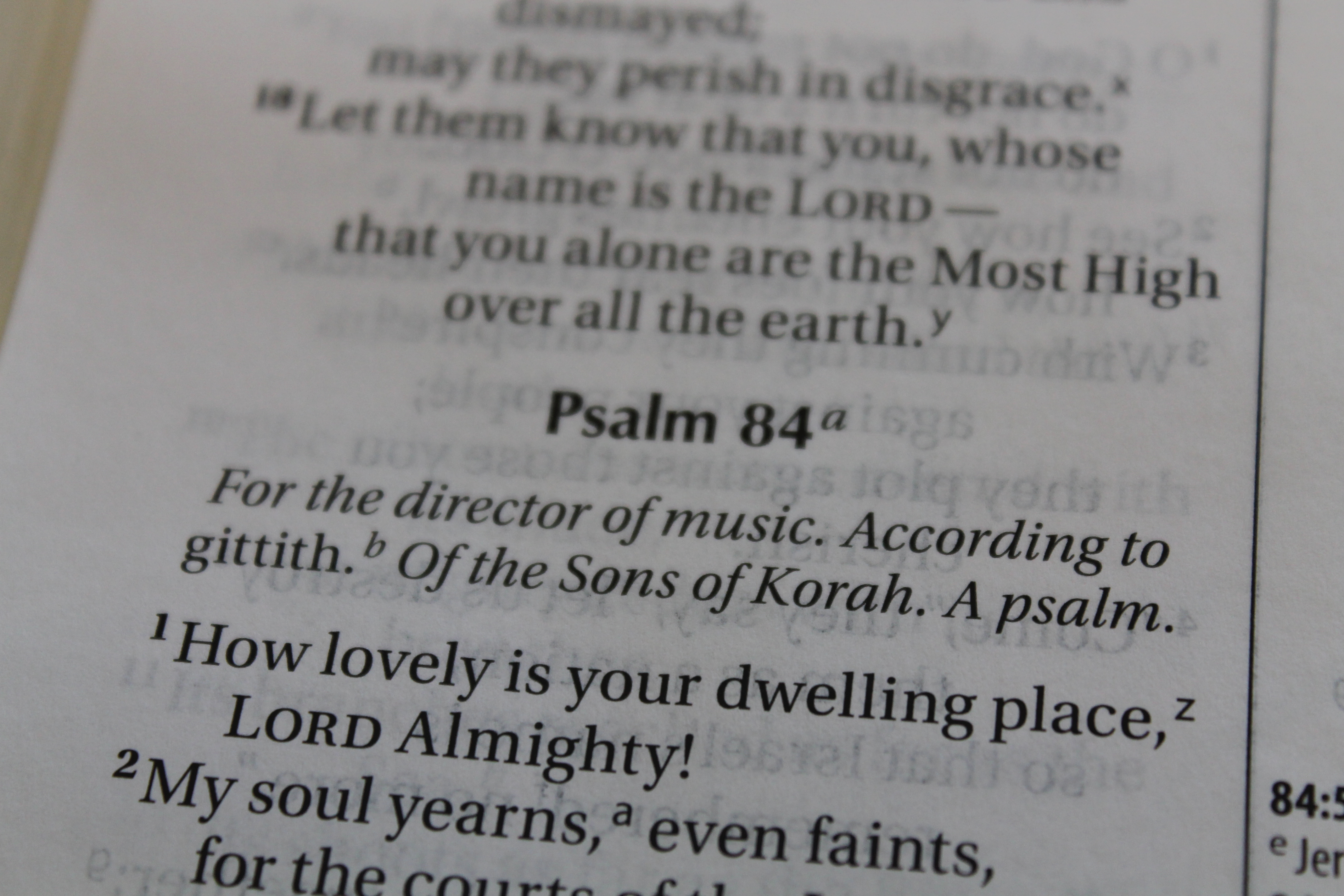


84:0. Most Bibles will some kind of heading before diving into the poetic words. It would seem that the heading provided more information for the original audience, more specifically for the choirmaster or director, but for the modern-day audience it feels like it provides less information and more confusion. The heading says, “According to the gitteth.” The scholar’s best bet is that the gitteth is some kind of tune or instrument, but that’s all we know. Some commentators have suggested the word come from root meaning “winepress,” hinting that the tune might be one familiar around the fall harvest, but that’s more of a guess and less of a hypothesis. The heading also states that this psalm is “of the sons of Korah.” The “of” here more likely means “belonging to” or “performed by,” and less likely means “wrote by.” Even if it did mean that, no one could pinpoint a certain Korahite that wrote. Therefore, the author is unknown, and this commentary will refer to the author as “the psalmist.” On a similar note, no one knows the date the psalm was written. As you imagine, this heavily affects the interpretation. If you believe this psalm was written in the time of David or earlier, the dwelling place refers to the tabernacle. If you believe this psalm was written in the time of Solomon or after, the dwelling place is the temple. Each side has its own reasons, but we really can’t be sure. Both the tabernacle and temple had courtyards. Yes, Psalm 84 does later on use the word Zion, but we have to remember we are dealing with a psalm, which loves using figures of speech. “Zion” could simply be a figure of speech for meeting God. After all, Abraham met with God on Zion. In this commentary, I will simply refer to it as “the dwelling place.”

 
84:1. In the opening verse of Psalm 84, the psalmist blurts out how he admires the beauty of Yahweh’s dwelling place. This will be the theme for the first stanza of Psalm 84. In the opening, the psalmist literally calls Yahweh “the Yahweh of hosts,” as most literal English translations follow. The title for Yahweh hints at this idea that Yahweh has invited the worshipper and is hosting the worshipper.

84:2. Awestruck by the beauty of Yahweh’s dwelling place, the psalmist expresses that his whole self, both the material and immaterial, desires to dwell with Yahweh in his dwelling place. Both the verbs “long” and “faints” demonstrate an intense desire, even to the point the soul exhausts itself to fainting. The phrase “cries out” (one word in Hebrew) better translates into “sing for joy,” as most literal translations do translate it. When coupled with the word “faint,” however, the phrase adds a layer of sorrow. Together, they paint a picture of a worshipper, so overjoyed about dwelling in the presence of the Lord, and when the worshipper does not stand in the Lord’s presence, he or she suffers in pain. Rob Lacey depicts in perfectly in his paraphrased version of the Bible, The Word on the Street, where he writes, “Your place is best, God; I’m gasping for it, almost collapsing for it, God; My skin, my soul, the whole of me screams for more of you, vibrant one.” The synonymous parallelism in verse 2 demonstrates that at the heart of the psalmist longing for the Lord’s dwelling space is the longing for the Lord Himself. Whereas most Psalms, like Psalm 138, focus on the building itself, Psalm 84 focuses on the worshipper meeting God in that place. What the psalmist finds most amazing, awesome and beautiful about God’s dwelling place is that God dwells in it.


84:3. The psalmist then appeals to nature, in the form of a synonymous parallelism, as proof to justify his feelings. Both the sparrow and swallows are birds found aplenty in Israel. Here, “altar” is a metonym for Yahweh’s dwelling place. I can imagine that, as the psalmist wrote Psalm 84, he noticed a bird, like a sparrow or swallow make its nest nearby (or even on!) the temple. He must have thought to himself, “Hmm, even that bird knows how important it is to be close to the Lord. Should I not be the same way?” For whatever reason that bird put its nest there, the human can learn a lot from it. Perhaps the bird built its home because it felt safe there. If so, the human can learn he or she lives safely in the presence of the Lord. Maybe the bird nested there because the bird knew all it needed was nearby. In the same way, the human can learn that he or she will have all that he or she needs in the presence of the Lord. The author of Psalm 84 closes out verse 3 by calling Yahweh his king and his God. The audience should not take this as a redundancy. By calling Yahweh King, the author submits to Yahweh’s reign. By calling Yahweh God, the author acknowledges only Yahweh is worthy of worship.

84:4. The psalmist closes out his first stanza with a synthetic parallelism. He concludes that those who stand in the dwelling place of God receive a special blessing by just being there just because God is there. The psalmist goes on to explain that that the natural reaction of such emotions would cause the person standing in the presence of God to praise and worship him. The worshipper praises the Lord because he or she realizes how much privilege he or she has for standing in the presence of the Lord. The people the psalmist refers to in Psalm 84:4 most likely refer specifically to the priests and Levites, but it in general encourages the reader to seek to live in the presence of God just as much as the priests and Levites.


84:5. Now the psalmist has expressed his love for Yahweh’s dwelling place, the psalmist moves to describe a pilgrim’s journey getting there. In the second stanza, the psalmist wants to make it clear to his audience that blessing does not solely come from dwelling with Yahweh, but blessing can also come from the journey to Yahweh’s dwelling. Therefore, in the second stanza of Psalm 84, the psalmist describes a pilgrim on a pilgrimage to dwell in Yahweh’s dwelling place. The psalmist opens the stanza with a synthetic parallelism, granting pilgrims a blessing of strength. That blessing of strength cannot come from anyone or anywhere buy the Lord. Only those who had their hearts set on worshipping the Lord in his dwelling place would solely rely and trust on the Lord’s strength and power to get them there.

84:6. The Valley of Baka may have been a place all pilgrims would have taken to the tabernacle or temple. The context clues in verse 6 alone already hint that the Valley of Baca is a dry and arid desert. In Psalm 84:6, the psalmist paints a picture that as the pilgrim marches through the Valley of Baca, springs of water come forth, as well as pools, as a result of early rains, which, in the Hebrew seasons, is early autumn. The psalmist depicts a place going from a dry and arid desert to an oasis full of vegetation. Once again, the psalmist illustrates to the readers that the pilgrim receives such blessings because the Lord is with the pilgrim. Once again, the psalmist makes it abundantly clear that the Lord and his blessings do not have to stay confined to his dwelling place. God can dwell with his people anywhere and bless them, even in places where it may seem blessing cannot happen.

84:7. The first cola of Psalm 84:7 has caused some confusion, as the phrase “go from strength to strength” only appears here in the entire Old Testament. Some commentators have proposed it means they get stronger as time goes by, while other scholars suggest it means they travel from refuge to refuge. The latter seems to make more sense in context, especially in light of Psalm 84:6. Psalm 84:7 explicitly explains what the psalmist is trying to illustrate in Psalm 84:6. The pilgrim relies on bits and pieces of Yahweh’s strength from place to place, until the pilgrim reaches his final destination. Not a single worshipper will fall out of God’s sight or man. The Lord will make sure each and every worshipper appears before God in Zion.

84:8. The psalmist closes out his second stanza, using a synonymous parallelism. The psalmist petitions Yahweh that what he described in Psalm 84:5-8 may be so, that the pilgrim will be rewarded with blessings of provision and safety as he makes his way to Yahweh’ dwelling. The psalmist may also feel led to pray that, now that he or she has made such a journey to worship, God will indeed receive the worship as an acceptable offering.

 84:9. The closing stanza wraps up Psalm 84. First, in verse 9, the psalmist reminds Yahweh of his relationship with His people. That’s why the psalmist can use with confidence the plural possessive pronoun. Yahweh’s shield is our shield because Yahweh and his people are now in covenant.


84:10. Second, in verse 10, the psalmist re-iterates his love for the Lord’s dwelling. The psalmist states that a day in the courts of Yahweh is better than a thousand elsewhere. Interesting enough, the Hebrew text does not have the word “elsewhere.” Honestly, most English translations add the word “elsewhere,” with the exception of the King James Version, which leaves it out. Most scholars deem the addition necessary, for without the addition, it would sound like the psalmist says that one day in the Lord’s courts is better than one thousand days in God’s house. Some commentators, however, have suggested the psalmist might have attempted to convey another truth. If given the choice of a one-day life in the Lord’s courts or a thousand-day life outside God’s house, the psalmist would choose the one-day life, knowing he spent it in the presence of Yahweh. Either way, the second bicolon in verse 10 reaffirm the psalmist’s love for the Lord’s dwelling. If given the choice, the worshipper would rather sit at the threshold, or door, at Yahweh’s house than dwell among the tents of the wicked. Being close to the presence of God is better than no presence at all. Being the most humbled at the house of God is better than being the exalted among the wicked. While the wicked may have possessions, God is the source of all those possessions, as so much more. The singers, the Korahites, would have understood this metaphor the best. Their ancestor, Korah dwelled in the house of wicked men, as seen in Numbers 16:26. The Lord truly redeemed them. He pulled them out of that situation and gave them the role of serving as the doorkeeper to the temple (see 1 Chron. 9:19; 26:12–19)


84:11,12. Third, the psalmist assures himself that God has heard and answered his prayer, that God will bless those who make a pilgrimage to God’s dwelling place. The psalmist remembers that the Lord, in his very nature, wants to protect and provide. Therefore, the psalmist calls the Lord both a sun and a shield, adding to the title given in verse 9. In fact, this is the only time in the Bible the Lord is directly called a sun. Then the psalmist reminds himself that God delights in giving good things to those who done good things. If in the goodness of a person’s heart that person desires to worship God in his dwelling place, then God will bless that person with what the person needs to get there.

Illustrating Psalm 84

After reading Psalm 84, only 1 question, consisting of 2 simple words, comes to mind: "What happened?" How did we go from Psalm 84, about a person who loves the dwelling place of God so much that when he is away from it, his body and soul are hurting, to today? If you were to ask a lot of pastors today what the biggest sign is that society is becoming more secular and less friendly to Christians is, it's not something that's happening in the government, it's not something that's happening in politics, it would be that more and more children sports games are happening on Sunday mornings. And the worst part is that it's sneaking into the church. Parents will take their children to their sports games, not even blinking an eye, not even pausing to think if skipping church for the sports game is wrong or what the right decision is. It's so bad that pastors can't even feel like they can bring this concern up to their congregation. They're afraid they'll be tagged as judgmental or selfishly greedy about the tithe money or their popularity if they try to convict their congregation that is wrong to skip church for sports games. How did we get to this point?

I've studied church history and I've studied ecclesiology (that is, theology of the church) and through the study of both, I've noticed there's a lot of what I like to call "pendulum swings" in church history and church movements. The importance and significance of church is one of them. Earlier in modern church history, believe it or not, we did believe that going to church was necessary for salvation. Our thinking went somewhere along the lines of this: Real, true, good Christians go to church every Sunday. Therefore, if you do not go to church every Sunday, you're not a real Christian, you're not a true Christian, you're not a good Christian. One of the strengths of this view is that, by golly, it got people to show up for church. Your life depended on it. As you can imagine, though, it also quickly led to some very negative drawbacks. People literally thought that because they were sitting in the church pew for an hour a week, they were born again Christians, saved from hell, on the road to heaven. Heck, you even had non-Christians showing up once a week for an hour of church, just so they could tell their Christian parents that they were going to church, and their Christian parents could believe that they were good, real, true Christians, just because they were attending church. Made it a little less tense at the next family get together. Even if some people did not literally think in their minds that going to church saved you, some people would still subconsciously act like it did. In the season finale of season 3 of the hit sitcom Big Bang Theory, Sheldon Cooper meets his girlfriend Amy Farrah Fowler for the first time. Their first conversation consists of this bit of dialogue-


Amy Farrah Fowler: In any case, I'm here because my mother and I have agreed that I will date at least once a year.
Sheldon Cooper: Interesting. My mother and I have the same agreement about church.
Amy Farrah Fowler: I don't object to the concept of a deity, but I'm baffled by the notion of one that takes attendance.
Sheldon Cooper: Well then, you might want to avoid East Texas.

Well, Amy Farrah Fowler, I, too, am baffled by the notion of a God that takes attendance. But when you believe that going to church is a part of your salvation, you also believe God takes attendance. Then, you start acting like it, some more literally than others. When I was studying my undergrad at Lancaster Bible College, I was required to attend chapel three times a week. To prove that I was actually there in chapel, I had to scan my school ID badge before entering. I had another friend who went to a different Bible college. They too had mandatory chapel three days a week, but unlike Lancaster Bible College, they didn't have the technology to scan in, so they literally had to sign in for chapel. Yeah, obviously church is not like this. I don't have to scan in or sign into church, yet we still sometimes act like it. It's like we expect one day for Jesus to return in bodily form at our church, and the first thing he's going to do is start taking roll call. It's like we expect that when we appear before God, whether that be before the great white throne or the bema seat, we expect God to bring up our church attendance. We fear he may say something along the lines of, "You only came to church about 67% of the time? Geez, you know that 67% is a failing grade in some places. This is really going to hurt your participation points." Once again, this is all a side effect of believing that your salvation is affected by your attendance at church. And it wouldn't surprise me if some Christians today still think or act this way.

So a lot of pastors got the message out that going to church did not make you a born-again Christian, and it did not save you from the fires of hell. They emphasize that each and every person must make a personal committed relationship with Jesus Christ. That's what saved you from your sin, death and hell, and that's what put you on the path to heaven. After salvation, they emphasized a personal devotion time with God, consisting of private Bible reading and private prayer, to live out salvation. This all cause the church pendulum to swing in the opposite direction. The evangelical church has a theological term for this: reductionism. What is reductionism? If you haven't caught on yet, you'll notice what I just described emphasizes individualism: individual salvation, individual relationship with God, individual Bible reading and individual prayer. Reductionism is when the Christian faith is reduced down to these three concepts: individualize salvation through an individual relationship with Jesus, individualized Bible reading and individualized prayer. 

 Now, believe it or not, reductionism does have its strengths. As crazy as this sounds, earlier in church history, you would've been told that you cannot have a meaningful spiritual experience with God outside of church. Reductionism reminded us that you can indeed have a meaningful spiritual experience with God, even if you are alone, even if you're by yourself, even if you're out in the middle of nowhere. We go doubt that Moses had meaningful spiritual experiences with God on Mount Sinai (or Elijah for that matter in 1 Kings 19), nor do we doubt Jesus had meaningful spiritual experiences with God when he went alone to pray to his Father. But as you can imagine, this has some negative drawbacks as well. Think about it. If you individualize everything about the faith, good luck convincing anyone to do anything corporate. Therefore, the evangelical church is having the hardest time convincing people to come to church. If everything about the faith of individualized, and salvation is not dependent on church, then why bother to go? The best thing the evangelical church can do to get people into church is to convince them that the church is a service, not for God, but for you. The church is there to make sure you are spiritually healthy and spiritually fit. Just like you go to the doctor when you're sick, or you go to the mechanic to get your car fixed, the church is there to serve you, so when you get spiritually unhealthy, the church can make you spiritually healthy again, and when you're spiritually broken, the church can spiritually fix you. This view can only do so much. Let's stick with our metaphor of the doctor and the auto mechanic. You've probably been in this position before. You went to your doctor to get in your annual physical. The doctor does some tests. At the end, the doctor says, "Yeah, you're healthy. That'll be $25” (and that's assuming you have good health insurance). Similarly, you didn't do your auto mechanic to get the car inspected. Your mechanic runs a few tests. At the end, the car mechanic reports to you, "Your car is running just fine. That will be $88." In both instances, you're thinking to yourself, "Gee, I could have told them that for cheaper than what they are charging!" Well, that's how a lot of people feel about the church. If they feel like they're spiritually healthy, they see no need to go to a place that will either verify that they are spiritually healthy or disagree with them, telling them their spiritually unhealthy, and all at a price of a 10% tithe!

To sum up reductionism, I would like to quote D.G. Hart, a leader in the evangelical church, who is struggling alongside the evangelical church to decide the importance and significance of the church. D.G. Hart is quoting saying, "If, as the evangelicals believe, the most important aspect of Christianity is a personal friendship with God through private Bible reading and prayer, then who needs the ministry of the church?" And that's exactly what reductionism has done to the church. It’s left everyone questioning, “Why do I need the church?” and it has no answers.

Applying Psalm 84

At this point, I imagine you too have some questions you want answered. You might be wondering, “How can we avoid this pendulum swing? How can we get the pendulum to stop right in the middle, a balance between public, corporate church and private, individualized church, a balance between needing church for salvation and church being an optional, only desired when wanting a spiritual tune-up? What can we do?” Would I sound blasphemous or heretical if I suggested that there is nothing that we can do?

I italicized do because I want to do draw emphasis to that word. When we say we want to do something, we mean we want to act, but I think acting and doing in this case can actually be a roadblock. I assume that many of you reading this have been born again Christians for years. You know what to do. In fact, I wouldn't be surprised if you're already doing them. Even if you don't know what to do or how to act, there are tons of books and websites out there that will exhaustively list all the spiritual disciplines you can practice and how to practice them. They would do a better job than I could here and now, so anything I attempted would be redundant. Doing and acting also can be a roadblock because not all applications have to involve activity. Application can be passive, just simply be. Of course, the natural question to follow is, “How do you passively just be?” and then my temptation would be to give you a list of dos, which would be counterproductive. Trust me, I know there’s a very thin line between doing and being.

One of my pet peeves is when people start categorizing Bible verses into doctrine verses and application verses. I actually believe all the Bible is application. It's just a matter of how to apply it. That falls into 3 categories. The first category you're most familiar with as application. It is known by the theological term of orthopraxis. This theological term comes from the Greek language. The Greek prefix ortho most literally means “straight,” “upright,” “right,” or “correct,” but it also carries a connotation of “sameness,” “like-minded,” “agreement” and “consensus.” Don’t get me wrong. This does not mean “This is the right truth because we all agree on it.” Rather, it means quite the opposite. It means, “We all need to come a like-minded consensus on this truth because it is the right truth.” Once again, we already see that true Biblical application is just as much about community as it is about truth. The Greek verb praxis means “to do” or “to act” (this is where we get the English word “practice”). Therefore, the goal of orthopraxis is to get everyone to act correctly that is, acting in a godly, Christ-like manner. This is what we think of most often when we think of application, but it’s not the only application. Another application you might think of is orthodoxy. The doxy orthodoxy means “thinking.” Therefore, the goal of orthodoxy is to get everyone to think correctly, that is, thinking in a godly, Christ-like manner. I sometime call this “checking off on your doctrinal statement.” Again, a common application, but there’s still one more. The last application is orthopathy. The goal of orthopathy is to get everyone to feel correctly, that is, feeling in a godly, Christ-like manner. I believe that’s where Psalm 84 falls.

Psalm 84 isn't commanding you to do anything or act in a certain way. As stated above, you're probably already doing enough, and if not, there's plenty of other Bible verses that can teach you what to do. Psalm 84 isn't instructing you to think a certain. Psalm 84 states the truths matter-of-factly, like it's common sense. The purpose of Psalm 84 is to get you to honestly and sincerely ask yourself, “Do I have a heart to dwell in the presence of God just as psalmist in Psalm 84?” If not, then Psalm 84 motivates you to make your heart match the heart of the psalmist in Psalm 84. So does your heart match the psalmist in Psalm 84? Do you have a heart to dwell in the presence of God? Do you desire the presence of God in your life above everything else, so much so that it hurts to be apart from God’s presence? Would you go any distance just to be in God’s dwelling place? I hate to be this blunt, but if you answered no to any of those rhetorical questions, there's something wrong with you.

I know the 2 most common objections that will come up right now, and to be honest, you could target right back at me. The first and foremost object has you thinking along the lines of, “But Graham, some people just have to work on Sunday mornings to stay alive and provide a living for their family. Heck, weren’t you even working a Sunday morning job at one point?” Indeed, I was at one point in my life working every other Sunday just so I could move out of my parents’ home and move closer to my then-fiancée now-wife Carrie. (But to be fair to me, in my defense, my boss told me at my interview that Sunday mornings were voluntary. He failed to inform me that if no one volunteered, I have to work every other Sunday. If I would have known that, I probably wouldn't have taken the job.) So yes, I do understand that some people just have to work on Sunday mornings to stay alive and support their family, I get it. Heck, I would even go as far as to say that if a person worked 10 hours a day, 6 days a week, and that person slept in on Sunday mornings because it is their only day to sleep in, I understand that, too. After all, the Sabbath is to be a day of rest. I could easily accuse those who work of Sunday morning of not having enough faith to trust God to provide a job that doesn't interfere with Sunday morning worship, but a feel that’s a cop-out. What if the Lord did provide that job, in order that the person may in turn provide for his family? What if that person’s act of worship is providing a godly, Christ-like work ethic to his boss (I can relate to that)? Furthermore, I don't like that accusation because I once again feel like that's focusing too much on the do. Psalm 84 brings up questions of feeling. How do you feel about working on Sunday? For me, I hated and dreaded it! I wanted to be at church, not at work. Once the boss dismissed me, I would race to church (I will not mention how much over the speed limit I was going) hoping to catch some church, even if it was the benediction. When I no longer had to work on Sundays, I felt a joy swell up in my heart, not because I had full weekend off now, but because I could now go to church every Sunday morning to worship my Lord and King. If don’t go to church out of necessity, but your heart hates or dislikes it, then your heart is in the right place.

If you don’t go to church out of necessity, but your heart doesn’t mind it, likes it or enjoys it, I might question your heart. I will wonder and be worried that you might end up like one of Bible quizzing friends. When I was a Bible quizzer, I quizzed with this one quizzing girl. This certain girl I came to know as a sister in Christ who was really seeking God. She wanted to know all the spiritual disciplines, and she wanted to practice each and every one of them. She knew all different ways to read the Bible, and she knew all types of prayers. She practiced everything from evangelism and discipline to fasting and retreats of silence and solitude. So many Christians looked up to her for spiritual discernment. Shortly after graduating high school, she started seeking work, so she could move out of her parents’ home. The first job she found was for the local grocery store. They wanted her to work Saturday and Sunday mornings. At first, she was appalled. She had grown up going to church every Sunday as a child. Soon, though, she quickly justified skipping church work, using the extreme sides of the pendulum swing I just mentioned. She told herself that going to church doesn’t bring about salvation, so she was still a born again Christian, even though she did not attend church. She told herself that she could individually practice her faith, through private Bible reading and private prayer. Just before she took this job, we talked about it over Facebook chat. I tried to remind her of the pros and cons, but she seemed set on taking this job. I offered her my prayers, and that’s where the conversation ended. We pretty much stopped communicating after that (which might be just coincidence), but Facebook kept me updated on her, and I started noticing changes. She started smoking. She started drinking. She started cursing. She got a tattoo. Now, she’s a single mother. Now, although she no longer has that Sunday morning job, she no longer attends any church because she doesn’t like any church.

I know we could debate on whether those things I just listed are sins or not, and I’d be more than glad to have a conversation about the purpose of God giving people laws and commands (that’s for another time). What I’m trying to illustrate is that I noticed a girl go from very godly, very spiritual and very counter-cultural, to a girl who is very cultural and very worldly. I don’t want to oversimplify it, but I can only see one common denominator: she ceased going to church. Christians can no longer fool themselves into thinking they can practice the faith alone. We turn into the people around us, in one way or another. I’ll admit that one of the reasons I avoid sin is because I know that if I sin, you might stop listening to me for Biblical insight, and you might be the least judgmental person in the world! As a church, we equip, edify and encourage one another to live out godly, Christian lives. This alone is a good reason why Christians should develop hearts that desire church.

The second objection goes something along the lines of this: “But Graham, the Sabbath isn’t meant solely for worship. It’s also meant to be a day of rest. You yourself even admitted earlier that you understand if a person working 10 hours a day, 6 days a week would want to sleep in on a Sunday morning. Heck, I’ve seen you on Sunday mornings during the fall. You dart out of the church, so you can make the 1 o’clock kickoff of the football game!” Indeed, I did say that I understand a person working 10 hours a day, 6 days a week wanting to sleep in on Sunday mornings. But once again, I ask you, “Where is your heart?” If you are sleeping in on a Sunday morning to get the rest you to be a godly witness to your boss, supervisor and co-workers for the rest of the week, I get it. But if you sleep on Sunday mornings for church, but you get up early on Sunday mornings to leave for your week-long beach vacation or to grab your coffee at Starbucks before you go on a morning, then there’s a heart issue. That’s what Psalm 84 is asking us to do. Psalm 84 encourages us to honestly and sincerely ask ourselves, “Where is my heart?” and to fix it if it needs fixing.

So yes, I will confess that I do want to make the 1 o’clock football kickoff, but I know where my heart is. One time, my wife Carrie offered to buy me tickets to a 1 o’clock Philadelphia Eagles football game. I looked at her sadly and said, “But then I’ll miss church.” One time, my wife Carrie and I were planning to attend Philadelphia Eagles training camp. When I found out the only days left were Sunday mornings, I immediately cancelled those plans because I did not want to miss church. Once, Carrie and I went down to Virginia Beach for the weekend. She asked me what the one thing I wanted to do was. Of course, I told her I wanted to go to church! I can look deep inside my heart and honestly answer that I put church before football. Can you look into your heart and sincerely say that you put church before everything else?

In the commentary Opening Up the Psalms, pastor Roger Ellsworth tells this story: “One of my fellow-pastors had a church member who refused to attend church because he claimed to be unable to sit on a pew for any length of time. But one day this pastor passed by the pool hall and noticed this gentleman sitting there. Three hours later the pastor went by the pool hall again and noticed the man sitting in the same place. The pastor, thinking the pool hall must have had some very comfortable seats, went inside. The only seats he found were old, unpadded church pews!”

I’ve heard it once said, “There is no such thing as ‘busy.’ There are only priorities.” Think about it. When you say, “I’m busy,” you’re really saying, “There is something else of higher priority I must do instead, which will not allow me to do what you just asked.” We should never be busy for God or his dwelling in our lives. God and his dwelling place should be our highest priority.

Concluding Psalm 84

I get. Sometimes the struggle to desire God and his dwelling place is because we don’t have a God that we can visually see or audibly hear. That’s why we can spends hours with family or friends, yet a half hour, even a quarter hour, with God can seem like a struggle. If you do struggle with that, read the book of Revelation. To borrow the words of the Apostle Paul, right now, when we dwell in the presence of God, it is looking into a poor reflection of a dimly lit mirror. One day, though, we will dwell with God, face-to-face. Remember practicing the presence of God is just that. It’s practice for the day when we will walk with God and talk with God side-by-side, right to his face. May that thought fuel the fire of desiring God’s presence in your place of worship.

Thursday, May 11, 2017

You know you go to a conservative Bible College when...

Since I received some positive feedback from my last post (and when I say "positive feedback, I mean I got likes on Facebook), and since I will be graduating from Evangelical Seminary on Friday and my 6 year anniversary of graduating from Lancaster Bible College will happen on Saturday, I thought I would post this. This was a list I progressively created as I went through my 4 years of undergrad at Lancaster Bible College. As I shared my list in a Facebook group, I learned a lot of students from other Bible colleges could easily relate. Some even posted their own in the Facebook group. Although I wasn't on Evangelical Seminary campus a whole lot (the downfall of commuting from an hour and a half away), I could image some of these might be true for seminaries as well. So without further ado-

You know you go to a conservative Bible College when...

...Bible verses are used to defend everything from not using your cell phone in the library to proper use of washers and dryers in the laundry room.
...putting your hand on the back of your boyfriend/girlfriend is not ok, but putting your hand on the back of the chair he/she is sitting on is ok. ('cause that piece of wood/plastic makes all the difference)
...the student handbook goes into great detail about what forms of public displays of affection are allowed and not allowed, all the way down to linking arms
...you hear other Christian colleges are going "liberal" because they are allowed to watch R rated movies, play M rated videogames, allow couples to kiss in public, and have no curfew.
...93% of the college is Republican, and if you're part of the 7% that isn't, your faith is in question.
...every chapel opens with contemporary praise and worship music, and hymns are only used once a month to please the traditional church students.
...the biggest debate on campus is Calvinism vs. Arminianism (and you know both sides).
...you know that the term "Bedside Baptist," "Pillow Presbyterian" and "Mattress Mennonite" refers to sleeping in on Sunday morning instead of going to church, which is required on the honor system.
...your Sunday afternoons consist of your friends getting together and criticizing the church, especially the pastor, you visited that morning for church.
...you have heard a speaker reference the Hebrew/Greek word and its definition once in a speech or sermon, and maybe you've used it once or twice yourself
...your "gen ed" course for your 4 years there consist of 1 English course, 1 Literature course, 1 Math course, and 1 Science course. That's it.
...students describe the dating scene on campus by replacing the word "BIBLE" with the word "BRIDAL" in the school name, making it "BRIDAL college"
...going on a walk to the nearest gas station convenience store with someone from the opposite gender is considered a legitimate date.
...you know the "4 year plan" means you're friends your freshman year, dating your sophomore year, engaged your junior year and married your senior year (with kids after graduation)
...the "Senior Panic" refers to the belief that if you graduate college single, you will be single for the rest of your life. Symptoms among men include going from dorm room to dorm room, asking woman out. Symptoms among women include random bursts of crying over not having a wedding or not having children.
...single people joke at graduation they should get a partial refund for still being single
...the sports teams for the college have required devotions, and not going is penalized with a fine
...you name your bed "The Word" so when people ask you if you're been doing your daily morning devotions, and you have just been sleeping in, you can honestly say, "I spend my morning chilling in the Word" and not feel about yourself.
...having holes in your pants is considered "immodest" dress
...you know where the local Buddhist temple, JW Kingdom Hall, and Muslim mosque are located, just because you had to go there for some apologetics or evangelism project.
...the Bible colleges chooses October 20 to wear pink for Breast Cancer Awareness Month, in order to prevent anyone from wearing purple for Gay and Lesbian Awareness Day
...people spend the last couple weeks of fall semester, reminding you to keep Christ in Christmas during the winter break

Wednesday, May 10, 2017

The 4 People You Meet in Bible College and Seminary

In a couple of days, I will graduate from Evangelical Seminary with my Masters in Divinity. My degree will be the product of a very process, a process, in all honesty, I can't exactly pinpoint to where it began. Did I begin when I began attending Evangelical Seminary in the fall of 2013? But I transferred to Evangelical Seminary in fall 2013, and I only did 3/5 of the work there. Did it begin when I began Lancaster Bible College's Graduate school in the summer of 2011, and I began in the Masters of Bible program? But some of those credits rolled over from my 4 years at Lancaster Bible College in undergrad. Then did it begin when I began attending Lancaster Bible College in fall 2007? Needless to say, it's easy to blur the lines. The blurriest of lines comes between spring and summer 2011. The week before undergrad graduation, I was already accepted into Lancaster Bible College's Graduate School, I had already chosen Master in Bible as my program, and I had even selected my first class, Apologetics. The week after undergrad graduation, I had already received my syllabus for Apologetics class, which instructed to me read all the textbooks and write reviews on them. I had no rest after graduation. Indeed, I have saturated myself in the world of Bible college and seminary for the past 10 years. In those 10 years, I've noticed a lot of commonalities among the people I've met in both Bible college and seminary. In fact, I propose that it doesn't mater what Bible college or seminary you go to, it doesn't matter if it's an undergrad student or a grad student, you will meet 4 people (or rather, 4 different types of people, or 4 personalities) in Bible college and seminary. I've also noticed that certain people, certain types of people, certain personalities tend to typically fall under the same year they are in the program. So let me explain to you the 4 people you meet in Bible college and seminary. Each person(ality) will be broken down into two parts: the "expectation," meaning what you expect the person to be like (in which I will use a narrative description), and the "reality," meaning the reality check that person has to come to in order to move on to the next level (in which I will put in quotes the thoughts the person has to deal with before moving on).

THE FRESHMAN - THE SPIRITUALIST

Expectation: The spiritualist goes in Bible college or seminary, expecting it to be youth group for young adults. The spiritualist expects to walk into a classroom where the chairs are all in a circle facing each other, and maybe desks or tables in the circle, as long they don't interfere with the communication between the community of believers there. The spiritualist expects the teacher to walk in with a Bible passage in mind for the day's topic of discussion. The professor will read the Bible verse aloud, and the students will go around the circle, sharing how the passage makes them feel. The spiritualist excepts the class to end with the professor pulling out his acoustic guitar to lead the class in a feel-good contemporary praise and worship song, or the like, such as kumbaya.

Reality: "Ok, I guess it's cool to we are reading the whole book of the Bible, but do I seriously need to know how all the verses and chapters work together?...What do you mean that I have to know who the human author was and what he was like? God is the author!...What do you mean I have to know the original intended audience, I need to know the culture they lived in? I thought It was the original, intended audience!...Why do I need to know when it took place in history? Biblical truths are timeless!...Why do I need to know how the early church fathers interpreted the passage? That's so old fashion!...Why do I need to know what modern-day scholarship revealed about the passage? I thought the Holy Spirit was enough!...Man, this is going to take a lot of work, more than I expected!"

THE SOPHOMORE - THE KNOW-IT-ALL

Expectation: The sophomore has put behind his foolish thoughts that Bible study is all about good feelings from the Holy Spirit, but he has swung the pendulum to the other extreme. The sophomore has become the Know-It-All. The Know-It-All does indeed feel like he knows it all. He's memorized tons of verses, even some whole chapters! If he doesn't have a whole book memorized, he can at least give you a pretty descriptive summary, not just of the text, but also the themes. The Know-It-All just doesn't know what's in the Bible, the Know-It-All knows what's behind the text with all that introductory material. He knows the about the human author and what he was like. He know about the original, intended audience, and he knows what it was like to live in their culture. He knows when the story happened in history, and how the history impacted the book of the Bible. He can outline any book and any chapter. He can even read it in its original language. The Know-It-All can tell you about how the church has interpreted the passage, from the early church, to the medieval church, to the Reformation church, to the modern-day church. The Know-It-All just doesn't know about the Bible, the Know-It-All knows all about systematic theology. The Know-It-All can defend any theology he believes in, knowing every time his theology appears in the Bible. Heck, the Know-It-All can defend his opponent's theology better than the opponent can defend his own theology. If anything, this is the guy you want on your team for Bible Quizzing or Bible trivia game night. But beware, don't dare say the wrong thing in Sunday School!

Reality: "What do you mean I have to filter what I choose to say? It's all important, therefore, they need to hear it all, even if it's an hour long sermon!...What do you mean I have to apply it? Knowing it is my application!...What do you mean I have to communicate to my congregation the importance and relevance of the passage, and all the facts that go with it? It should be obvious to them!...What do you mean that some people don't care about the background information or church history's interpretation? If they really loved God and His Word, they should care! If only they loved God's Word as much as me, then they would care. I will make them care!"

THE JUNIOR - THE CHURCH FIXER-UPPER

Expectation: The junior finally admits he or she is not in Bible college or seminary to pass a heavenly SAT consisting of matching, multiple choice, true-or-false and essays at the pearly gates. All those facts and all that knowledge must be applied. Unfortunately, the junior only knows how to apply it in one way, and that turns the junior into the Church Fixer-Upper. After a long and hard week of learning Bible and theology at Bible College/Seminary, the Church Fixer-Upper enjoys going to church on Sunday, but not in the way you think. From the second the Church Fixer-Upper place his first step in the church, the Church Fixer-Upper immediately knows what's wrong it. The criticisms do not end. The Sunday School teachers are inadequately prepared. The worship leader is leading worship incorrectly. The pastor is preaching incorrectly. The congregation is not reacting correctly. The ushers are not handing out the offering plate correctly. Heck, even the church's architecture is not built in a God-honoring way. The list goes on and on! Of course, the Church Fixer-Upper has all the answers. The rest of the church just needs to listen to the Church Fixer-Upper. The Church Fixer-Upper will become very vocal all aspects of church, quickly correct those who disagree with him or her on the spot. Frustration mount between the Church Fixer-Upper and the church...on both sides equally. Eventually, when the Church Fixer-Upper feels like he or she cannot do anything more, the Church Fixer-Upper moves on to the next church, to find what it's doing wrong and how to correct. Sometimes the guilty pleasure of the Church Fixer-Upper is to never stay at a single church, but to visit a new church every Sunday, just to come back every Sunday afternoon and join friends over lunch to share criticism of the church. Overall, this practice gives the Church Fixer-Upper a negative view of church, with only the optimistic hope that Jesus will return soon and restore the church to what it should be, which is exactly how the Church Fixer-Upper imagined it.

Reality: "What do you mean I can't barge in and tell them how to fix things? I'm the one who went to Bible college/seminary, not them! They don't know what they are talking about!...What do you mean they have gotten something right? How can they, without a Bible/theology degree?!...Why can't I do everything myself? Do I really have to let other people help?...Can the church really be fine on its own without my help?...I guess I'm still learning, and I can learn from them, too"

THE SENIOR - THE WELL-ROUNDED MINISTER

Expectations: The senior is all 3 parts of the freshman, sophomore and junior, equally diverse yet united together as one. The senior recognizes the Bible as a spiritual book, not just a book of facts, but he will not succumb to good feelings and laziness toward the Holy Spirit. He will take the time to learn everything about the Bible he can, and he will not stop with knowledge, but he will continue to apply it until that knowledge becomes wisdom. The senior also recognizes that the applying does not simply mean fixing what he believes is wrong in the church. Applying Scriptures affects the self. Through applying Scriptures to the self, the senior learns that best way to encourage the church to change the negative within it is to demonstrate in his own life the Scriptures lived out.  I chose the title "minister," for lack of a better word. Most people think of the word "minister" interchangeable with the term "pastor," but I mean it in the truest sense of the word. A minister is someone who serves in a ministry. It doesn't mater if that ministry is as a pastor, chaplain, missionary, teacher, worship leader or any other kind of missionary, the well-roundedness of the senior will make them the perfect person to serve in that ministry.

Reality: "I know the Bible is a spiritual book, so I must listen to how the Holy Spirit is moving in my heart when I read it. But I also know it's an intellectual book. I cannot succumb to spiritual laziness toward the Holy Spirit. I must learn it more, so I can love God more. Still, I can learn as much as I want, but I can only love God so much by merely learning it. I will love God even more if I can apply it, too. Applying it starts with fixing myself internally. Once I fix myself internally, I can start fixing and restoring my relationship around me. Those loved ones around will witness that change, and they will want to change in the same way, too. Then I can equip and encourage them to change. Still, I need to learn from them as much as they learn from me. Only then I can be a true minister."

Congratulations to all of those graduating from Bible college and seminary this year. That diploma recognizes you as the well-rounded minister.

Sunday, January 22, 2017

Rethinking Samson


In 2016, Sight & Sound Theatre put on a production on the story of Samson. In case you didn’t see, but you still want to buy the DVD and watch it, I won’t spoil anything. (Well, I won’t spoil how they did it. You can spoil the story for yourself by reading Judges 13-16). All I will say is it was awesome, and it was excellent. As I grow older, I find myself appreciating Sight & Sight more and more. When I was a younger boy, I appreciated Sight & Sound because it held true to its motto. It really brought the Bible to life. Now I have gone from a young boy to a young man, who has gone through 4 years of Bible college and 7 years of seminary, I now appreciate Sight and Sound even more because it tells a good story, yet it does not sacrifice the Biblical or theological truths in order to do so.

Yes, I am that guy. I am that guy who sees the Bible portrayed on the big movie screen or the small television, and I’m the one yelling, “That’s not in the Bible! That’s not what the Bible says!” I do so for a few reasons, some more obvious for the others. First of all, when we see movies or television change the Bible story, we know that means that the screenwriter, the director or the produces questions the historical accuracy of the Bible, even possibly believing the Bible is all fiction. Second, to change the Bible story to make it more action-packed is really insulting to the Bible. Remember that back then is not like today, where every child goes to school to learn to read and write. Only the smartest kids (and sometimes the richest kids) got to go to school to learn to read and write. Therefore, reading and writing became a skilled trade. To them, reading and writing was both an art and a science. So when you read in Deuteronomy 6 God commanding the Israelites via Moses to teach their children the stories of the Israel, don’t put in your mind this mental image of the children all sitting around their father, while the father pulls out a scroll and begins the story (for even if the father could read, he probably couldn’t afford a scroll, which were expensive to make). No, the mental image you should put in your head is the children sitting around their father, listening to their father recite the stories from memory. So how do you make a story easy to remember? You make it exciting, you make it fun, you make it interesting. These Bible stories are meant to be exciting, fun and interesting already. To change it to make it even more exciting, fun and interesting is really insulting to the Bible, for you are claiming it isn’t. Third, as I said before, when the Bible story gets changes and rearranged, Biblical and theological truths get lost, or worse, the story teaches a lesson quite the opposite of what the Bible intended.

To be fair, movies and television aren’t the only one guilty of this. I will confess on behalf of preachers and teachers alike (because I will confess that eve I myself, as both a preacher and teacher, am guilty!) that sometimes Bible teachers and preachers can get so caught up in telling a Bible story, they forget to teach the Biblical truth about God, or worse, teach a lesson contrary to what the Bible teaches. I find this happens most often in the book of Judges, especially when it comes to the story of Samson. Today, I invite you to look again at the story of Samson, rethink the Bible intends the reader to learn from his story, and I promise you, you’ll find stronger applications for Samson than you ever have before.

Now if you know me, you know I’m really big into context. After all, my blog is called “The Contextual Literalist.” Historical, geographical and cultural context all play a big part in the book of Judges, but the biggest role goes to literary context. Literary context can be broken into three parts. First, there’s the immediate context, which asks, “How do the sentences/verses come together to form the story of the judge?” Second, there’s the near context, which asks, “How do the stories of the judges come together form the book of Judges?” Third, there’s the far context, which asks, “How does the book of Judges contribute to Bible and our theology about God?”

First, let’s explore that immediate context, or how the sentences/verses come together to form the story about the judge. Fortunately for the reader, the book of Judges comes with an outline for each story of each major judge. (The book of Judges has 12 judges: 6 major and 6 minor. The difference between a major judge and a minor judge is that a major judge has a whole story, whereas the minor judge has only 1 verse.) This outline can be found in Judges 2:11-18. Most Bible commentators refer to this as the “Judges Cycle,” for the outline repeats itself with every judge in a cyclical manner. This paradigm happens in 5 stages. First, Israel does evil in the eyes of the Lord, which is most often falling to the sin of idolatry. Second, the Lord hands punishes Israel for its sin, most often by allowing a foreign nation to invade Israel’s promised land and oppress Israel. Every time this happens, the book of Judges demonstrates how just are God is. Most often, the Lord hands the Israelites over to the foreign people whose idols Israel has begun worshipping. If the Israelites begin worshipping Baal, the god of the Canaanites, the Lord hands Israel over to the Canaanites. If the Israelites start worshipping Dagon, the god of the Philistines, God hands Israel over to the Philistines. It is as if God is saying, “If you worship their gods, then you will become like their people, and thus you will serve them. So if you begin to worship Baal, you will begin to act like the Canaanites, and so you will serve the Canaanites. If you start worshiping Dagon, you will start acting like Philistines, and thus you will serve the Philistines. Once Israel finally realizes how much distress their idol worship has put them under, Israel cries out to the Lord for help, which is the third stage of the cycle. Then, fourth, the Lord sends a שָׁפַט (šāpaṭ). Traditionally, this word has been translated “judge,” but modern-day scholarship believes that “deliverer” or “savior” would be a better translation. It makes if you think about. These people don’t make decisions about the laws of the land, like Judge Judy or Judge Joe Brown. These people save the Israelites by delivering them from the hand of their oppressive enemies. Since most people are more familiar with the tradition translation of “judge,” however, we will stick to that word. That judge would save Israel from its current enemy and deliver it from any future threat. As long as the judge lived, Israel experienced the fifth and final stage, shalom and Shabbat, or peace and rest. This would last all the way to judge’s death, when Israel would fall back into the sin of idolatry, and the cycle repeated.

Now that’s the immediate context, or how the sentences/verses come together to make the story. Next, let’s look at the near context, or how the stories come together to create the book of Judges. I’m going to teach a new way that you can read through the Old Testament history books. First, make a graph (I’m hoping math class didn’t scare you away from making graphs). The horizontal line (in math terms, this is the x-axis) represents the progression of the book. You can make marks for each one of the chapters, or you can just wing it. The vertical line (in math terms, this is the y-axis) represents Israel’s relationship with the Lord. On the top, put a happy smiley face, and on the bottom, put a sad frowny face. If Israel is seeking God’s will and obeying God’s commands (in essence, making God happy), we’ll mark it off at the top of the graph. If Israel is seeking their own will in front of God’s, and/or they are disobeying God’s commands (in essence, making God sad), we’ll mark them at the bottom of graph. We’ll only do this for the 6 major judges that fit the Judges cycle. By the time we get to Samson, you’ll notice a pattern, and you’ll be able to tell where Samson will end up.


The first judge we run into is Othniel, found in Judges 3:7-11. Othniel’s story is the shortest of the major judges, for his story fits the cycle perfectly. Israel begins worshipping the gods of the Mesopotamia, and so Israel soon finds themselves in bondage to the king of Mesopotamia. Israel cries out for help, and the Lord raises up Othniel to be their first judge. Othniel is supposed to remind you of Joshua, for many reasons. First, Othniel’s story comes first in the book of Judges, right next to the end of the book of Joshua. Second, Judges 3:9 informs the reader that Othniel is the nephew of Caleb. If you remember from the book of Numbers, Joshua and Caleb were the only 2 spies who gave a good report because they trusted God for victory against their enemies in the promised. Therefore, Othniel is very much like Joshua in the way he goes to war with the king of Mesopotamia. He trusts in the Lord, seeks the Lord’s will, gathers an army, faces the king of Mesopotamia and his army face-to-face, and with God’s power and presence, Othniel comes out victorious. Obviously, without a doubt, Othniel goes on the top of the graph, for he does everything right. He seeks God’s will, he obeys God’s commands, and God blesses him with the victory.


The second judge, Ehud, appears in the same chapter, Judges 3:11-20, and let me tell you, this story is meant to be funny!. This is the second shortest judge story because it follows the judges cycle for the most part, but not exactly the way one would expect, or hope. Israel starts worshipping the idols of Moabites, and the Lord allows Eglon, king of Moab, to oppress the Israelites. Not only does Eglon enslave the Israelites, he forces them to pay a tribute, or a tax. And guess who is responsible for delivering this tribute? It’s Ehud, the guy the Lord raises up to be the next judge! On a certain day, as Ehud wraps delivering the tribute, he speaks up, “Oh by the way, I have a דְּבַר־סֵתֶר  (seter devar) for you.” This phrase is a double entendre. The Hebrew word seter can mean “secret” or “hidden” (after all, a secret is hidden from public knowledge). The Hebrew word devar can mean “thing” or “word” (as in a saying, as in, “May I have a word with you?” or “I have a few words for him.”). So what’s Ehud saying? He’s saying, “I have hidden thing for you,” referring to the 18-inch blade strapped to his thigh. But that’s not what King Eglon hears! He hears, “I have a secret message.” Eglon gets so excited about this secret message, he sends all his armed guards out of the building! When finally alone, Ehud says further, “This seter devar is from God.” Funny thing about this double entendre is that it works both ways. Ehud gets so excited, he stands up for it. He might have been like, “Oooh, please give it to me, give to me now!” “Ok,” Ehud says as he slides the 18-inch blade into Eglon’s stomach. Previously in the story, Eglon is described as fat man, symbolizing his power and strength. The text now informs the reader that Eglon was so fat, the fat consumed the blade, and it smelled, so bad that the armed guards outside thought that he was pooping. (Because the armed guards think this, some scholars believe that the toilet is somewhere in the second-story room, and therefore it is quite possible that Ehud escaped through the toilet hole.) When the armed guards finally realize Eglon is taking too long to relieve himself on the toilet, they walk in to find their king dead! Now put yourself in the mind of Moabites. Here they are living in a strange land. They have been depending on their big, strong, powerful king for defense and support. Now, all of a sudden, their king is dead, and the murderer and terrorist is on the loose, nowhere to be seen. Their first thought must have been, “These people are crazy! Let’s get out of here!” So they began retreating for the border to head back into Moab. What’s Ehud and his buddies doing? They are killing all the Moabites as they retreat!

At the end of Ehud’s story, the reader learns that Ehud is an assassin and a sniper. Now I play a lot of video games, including multiplayer. In the world of multiplayer, especially online multiplayer, taking the role of an assassin or a sniper is a cheap move. Some even consider it a form of cheating. Why? Because it’s not fair. A fair fight is when two men take on each other head-on, face-to-face, in their full strength, to prove who is the strongest. When someone takes on the role of an assassin or sniper, the fight becomes unfair because the assassin or sniper is taking advantage of an opponent’s disadvantage, or he’s gaining a strength off of the opponent’s weakness. Othniel offers a fair fight to the king of Mesopotamia, but Ehud gives the king of Moab an unfair fight by taking on the role of an assassin and a sniper. This nontraditional and unconventional method of fighting leaves the questioning, “Where is Ehud’s faith?” Othniel had faith in the Lord, and so have a fair, face-to-face battle with the king of Mesopotamia was no problem for him. Since Ehud chose to became an assassin and sniper, it hints that Ehud did not have the faith Othniel had. Perhaps Ehud doubted God would provide him with a large enough army or that God would protect him from danger. Therefore, he resulted in sneaky tactics instead of a fair, face-to-face fight. On our graph, Ehud still ends up near the top of the graph, but he also ends up lower than Othniel. Yes, he gets the job done. King Eglon is dead, and the Moabites retreat back to Moab lesser in number. At the same time, Ehud does not have the faith to engage Eglon in a fair and honorable battle. He has to resort to nontraditional, unconventional methods.


If you’re still unsure about my interpretation of Ehud, pause right here and check out Shamgar, the first minor judge of the book. Shamgar’s story appears right after the story of Ehud, and it closes out Judges 3. It’s only 1 verse long, in Judges 3:31. The verse reads, “After him was Shamgar the son of Anath, who killed 600 of the Philistines with an oxgoad, and he also saved Israel.” It’s only 1 compound sentence, but that sentence says a lot. You can almost imagine it. The Philistines have taken control of the Promised Land, probably due to Isarel worshipping Dagon, the Philistine god. From the 1 verse, the reader can assume Shamgar is some kind of herder, for he has an oxgoad, which is a long, pointy stick used to prod animals. One day, while Shamgar is herding his animals in the fields, he looks around, and he sees the Philistines standing all around, everywhere he looks. He starts to get mad, for he knows the Lord did not intend for the Philistines to have the land, but Israel to own the land. Out of his anger, he starts stabbing Philistines with his oxgoad! As a result, he kills 600 Philistines. The Philistines must have saw this terrorist on a murderous rampage and said, “These people are crazy! Let’s get out of here!” With that, the leave. See the similarities with Ehud’s stories? Once again, Shamgar does not raise up an army to face the Philistines head-on, but rather he chooses a nontraditional, unconventional way. Again, that nontraditional, unconventional way gets the job done. And again, it leaves the reader to question, “Where is Shamgar’s faith?” Why couldn’t Shamgar lead an army into a head-on battle? Did he not trust God to provide for him or protect him?

The third major judge we come across is Deborah & Barak. I pair the two names together, and there’s a reason for that. At the beginning of Judges 4, the reader learns that Deborah is a prophetess and a judge. This time, Deborah is a legit judge, making rulings about civil and criminal court cases. Up to this point, the Lord has been “raising up” judges. This phrase “raising up” could simply mean that the Holy Spirit provoked the person’s conscious that he needed to lead and save Israel. After Ehud and Shamgar’s nontraditional, unconventional and unfair ways, the Lord wants more of an audible voice to commission the judge. God chooses the godly prophetess Deborah to do the job. Deborah delivers the news to Barak, “Congratulations! God has chosen you to save Israel! Now go save Israel!” What’s Barak’s response? Judges 4:8 records it as, “If you will go with me, I will go, but if you will not go with me, I will not go.” I wonder if this caught Deborah off guard, hearing a “no” the Lord’s calling. Deborah responds by prophesying in Judges 4:9 that Barack will not get the glory for the victory, but rather, a woman would receive the glory. I need you to step out of your 21st American mindset and step back into the mindset of an Israelite before the time of Christ. In the 21st American mindset, Barak is no longer the judge, but instead, Deborah takes the role of the deliverer. Therefore, to the 21st century American, this story is about a strong woman in a leadership role. The 21st century American wants to cheer, “Girl power! You go girl!” Sorry, but that’s not how the original audience, Israelites before the time of Christ, would have read the story. In their mind, Barak is still the judge, but he is a weak judge because he needs a woman to hold his hand and help him through everything. I know this can be hard for a 21st century American audience to hear, so let me put in terms you might be able to better relate to. Deborah is an early example of the overworked church worker…well, the B.C. Israelite version, but you get my point. The Lord had a plan. Deborah, as prophetess, was to listen for God’s Word, and she would then communicate it to Barak. Barak, as judge, would execute God’s plan, and thus deliver Israel. Barak, however, refused the plan, desiring for Deborah to come with him. Now Deborah has two roles: as prophetess, listening for and communicating God’s Word, and as judge: executing God’s plan. Actually, Deborah now has a third role, too, which is babysitting Barak. Deborah and Barak engage Jabin, the king of Hazor, and Sisera, Jabin’s general, in a face-to-face battle (at least they got that going for them). Because Barak will not listen to God’s plan fully, the best they can do is get the opposing army to retreat. It is Jael, a Gentile woman, who kills Sisera, thus ending the war, and bringing ultimate fulfillment to Deborah’s prophecy. While Deborah & Barak still fall on the top half of our graph, it’s more like the top of the middle. Once again, they do get the job done, but at what cost? Deborah is overworked, Barak is weak and does not trust God, and because Barak’s reluctance to listen to God, the best they can do is get the army to retreat. All in all, the judge Barak does not listen to God’s plan, dropping him lower than Othniel and Ehud.


The fourth major judge is Gideon. Gideon’s story is the 2nd most understood story, right next to Samson. This time the Midianites and the Amalekites have teamed up with other, smaller eastern people groups to take Israel’s land. Apparently, the judges do no better listening to a prophetess’s voice than the stirring of the Holy Spirit in the conscience, so this time the Lord goes a step further and sends a divine messenger, an angel, to give the new judge, Gideon, the message. The angel find Gideon threshing wheat in a winepress. Back then, they would thresh wheat by winnowing, or throwing the grain and chaff in the air, to let the wind blow away the chaff and let the grain fall to the ground. As you can imagine, this is easiest to do where there’s a lot of wind, like a mountain or a hill. Gideon is not threshing wheat on a mountain or a hill. Instead, he’s threshing in an enclosed winepress. This guy is so afraid of being spotted by the Midianites and causing him trouble that he rather cause himself more work than cause trouble with the Midianites. The angel must have took one look at this and said, “You’ve got to be kidding me.”

Nevertheless, the angel approaches Gideon and says, “Congratulations! The Lord is with you, for he has chosen you to save Israel. Now go, and save Israel!” Gideon speak back in doubt, “No, the Lord is not with us. He is with our enemies, for he has given them victory over us.” The angel reassures Gideon God is with him, and Gideon doubts again, “I think you must be have me confused with someone else. I’m the least in my family, and I am from the weakest clan.” The angel again reassures God is with him. Then Gideon says, “Prove it. Prove that you are really sent from the Lord.” The angel instructs Gideon to prepare a sacrifice, and Gideon does so. After preparing the sacrifice, all the angel has to do is touch the sacrifice with the tip of his spear, and it bursts it flames. I can imagine the angel saying, “As you can see, I am really from the Lord. Now go, and save Israel!” “Wait a minute…” Gideon speaks up. The angel wonders, “What do you mean, ‘Wait a minute.’? Did I not prove I was sent from God?” “Well yeah,” Gideon says, “but how do I really know the Lord is with me and will use me to deliver Israel? Here, I got a plan. I will put out a wool fleece outside. If the fleece is wet from the dew but the ground is dry, then I will believe that God has chosen me.” The Lord agrees, Gideon lays the fleece out overnight, and by morning, the fleece is wet and the grass is dry. The angel speaks up again, “As you can see, the fleece is wet, the grass is dry, so therefore you are chosen by God, so now go and save Israel!” “Wait a minute…” Gideon begins. “WHAT NOW?” the angel yells impatiently. “Well,” Gideon says, “it would make sense for fleece to be wet and the grass to be dry since the fleece is thicker than the grass. So tonight, I will lay out the fleece again, but let’s see the opposite results. “FINE!” the angel quickly says. Sure enough, the next day, the fleece is dry and the grass. The angel must have been like, “Now will you go save Israel?” “I guess,” Gideon mutters. I hope you don’t think I fabricated the story too much, but I’m trying to illustrate how reluctant Gideon is to take the honored role as God’s chosen judge. Israel could have been saved days ago, but due to Gideon’s doubt and reluctant, Israel’s salvation was delayed. Already, the reader can tell this will not end well.

I’m not going to go into too much detail about the actual battle, for I image many of you are familiar with it. For example, we all know how the Lord brings Gideon’s army to about 1.5% of its original size. I will point one detail, though. Note how they begin the battle. Gideon’s army surrounds the Midianite camp. They blow their trumpets and uncover their torches, which causes the army to fear and flee. Then Gideon’s men chase after them. The best way I can describe this warfare is as an ambush. Just like Ehud and Shamgar, Gideon’s reluctance to face the opposing army head-one might reflect his lack of faith that God would protect and provide.

Then the reader reaches the end of Gideon’s story in Judges 8. At the beginning of Judges 8, Gideon must have thought himself, “While I have an army under my control, might as well put good use to it.” He then uses his army to chase after the Israelite men who killed his brothers and kill them. Not all of the rest of the nation approves, and they fight back. The nation is divided, and Israel plunges into civil. Gideon’s army of 300, still high off of the defeat of the Midianites and Amalekites, win yet again. You can imagine Gideon’s winning streak has made him famous and popular. I can imagine a crowd surrounding him, chanting, “GIDEON! GIDEON!” Then someone in the crowd yells, “Let’s make him king!” The crowd cheers and begins chanting, “KING GIDEON! KING GIDEON!” The reader holds his/her breath, thinking “Oh no…Come on, Gideon, do the right thing.” Gideon speaks up, “No, do not make me king, for God is your king.” The reader sighs a breath of relief, “Whew! Good! Because I thought…” “However,” Gideon speaks again, and the reader again goes, “Uh-oh.” “However,” Gideon says, “if you want to reward me, you can make me an ephod.” Ladies and gentlemen, an ephod is a crown for a priest. So Gideon pretty much said, “Don’t make a king, but make me a crown.” The people don’t question it. They go along with it. In fact, the Bible says they start whoring after it. In other words, they treat it like an idol. As for Gideon, the ephod must have gone to Gideon’s head, both literally and figuratively, for Gideon names his son Abimelech! Ladies and gentlemen, the name Abimelech means, “My father is king.” So once again, Gideon said, “Don’t make me king,” but he went and named his son, “My father is king.”

If all this fame didn’t go to Gideon’s head, it went to his son Abimelech’s head.  Abimelech takes his name very seriously. He concludes, “If my name means ‘my father is king,’ that must mean my father is a king, and if he’s king, once he dies, I become king!” Once Gideon does die, Abimelech sets himself up as the king of Israel. In reality, he’s more like an anti-king, for he’s the exact opposite of what God looks for in the king of Israel. Abimelech further promotes the idolatry in the land. He also sends the nation into civil war for his own persona vendetta. In the end, Abimelech becomes a worse oppressor than any of the foreign nations ever had! Things get so bad that God himself has to save Israel…from itself!

In conclusion, Gideon falls in the middle of our graph, but towards the bottom half. Once again, I agree the job gets done, but do the ends justify the means? Gideon can be seen as a bad judge from the start. Gideon is reluctant to take the honorable role as judge. Gideon doubts God, even questioning God’s holiness due to Israel’s oppression (which is really a result of Israel’s sin). Gideon puts God to test, which Deuteronomy specifically says is a sin (remember, Jesus quoted that to Satan during the temptations). Gideon is just as bad at the end of the story as he is in the beginning. He uses his power for his own personal vendetta, plunging the country into civil war. Although he credits God, he rewards himself selfishly, like a king. He does nothing to stop the idolatry to come back. In fact, he adds to it. Then he does nothing to stop his son, who will amplify all these problems in his “kingship.” After this hefty list of negatives, Gideon should find himself luck he’s closer to the middle than the bottom.


At this point, we’ve gone through two-thirds of our major judges. I pause here because we are going to notice a very important shift. The first half of our major judges were good, godly influences upon the people they led. The second half of our major judges begins with Gideon, and he starts the shift. In the beginning of the story, Gideon seems to be influencing the people positively. He destroys the Baal altars and cuts down the Asherah poles. By the end, however, the people seem to be influencing him more, so whatever influence Gideon gives, it come out negative. Thus, Gideon only further feeds into Israel’s idolatry. Our last third of the major judges are the opposite of the first half. These judges will represent the moral decline of the people. There’s good application here. At the end of the 2016 presidential election, a lot of people scratched their head and wondered, “How could we let him become president?” To prove I’m not showing partiality towards or against a certain political party, I also noticed at the end of the primaries, a common concern was “There are 300 million Americans living in the United States, and we really got it down to these two?” How could we get it down to those two, and then get it down to that one? Just look no further than the people. A lot of times, especially in a democracy, the leader represents the citizens he leads. So we can say that the leader is sick, but just as true (if not more true), we can say they the nation is sick. We’ll see that here in the book of Judges. As sick as these judges, they reflect an even sicker nation.

Here comes Jephthah, and with Jephthah, our first hiccup in the Judges cycle. The cycle starts as normal. Israel decides to worship the gods of Ammonites, and so the Ammonites take the Promised Land away from Israel. At this part of the cycle, the reader usually sees a cry for help. Israel’s cry, however, is questionable. Israel pretty much says to the Lord, “Alright, you know the drill. Come save us.” The Lord replies, “No! Despite that I saved you time after time from the foreign nations, you still worship their gods! So go cry to their gods, and let’s see if they save you!” Israel pretty much replies to God, “Listen, Yahweh, can we call you Yah for short? Yah, you know what’s the right thing to do. You just worry about doing what’s right on your end, and we’ll do what’s right on our end. Okay? Okay.” How rude! How disrespectful!

Yet God’s reaction is very interesting. See, I believe God is omniscient, meaning his knowledge and wisdom far surpasses any human knowledge and wisdom. I also believe that God loves us so much, and he desires to be in relationship with us so much, that he also desires to reveal himself to us. Put that together, and what do you get? Sometimes God will explain things in the best way humanly possible, and sometimes it can even blasphemous or heretical (see 1 Corinthians 1:18-31). This is one of those instances. When I read Judges 10:16b, I see God in conflict with himself. Sounds heretical, right? But for parents, I think it makes sense. Parents, ever tell your children not to do something because they will get hurt? Then the child does it, and sure enough, the child is hurt, bawling his eyes out. Half of you is saying to yourself, “I told him/her not to do, and look what happened! Go cry your eyes out, I’m not comforting you for your disobedience.” The other half of you is saying, “My poor baby is hurt! I must go love him and hug and kiss him and rock him in my arms!” That’s what God is feeling. God is not stupid. God know the cycle. God knows they will revert back to their idolatry. At the same time, he sees his beloved people hurting from their oppression. He loves them so much, he just wants to save them from their hurt and pain. God’s inner conflict is a conflict of justice vs. compassion and grace.

Well, Israel doesn’t wait for God. If they had, from what we know with the previous judge and the next judge, God would appointed another judge by divine messenger. This time, Israel decides to go out and find the judge they like. They put up all kinds of rewards, like leadership over Gilead. From their search arises Jephthah. Jephthah is introduced in Judges 11:1, “Now Jephthah the Gileadite was a mighty warrior, but he was the son of a prostitute. Gilead was the father of Jephthah.” Notice the emphasis on the conjunction “but.” The author seems to discard Jephthah’s warrior skills because he is the son of a prostitute. Just like Deborah and Barak, I need to ask you kindly to remove yourself from your 21st century worldview and think with the mindset of an Israelite before the time of Christ. In the 21st century way of thinking, we want to cheer on Jephthah as an underdog story, overcoming cultural expectations to contribute to society. This is not how the original audience, the B.C. Israelite would have seen it. For them, this is an omen that the story will not end well.

The key word is “end,” so let’s jump ahead to the end of the story. During battle, Jephthah promises the Lord that first thing that comes out of his home he will sacrifice the Lord. With the Holy Spirit on Jephthah’s side, Jephthah is indeed victorious. On his way home, the door springs open, and his daughter come out to greet him with tambourine and dance. Now Jephthah is in quite the pickle. Jephthah knows from Leviticus 20:2 that God finds child sacrifice (his daughter was probably a young child, for Judges 11:34-40 emphasizes her virginity) as detestable and an abomination. Jephthah also knows that vows to the Lord need to be taken seriously. What does he decide? He decides he can’t break his promise to God! He sacrifices his daughter, which God finds detestable and an abomination, in the name of the Lord! That’s like someone claiming that God told them to get an abortion, or someone having an abortion in the name of the Lord! Jephthah’s sacrifice is just as disrespectful as the Israelites’ request in the beginning of the story. Because of Jephthah’s sin, while Jephthah rules over Israel for six years, he never receives the rest or peace stage of the cycle. He will have to fight off his enemies (both internally and externally) until the day he dies. Therefore, the story of Jephthah definitely ends up in the bottom half of our graph.


Finally, we’ve reached Samson. Looking at our chart, you can understand why I went through all that before getting to Samson. If we were to “connect the dots” of our graph, you’d notice a line, a straight line plummeting downward. As you can see, Israel is morally declining with each judge. Sadly, the pattern will not end with Samson. Therefore, even before we dive into Samson, we know the story of Samson will not turn out well.

The cycle for Samson starts out just like any cycle for any judge. Israel does evil the eyes of Lord, most likely worshipping the idol of Dagon, the god of the Philistines. Shortly after, the Philistine take control of the land. This is where the wheel of the Judges cycle goes flat. Typically, here, the reader sees a cry for help. While the story of Jephthah had a questionable cry, it had a cry nonetheless. In the story of Samson, there is no cry for help. In fact, later on the story, the Israelites are more than willing to acknowledge the Philistines as the power in control, so much so they will even give up Samson to the Philistines willingly (see Judges 15:11-13)! What exactly happened? Scholars and commentators debate. Did the Israelites believe they could not fight off the Philistines, so they just gave up and left? Did the economy get so bad that they welcome the Philistines, hoping they could boost their economy?  Was it a slow and gradual change over time that the Israelites did not recognize what had happened? Had the Israelites become so engulfed in the Philistine culture (including their religion) that they were happy living alongside the Philistines? Either way, it would seem that Israel didn’t want to be delivered. Only God wanted Israel delivered. To me, this reflects God’s compassion, grace and mercy. When God sees his people hurting, he helps them, even if they don’t want help, or they are unaware they need help.

Just like in the story of Gideon (and possibly in the story of Jephthah if the Israelites had waited), the Lord uses the divine means of an angel to call a judge. This story stands unique, however, in the fact that God calls the judge even before the judge’s mother births him into the word. That fact alone proves that this judge has the potential to be great. Furthemore, we read in Judges 13:2,3 that Manoah and his wife are old, married and barren. From what you’ve read in the Pentateuch (the first 5 book of the Bible), what other couples do they sound like? They sound like Abraham and Sarah before they had Isaac, Isaac and Rebekah before they had Jacob and Esau, Jacob and Rachel before they had Joseph and Benjamin. These are the great patriarchs of the faith. Manoah and his wife would have been familiar with these stories about the heroes of their faith. They themselves also would also realize their son could be the next hero of the faith.

The child comes with stipulations, though. These stipulations are important. They are repeated three times in Judges 13:4-14 alone. These stipulations are better known as the Nazarite vow, a vow used to set apart someone as special to the Lord. Other famous Bible people who have taken up the Nazarite vow are Samuel, Elijah and John the Baptist. If you want to learn more about the Nazarite vow, check out Numbers 6, where God establishes it. Judges 13:4-14 highlights three important conditions of the Nazarite vow.  First, the Nazarite cannot drink wine or any other alcoholic drink. Second, the Nazarite cannot eat any unclean food. Third, the Nazarite cannot use a razor on his head. While in most Nazarite vows, the person choose the date and time to start and stop, the reader learns from Manoah’s wife in Judges 13:7 that the son will be Nazarite from the day of birth to the day of death. Therefore, when Manoah’s wife is pregnant with their son, she too must not partake of fermented drink or unclean food. Once again, I draw your attention to those 3 stipulations of the Nazarite vow repeated 3 times in the Judges 13:4-14 alone. The author does this with good reasons, for these stipulations will roughly outline the story of Samson’s adult life.

The story of Samson can be split into 2 “acts.” What divides the acts is which woman is with Samson. The first act, found in Judges 14-15, Samson is with his Philistine wife. The second act, found in Judges 16, Samson is with Delilah. The first act, beginning in Judges 14, starts off with Samson requesting from his parents a wife from among the Philistines. Samson’s parents are appalled by the request. The know from Exodus 34:16 and Deuteronomy 7:9 that God forbid the Israelites from marrying a Gentile. They try to word it nicely, asking Samson, “Isn’t there a nice Israelite girl you rather marry?” Samson insists she is right for him. Although the reader would want to side with Samson’s parents, the text assures the reader in Judges 14:4 that the Lord used this as an opportunity to confront the Philistines. On his way to meet up with his future wife, Samson encounter a lion. With his bare hands, Samson kills the lion, and he continues on his way to meet his future wife. On the return trip, Samson sees the lion carcass still on the road, but something peculiar has happened to it. Instead of flies and maggots feasting on the rotten flesh, honey bees have built a hive in it. Seeing the honey dripping from the hive, Samson scrapes the honey out and eats it. Honey made in a dead animal is unclean. Therefore, Samson has eaten uncleaned food and has broken part of his Nazarite. Still, the Spirit of the Lord is upon him. Perhaps the Lord reasoned, “OK, Samson, you’re weren’t supposed to do that. It was important that you don’t do that. But hey, two-thirds rule, right? You still are following a majority of the Nazarite vow. I’ll let that one fly, as long as you keep a majority of the vow.”

Judges 14:10-20 describes the wedding of Samson and his Philistine wife. The verses that draws the most attention to me is verse 10. Verse 10 reads, “His father went down to the woman, and Samson prepared a feast there, for so the young men used to do.” Most Bible translations translate מִשְׁתֶּ֔ה (mishteh) as “feast,” but a more literal translation is “drinking party.” The typical Philistine wedding consisted of seven days straight of drinking. Without a doubt, Samson took part of this binge drinking, violating his Nazarite vow again. That’s strike 2. Still, as the story continues, we found out the Spirit of the Lord is still upon Samson. Maybe God reasoned, “Alright, so we’re down 2 conditions of the Nazarite. Samson, you really got to work harder on trying to keep these stipulations. It’s important to me that you keep them. But hey, you haven’t thrown them all away, so I know you haven’t given up on being a Nazarite yet. Let’s just hold on and stay strong to keeping a razor away from you head.”

Samson has already broken two-thirds of the Nazarite vow, and we haven’t even left Judges chapter 14! There’s still 2 chapters to go! Remember that Judges 14 has to do Samson’s Philistine wife during their 7-day wedding. Not only will the wedding last 7 days, so does the marriage. During the wedding, Samson makes a high wager on a riddle he created. The Philistine become quite irked they cannot solve the riddle, for they are about to lose a big wager. So the Philistines gang up on Samson’s wife, threatening to burn her and her father’s house if she does not get the solution for them. Afraid, Samson’s wife begs and begs until she gets the riddle’s answer. When the Philistines give Samson the correct answer, Samson kills 30 Philistines to pay off his wager. In hot anger, he leaves, and Samson’s wife is given to Samson’s best man.

I’m going to fast forward to Judges 16 for time’s sake (as if this isn’t already long enough). In Judges 16:4, Samson has a new girlfriend, who goes by the name Delilah. Delilah has chosen a bad time to date Samson. Samson’s antics against the Philistine had made Samson public enemy number 1 in their sight. When the Philistines find out Delilah is in an intimate relationship with Samson, they pressure Delilah into finding out the secret to Samson’s strength by bribing her with silver. At first, Samson makes up stories on how he will lose his strength, but they all get proven wrong. I can imagine the Philistine leaders are getting more and more upset with Delilah with every false tale she tells them. Delilah, upset herself that Samson will not tell her his secret, accusing him of not loving her and keeping secrets from her.

Samson’s Wife (Judges 14)
Delilah (Judges 16)
Samson falls in love with a Philistine woman (14:1-4)
Samson falls in love with Delilah (16:4)
Tension with the Philistines (14:10-14)
Tension with the Philistines (16:2-14)
Samson’s wife pressured with threats (14:15)
Delilah pressured with bribe (16:5)
Samson’s wife accuses Samson of not loving her (14:16)
Delilah accuses Samson of not loving her (16:15,16)
Samson confides in his wife the secret of the riddle (14:17a)
Samson confides in Delilah the secret of his strength (16:17)
Samson’s wife betrays Samson (14:17b,18)
Delilah betrays Samson (16:18,19)
Result: The Spirit of the Lord comes upon Samson (14:19)
Result: The Lord leaves Samson (16:20)

I’ve made a chart here to give you a visual, and I hope you are all seeing a pattern. Yes, literally the same thing that happened with Samson’s wife is happening with Delilah. The reader is just hoping that Samson too will see the pattern, too. Perhaps Samson did see the pattern. The big difference to me is that, with his wife, Samson just holds back the truth, but with Delilah, Samson lies to her to keep his secret safe. I’m leaning to believe, however, Samson did not see the pattern. He eventually gives in. Strike 3. Of course, the Lord leaves him! The Lord was probably like, “That’s it! I give up! I gave you every chance, forgiving you of every time you broke the vow! But now there’s nothing left. You disregard my requests for you, and once again, it’s for a woman you have some kind of infatuation for. Well, if you rather be with her, I’ll leave you two alone!” Samson may not have worshipped graven images, but may I suggest that the Philistine women had become his idol. Because he worshipped the Philistine women, he became like the Philistine, and as the reader sees in Judges 16:21-25, Samson would spend some time serving the Philistines.

On such occasion, the Philistines, celebrating their victory over Samson, decide to celebrate by sacrificing to their god Dagon. They bring in Samson to entertain them at this celebration. Samson asks the boy guiding him to lean him against the supporting pillars. Samson then prays in Judges 16:28, “O Lord God, please remember me and please strengthen me only this once, O God, that I may be avenged on the Philistines for my two eyes.” When I read this, I want to say to Samson, “Seriously?! Are you kidding me?! Shouldn’t your prayer be along the lines of, ‘O God, I’m sorry I disregarded my vow to you and your plan for my life. Please forgive me and give me one last chance to fulfill my purpose.’ And your biggest concern is your eyes?!” As selfish as Samson’s request may be, I don’t think God was pleased that the Philistines celebrated their victory over Samson to Dagan, for it suggested Dagan, the Philistine god, was victorious over Yahweh, Samson’s God. God must have been like, “Close enough!” The Lord grants his request. With the last of his strength, Samson literally brings the house down. The story of Samson concludes, “He had judged Israel for 20 years.” In short, Samson still served the role of judge, defeating the Philistines.


Let’s go back to our graph. Samson belongs at the bottom. Clearly, Samson is not the hero. He disregards God’s commands and the vow he has with God. He idolizes women, putting his relationship with them before God. He becomes engulfed with the sinful Philistine culture instead of resisting the temptation. He is selfish, only acting when the Philistines directly offend him. He does not care about the welfare of his people. Who then is the hero? The hero is God! God helps his people, even when they don’t want or call for help. God shows patience with Samson, providing grace and mercy for every time Samson messes up his vow. God uses Samson to save his people, even when Samson will only act selfishly, for God uses that, too.

So what do we learn about God from the story of Samson? For starters, God cannot be thwarted by any mere man. Most born again Christians don’t intend to thwart God’s plan, but sometimes, we act like we do. When we don’t do exactly as God asked us to do, we feel like we hindered God’s plan. As we learned from Samson, nothing can get in the way of God’s plan. Even when Samson conformed to the  Philistine, disregarded God’s vow to him and only acted when personally offended, God still used him to deliver the Israelites from the Philistines, and God still got the glory. Even when we mess up, God can still get the glory. God always wins. On a similar note, God will never give up on you. God had every right to give up on Samson whenever he broke the first condition of the vow. So God definitely had the right to give up on Samson we he broke every condition of the vow. Yet God did not. God still used him to bring salvation to the Israelites. We may feel like we’ve messed up so many times that God will never use us again. Let me tell you that God does not expect you to be perfect until the new heaven and new earth. He knows that you will trip and you will fall, but he will be there to pick you. A good parent doesn’t punish his or her child when the child falls learning to walk or riding a bike, nor does a good parent give up on the child. They work together until the skill is mastered. God will continue working with you, until you are mastered into that perfect creation that God intended you to be.

How should we, as Christians, respond to what we learn about God in the story of Samson? First, Christians should never become comfortable with sinful culture. Samson becomes too comfortable with sinful culture, and look what happened to him. It separated him from God, which led to his downfall. In the same way, when a Christian becomes too comfortable with sinful culture, it can be the Christian’s downfall, too, for it separates them further and further to God. Stay true to your relationship with God, seeking his will, following his commands and pursuing holiness. Second, never let your lusts replace the love of God meant for you. Let’s face it, what got Samson in trouble was that he chased after the Philistine women. If he chased after God with the same attitude, he would have been a good judge. Instead, he chased after his own selfish lusts, which lead to his downfall. Don’t let that happen to you. If you are single, remember that you are a part of the church, and as a part of church, you are the bride of the bridegroom, Jesus Christ. That means you, as part of the church, are the wife of your husband Jesus. Seek Jesus as your husband, and all other relationships, from friendships to romantic relationships, will fall in place. For my married folk, don’t think that means put your relationship with Christ ahead of your relationship with your spouse. When you love your spouse as God commanded you to, you’re showing love to God.

In closing, let’s look at the far context of the story of Samson, how it contributes to the Bible and our theology. I bet some of you are wondering, “Graham, how can you speak so lowly of Samson? He’s in the Hall of Faith, the hall of fame for God’s faithful people, found in Hebrews 11!” Indeed, Samson is in the Hall of Faith, Hebrews 11:32 to be exact. But look how the Hall of Faith ends in Hebrews 11:39-12:2. It reads, “39 And all these, though commended through their faith, did not receive what was promised, 40 since God had provided something better for us, that apart from us they should not be made perfect. 1 Therefore, since we are surrounded by so great a cloud of witnesses, let us also lay aside every weight, and sin which clings so closely, and let us run with endurance the race that is set before us, looking to Jesus, the founder and perfecter of our faith, who for the joy that was set before him endured the cross, despising the shame, and is seated at the right hand of the throne of God.” When we read the story of Samson, may it also cause us to look forward to Jesus, the ultimate deliver, who will never sin, and who not deliver us through a war of flesh and blood, but by giving up his own flesh and blood to win our souls.

The 2 Longest Lists in Acts 10-28 - And Their Problems

This Bible quizzing year, 2026, Bible quizzing once again quizzed on Acts 10-28. Bible quizzing has quizzed on exactly Acts 10-28 only twice...